Posted by
 The most interesting real estate in the outer Solar System does not orbit the Sun. It orbits Jupiter and Saturn. That inversion — moons turning out to be more promising for biology than the planets they belong to — is the reason alien moons have crept onto the target list for extraterrestrial life, alongside the rocky exoplanets that still get most of the telescope time.
Nobody has confirmed a single moon around another star yet. What we have instead is a very strong argument by example, assembled over four decades of flybys.
The Moons Were Supposed to Be Boring
Before Voyager, the working assumption was that satellites of the giant planets would be cratered ice balls, geologically dead for billions of years. Small bodies lose their internal heat fast. That is standard planetary physics and it happens to be wrong for moons.
In March 1979, a navigation engineer named Linda Morabito was processing a Voyager 1 image of Io to sharpen the star field for spacecraft positioning, and found a crescent of something rising off the moon’s limb. It was a volcanic plume, three hundred kilometres tall. Io turned out to be the most volcanically active body known, kept molten by gravitational flexing from Jupiter and its neighbouring moons. Nothing lives there — the surface is sulphur compounds and lava — but the discovery established that a moon can run on an energy source that has nothing to do with sunlight.
Three Worlds That Changed the Argument
Europa came next. The Galileo orbiter, working the Jupiter system from 1995 to 2003, measured a magnetic field induced in the moon by Jupiter’s own — the sort of response you get from a conducting layer, and the most plausible conductor is a salty ocean. Combine that with a surface of fractured, refrozen, barely cratered ice and the picture is of a global ocean under a shell, possibly holding more liquid water than all of Earth’s oceans put together.
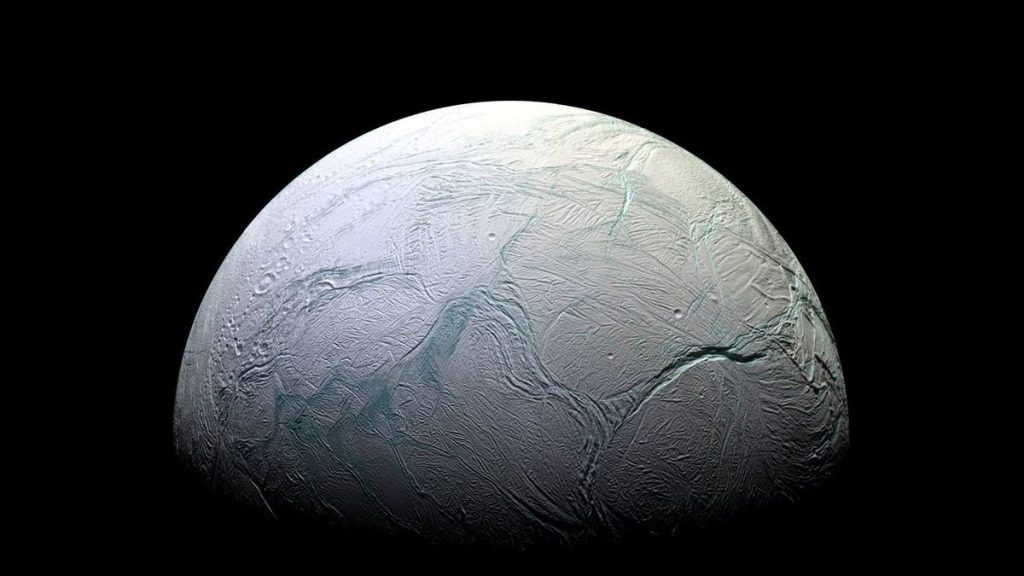
Enceladus is smaller and more forthcoming. Cassini photographed jets of water ice erupting from fractures near its south pole in 2005 and then spent a decade flying through them. The plume material has yielded salts, silica nanoparticles that imply water reacting with rock at temperature, molecular hydrogen, and — from a 2023 analysis of grains in Saturn’s E ring — phosphates, one of the elements every terrestrial organism needs and the one astrobiologists worried might be scarce out there.
Titan is the odd one. Huygens landed on it in January 2005 and sent back pictures of rounded pebbles on a plain that had clearly been shaped by flowing liquid — methane, not water, at around minus 180 degrees. Above it sits a nitrogen atmosphere thicker than Earth’s, hazy with organic molecules built by sunlight breaking apart methane. Whether anything in that chemistry ever crosses into biology is unknown and probably unknowable without going there, which is what the Dragonfly rotorcraft is for.
Moons Are Not a Small Category
People underestimate how much of the Solar System is satellites. Ganymede is bigger than Mercury and carries its own magnetic field, the only moon known to generate one. Titan is also bigger than Mercury. Callisto probably holds an ocean too and sits far enough out to avoid the worst of Jupiter’s radiation belts. Triton, captured by Neptune rather than formed there, was caught by Voyager 2 in 1989 venting nitrogen geysers.
Jupiter and Saturn each have well over a hundred confirmed moons. Most are captured rubble, but the count of genuinely substantial worlds among them runs to at least half a dozen.
They also got there by different routes, which matters for how common such worlds should be elsewhere. The big Jovian and Saturnian satellites appear to have accreted from a disc of gas and dust around the forming planet, the same process that builds planets around a star, scaled down. Triton was captured outright from the Kuiper Belt, which is why it orbits backwards. Our own Moon came out of a collision. Three separate mechanisms, all of which should operate around other stars too.
Scale that up. If satellite systems are a normal outcome of giant planet formation — and the circumplanetary disc that ALMA imaged around the young planet PDS 70c in 2021 suggests they are — then the galaxy’s population of sizeable worlds is considerably larger than its population of planets. Alien moons would not be a footnote to the exoplanet census. They could outnumber it.
So Where Are the Exomoons?
Undetected, so far, and the reason is signal size. A transiting Earth-sized planet dims a Sun-like star by about one part in ten thousand. A moon around that planet blocks far less, and it moves relative to its planet from one transit to the next.
The workaround, developed largely by David Kipping and his Hunt for Exomoons with Kepler team, is to look for what a moon does to the planet rather than the moon itself. A satellite tugs its planet around their common centre of mass, so the planet transits slightly early or slightly late, and the crossing takes slightly longer or shorter. Kepler-1625b produced a candidate signal in Hubble data announced in 2017; Kepler-1708b produced another in 2022. Both remain contested, with other groups arguing the signals are artefacts of how the light curves were processed. That argument is genuinely unresolved and it is the current state of the field.
What a Detection Would Actually Buy Us
A confirmed exomoon would settle whether the Solar System’s satellite systems are typical or a fluke, which is the question underneath all of this. It would also give the modellers something to calibrate against: a real mass, a real orbit, a real tidal heating rate instead of a parameter range spanning three orders of magnitude.
Beyond that the practical benefit is target selection. Right now a giant planet sitting in its star’s habitable zone gets filed as uninteresting, because gas giants have no surface. If large moons are common, that same planet becomes a system worth examining closely — the habitable object would be the satellite, receiving roughly the same starlight, but with rock underfoot.
The Signal Might Not Come From a Planet
There is a SETI dimension that rarely gets stated. If a moon can hold a stable environment for billions of years, complex life could evolve on it, and so in principle could technology. A radio or optical signal arriving from a distant system tells you which star it came from and roughly where in that system, but not whether the transmitter sits on a planet or on something in orbit around one.
It also implies a different history. A civilisation on a large moon would grow up with a giant planet filling a third of its sky, frequent eclipses, and neighbouring moons as visible discs rather than points of light. Interplanetary travel would be a short hop rather than a decade-long cruise. Whether any of that matters for how such a species develops is pure speculation, but it is the kind of speculation that keeps the search for extraterrestrial life from calcifying around a single template.
For now the case rests on Europa’s induced field, Enceladus’s plume chemistry, Titan’s haze, and a couple of disputed light curves. That is thin, and it is also more than we had twenty years ago. SETIworld follows the exomoon candidates and the reanalyses that follow them, which is usually where these things get decided one way or the other.