Posted by
 The idea that life might exist elsewhere is old. Greek atomists argued for infinite inhabited worlds. Giordano Bruno was burned at the stake in 1600 partly for insisting the stars were other suns with their own planets and peoples. For most of history, this was a matter of belief and argument, not evidence.
The quest to actually find that life — to drag the question into the realm of measurement — is much younger. It’s roughly a single human lifetime old, and it has been a story of false starts as much as progress.
The First Real Search
Modern astrobiology arguably begins with two events in the 1970s. In 1976, NASA’s Viking 1 and Viking 2 landers touched down on Mars carrying the first instruments ever designed to detect life on another planet. They scooped Martian soil, fed it nutrients, and watched for the chemical signatures of metabolism.
The results were maddening. One experiment, the Labeled Release test, produced a signal that looked biological. The others didn’t, and the soil showed no organic molecules at the sensitivity Viking could reach. The consensus settled on a chemical explanation — reactive compounds in the soil mimicking metabolism — but a minority of researchers has argued the Viking results were never fully resolved. Nearly fifty years later, the debate isn’t entirely dead. That’s the kind of field this is.
A Rock From Mars
In 1996, a team led by David McKay announced that a Martian meteorite, ALH84001, contained structures that might be fossilized microbial life — tiny tube-shaped formations and chemical traces. President Clinton spoke about it on the White House lawn. For a moment it looked like the question had been answered.
It hadn’t. Over the following years, researchers showed that the structures could form through non-biological processes, and the claim quietly lost its support. But the episode had a lasting effect: it galvanized institutional interest. NASA founded its Astrobiology Institute in 1998, partly in the wake of the ALH84001 excitement. A near-miss created a field.
What the Quest Borrowed From Earth
The same decades brought a discovery closer to home that reshaped everything. In 1977, scientists exploring the deep Pacific found ecosystems thriving around hydrothermal vents — entire food webs running on chemical energy from the Earth’s interior, in total darkness, under crushing pressure. No sunlight. No photosynthesis at the base.
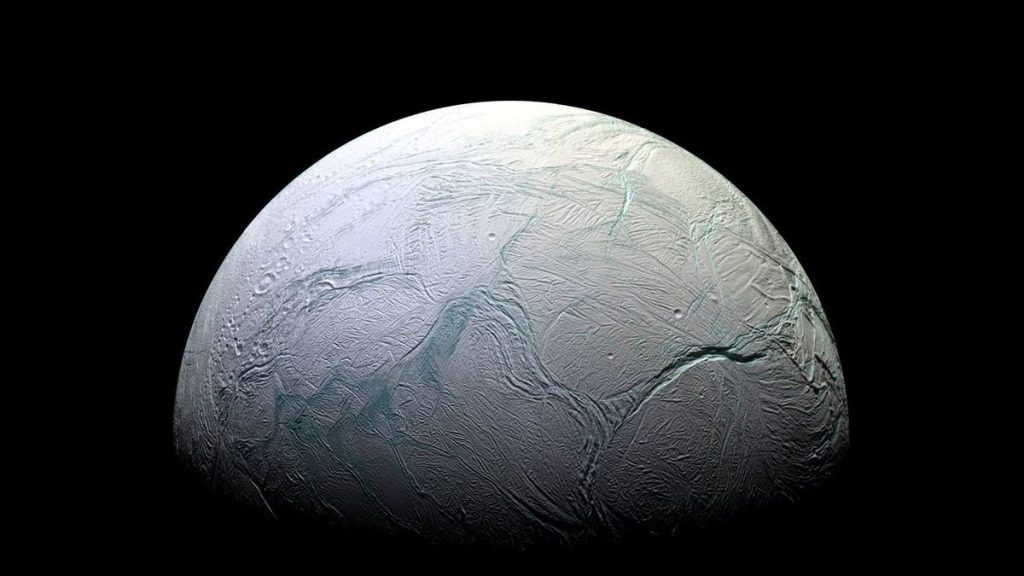
Before that, the working assumption was that life needed sunlight and gentle conditions. After it, the definition of “habitable” had to be rewritten. If life flourishes at a scalding vent on the ocean floor, then the cold ocean under Europa’s ice, or the hot chemistry beneath Enceladus, stopped looking hopeless. Much of the modern target list exists because of what was found at the bottom of our own ocean.
The Exoplanet Revolution
Then, in 1995, came 51 Pegasi b — the first confirmed planet around a Sun-like star. Within two decades the count went from zero to thousands. The quest suddenly had somewhere to point. Instead of arguing about whether other planets existed, astrobiologists could filter a catalog of real worlds for the ones worth examining.
This changed the character of the search. The Drake Equation, written by Frank Drake in 1961 to frame the odds of detectable civilizations, had a term for the fraction of stars with planets that for decades was pure guesswork. Now it’s measured: planets are common, and rocky worlds in habitable zones number in the billions across the galaxy. One major unknown got filled in. The harder ones — how often life starts, how often it becomes intelligent — remain open.
A Quest Defined by Patience
What strikes you, looking at the arc, is how much of it is waiting and re-checking. Viking’s ambiguous signal. ALH84001’s retracted fossils. K2-18b’s contested biosignature. The pattern repeats: an exciting result, a wave of scrutiny, a more careful conclusion. It can look like failure. It’s actually the system working.
The quest hasn’t found life. What it has built, slowly, is a discipline rigorous enough that when a real detection comes, it will be believed — and a network of missions and instruments positioned to make that detection plausible within a generation. That’s not nothing. For a question this old, having genuine tools pointed at it is itself a kind of arrival.
The Cliffhanger Sitting on Mars Right Now
The quest’s long history of false starts and patient verification has a live chapter playing out today, and it sits on the surface of Mars. The Perseverance rover has spent years in Jezero Crater — an ancient river delta, exactly the kind of place where traces of past life might be preserved — collecting and sealing rock cores into sample tubes. More than two dozen are now cached, waiting.
The plan was always to bring them home, because the instruments that could definitively search them for biosignatures are far too large and sensitive to fly on a rover; they live in laboratories on Earth. But the Mars Sample Return program, which would retrieve those tubes, has run into serious budget and schedule trouble, prompting NASA to seek cheaper mission designs. So the most promising samples humanity has ever collected for the question of past life sit sealed on another planet, their fate hanging on funding decisions rather than engineering. It is a fitting emblem of the whole quest — the science ready, the answer tantalizingly within reach, and the final step requiring patience, resources, and resolve. Whether those samples come home may shape what we learn about life on Mars for a generation.
Project Ozma and the Birth of SETI
If the quest has a formal starting gun, it’s the spring of 1960. A young astronomer named Frank Drake pointed the radio telescope at Green Bank, West Virginia, at two nearby Sun-like stars — Tau Ceti and Epsilon Eridani — and listened for artificial signals. He called it Project Ozma, after the queen of L. Frank Baum’s fictional land of Oz. It heard nothing conclusive, but it was the first time anyone had turned the search for other civilizations into an actual experiment rather than an argument.
A year later, in 1961, Drake convened a small meeting at Green Bank and, to organize the agenda, wrote down what became the Drake Equation — a string of factors that, multiplied together, estimate how many communicating civilizations might exist in the galaxy. It was never meant to give a precise number. It was a way of breaking an impossibly large question into pieces you could actually study: how many stars have planets, how many planets are habitable, how often life arises, and so on. Six decades later, it still structures how the field thinks.
The Question That Haunts the Whole Field
There’s a counterweight to all this optimism, and it dates to an offhand lunch remark. In 1950, the physicist Enrico Fermi, discussing the likelihood of alien civilizations with colleagues, reportedly asked the deceptively simple question: “Where is everybody?” If the galaxy is old and life is common, some civilization should have had time to spread across it or at least make itself obvious. Yet we see nothing. That tension is now called the Fermi Paradox.
The proposed answers all carry weight for astrobiology. Maybe life is genuinely rare. Maybe intelligence is rare even where life is common. Maybe technological civilizations tend to destroy themselves quickly. The idea of a “Great Filter” — some improbable step that few or no lineages get past — frames the entire search as an attempt to locate that filter. Is the hard step behind us, in the unlikely origin of life or complex cells? Or ahead of us, in the survival of technological species? The quest to find life is, in part, an effort to figure out which.
From Speculation to Institution
What changed over the past half-century isn’t that the questions got easier — it’s that they acquired infrastructure. The arguments of Bruno and the Greek atomists became, step by step, research programs with telescopes, funding lines, peer-reviewed journals, and graduate students. A question that was once purely philosophical now has dedicated institutions whose entire purpose is to answer it with evidence. That institutionalization is itself a quiet milestone in the long history of the quest.
A Quest Measured in Generations
One sobering feature of this history is its timescale. Project Ozma ran in 1960; the people who started it are mostly gone, and the question they posed is still open. Frank Drake died in 2022 without hearing the signal he spent a career listening for. The quest is genuinely intergenerational — researchers inherit instruments, datasets, and unfinished arguments from predecessors they never met, and hand their own work forward to people not yet born. That continuity is part of what makes the field serious rather than sensational. It is built to outlast the careers, and the lifetimes, of the individuals pursuing it.
Why the Long Arc Still Bends Forward
For all its false starts, the quest has a direction. Each decade the tools sharpen, the target list grows, and the standard of proof rises. Viking guessed in the dark; today’s missions measure with precision Viking’s designers could only dream of. The arc that runs from Bruno’s execution to a spacecraft sampling an alien ocean is not a straight line, but it bends consistently toward more evidence and less speculation. That trajectory is the real story — not any single result, but a question slowly, stubbornly migrating from the realm of belief into the realm of measurement.
SETIworld follows the long search for life beyond Earth — its missions, its setbacks, and its breakthroughs. Join the portal to follow the next chapter.
References
- Dick, S.J., The Biological Universe, Cambridge University Press 1996
- Sagan & Drake, The Search for Extraterrestrial Intelligence, Scientific American 1975
- Klein et al., The Viking Biological Investigation: Preliminary Results, Science 1976
- McKay et al., Search for Past Life on Mars: ALH84001, Science 1996
- NASA Astrobiology Institute — founding charter, 1998 astrobiology.nasa.gov
- Des Marais et al., The NASA Astrobiology Roadmap, Astrobiology 2008 astrobiology.nasa.gov