Posted by
 Are we alone? People have asked it around fires and in observatories for a very long time, and for most of history the honest answer was that we had no way to even begin checking. Astrobiology is what happens when that old question finally gets tools. It’s the science of life beyond Earth — where life might start, how it hangs on, and how we could possibly notice it across distances that make the word “far” feel small. Astronomy, biology, chemistry, geology, all leaning on the same problem at once.
The field has changed shape fast, and mostly because of one thing: exoplanets. Thirty years ago we knew of no planets outside our Solar System. Now the count runs into the thousands, and a good number of them are rocky worlds sitting at roughly the right distance from their stars for liquid water. That single fact reorganized the whole conversation.
So what does astrobiology actually study?
Partly it studies Earth. That sounds backwards until you look at where life on our own planet manages to survive — in near-boiling acidic springs, in the crushing dark of deep-sea vents, inside rock kilometers underground, in brine so salty almost nothing else works. These organisms, the extremophiles, keep resetting our sense of what “habitable” means. If a microbe thrives with no sunlight and no oxygen, then a moon we’d written off starts to look less hopeless.
The other half looks outward, at planets and moons that might carry the right conditions: some liquid water, a stable-ish atmosphere, an energy source, chemistry that isn’t hostile to complex molecules. The sweet spot everyone talks about is the habitable zone — the orbital band where a planet isn’t so close it bakes or so far it freezes solid. It’s a rough guide, not a guarantee. A planet can sit right in the zone and still be a dead furnace, as Venus reminds us. But it’s where we point the telescopes first.
Reading atmospheres for signs of life
Here’s the clever part. We can’t fly to these planets. What we can do is catch their starlight. When an exoplanet passes in front of its star, a sliver of that light filters through the planet’s atmosphere on the way to us, and different gases stamp their fingerprints on the spectrum. Pull that light apart carefully and you can start listing what the air is made of.
That’s the hunt for biosignatures — gases that hint at biology. Oxygen is the famous one, because on Earth it’s mostly there thanks to living things pumping it out. Methane is another, especially alongside oxygen, since the two shouldn’t comfortably coexist unless something keeps refilling them. Water vapor, carbon dioxide, and the overall chemical balance all feed into the picture.
The trouble is that none of these is a clean signature by itself. Oxygen can build up through plain photochemistry, no life required. Geology and volcanism can belch methane. The phosphine story is a good cautionary tale here: a few years back a team reported possible phosphine in the clouds of Venus and floated it as a biosignature, and the claim is still argued over, with other groups questioning whether the gas is even there. Nobody’s calling it aliens. That messy back-and-forth is what real detection looks like — a signal, then years of people trying to break it.
K2-18b became a talking point for the same reason. It’s a planet where instruments have picked up hints of carbon-bearing molecules, and one debated detection of a gas that on Earth is made by marine life. Intriguing. Not proof. The gap between “we found an interesting molecule” and “we found life” is enormous, and astrobiologists are usually the first to say so.
Listening for the ones that build things
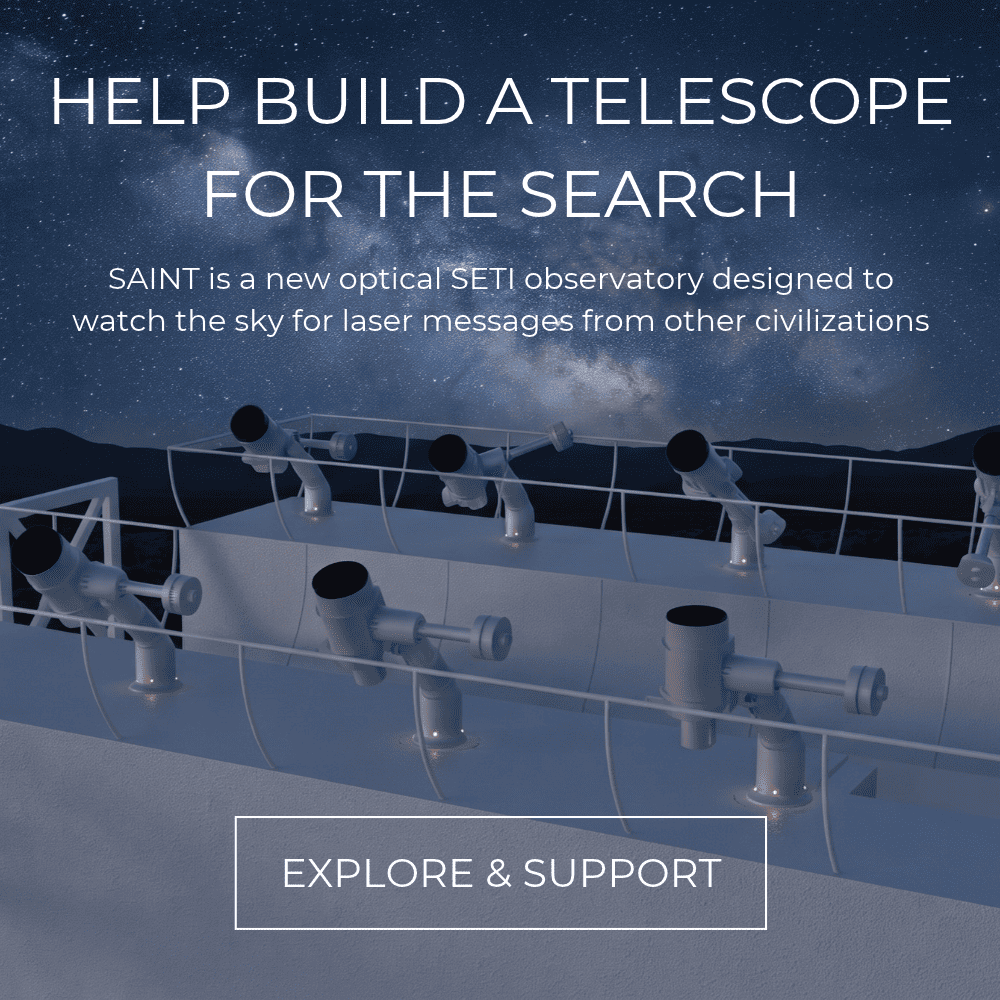
Biosignatures are about life of any kind, even pond scum. Technosignatures are a narrower bet: signs of a civilization that builds technology. Radio broadcasts leaking into space, a deliberate narrowband signal, pulses of laser light, maybe waste heat or industrial gases that no natural process would produce. This is the classic SETI end of things — radio telescopes sweeping the sky for something structured, something that stands out from the noise.
So far, nothing confirmed. Decades of listening and no message. That silence is itself a datum, and it loops straight back into the Fermi paradox — if the galaxy is old and vast and full of stars with planets, where is everybody? People have offered dozens of answers, from “intelligence is rare” to “we’ve barely searched” to less comfortable ideas. We genuinely don’t know which is right.
The machines that made this possible
Almost every step forward here traces to a telescope. Kepler stared at one patch of sky for years and turned exoplanets from a curiosity into a population — thousands of candidates, the proof that planets are ordinary. TESS took over the survey job across the whole sky, flagging nearby stars whose planets are close enough to study in detail. And the James Webb Space Telescope is now doing the atmospheric work that earlier instruments only dreamed about, teasing apart the light from distant worlds to read their chemistry.
Some of the most tantalizing targets came out of this machinery. The TRAPPIST-1 system, seven Earth-sized planets circling a small cool star, several of them in or near the habitable zone. Proxima Centauri b, orbiting the closest star to the Sun. Kepler-452b and TOI-700 d, rocky worlds in gentler orbits. Each one is a place to aim the next observation. And the coming giants — the Extremely Large Telescope on the ground, the Square Kilometre Array for radio — are being built partly with these questions in mind.
There’s a quieter revolution too, in software. The datasets are absurd. No team could eyeball every light curve Kepler produced or every hour of radio data, so machine learning now does a lot of the first-pass sorting, flagging the faint dip or the odd pattern a human should look at. It doesn’t replace judgment. It just makes the haystack searchable.
Why the hard part is staying honest
Detecting life is brutally difficult, and it’s worth being clear-eyed about why. The planets are faint smudges next to blindingly bright stars, often trillions of kilometers off. The signals are weak. And nature is a talented forger — again and again, a process with no biology behind it can mimic the thing we’re hoping to see. So the standard is high. One instrument, one measurement, one interesting gas is never enough. You want multiple lines of evidence, independent teams, the boring grind of ruling out everything else first.
Which is maybe the thing to sit with. A confirmed discovery of life elsewhere would reshape biology, philosophy, our whole sense of our place in things. But even coming up empty teaches us something real about how planets work and how rare our own situation might be. Either way the search pays off. We’re not there yet, and pretending otherwise does the science no favors — the value is in doing it carefully.
If any of this pulls at you, SETIworld is a good place to dig deeper into exoplanets, biosignatures, and the ongoing search for life beyond Earth.