Posted by
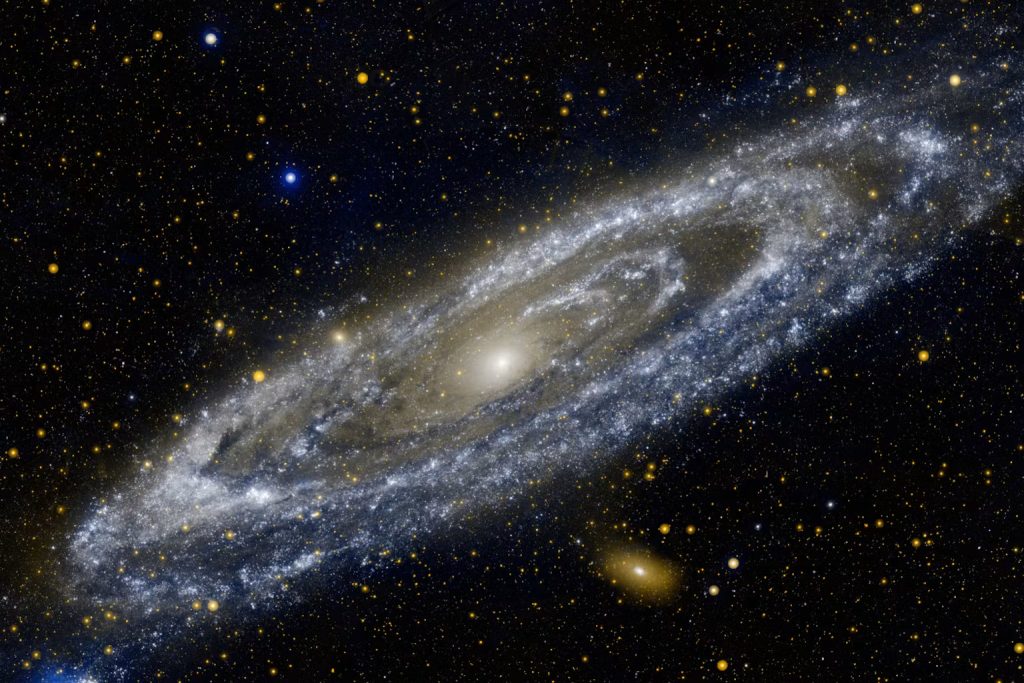
 Carl Sagan never committed to a number for how much life the universe holds, and he was explicit about why. What he committed to was a way of framing the question: life is a chemical process running on ordinary materials, those materials are everywhere, and the universe has had billions of years and a few hundred billion stars per galaxy to work with. Whether that produces company or a very quiet cosmos was, in his view, something to be found out rather than argued about from an armchair.
Star stuff, meant literally
The line about being made of star stuff is quoted so often it has worn smooth, but it was a compressed statement of real astrophysics. Hydrogen and helium came out of the Big Bang. Everything heavier — the carbon in a cell wall, the oxygen in the water it sits in, the iron in blood, the phosphorus in DNA — was assembled inside stars and thrown out when those stars died. The calcium in your teeth was manufactured in a stellar interior that no longer exists.
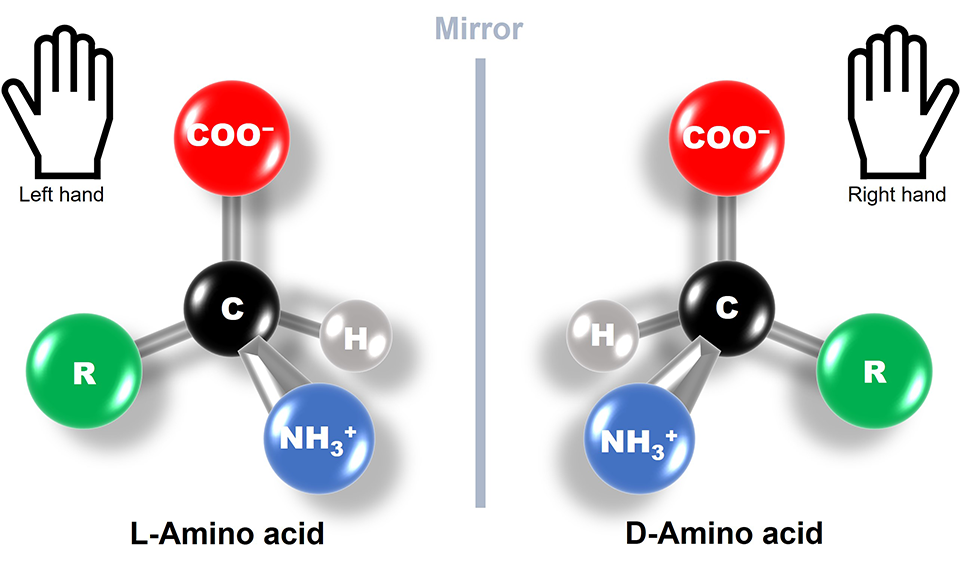
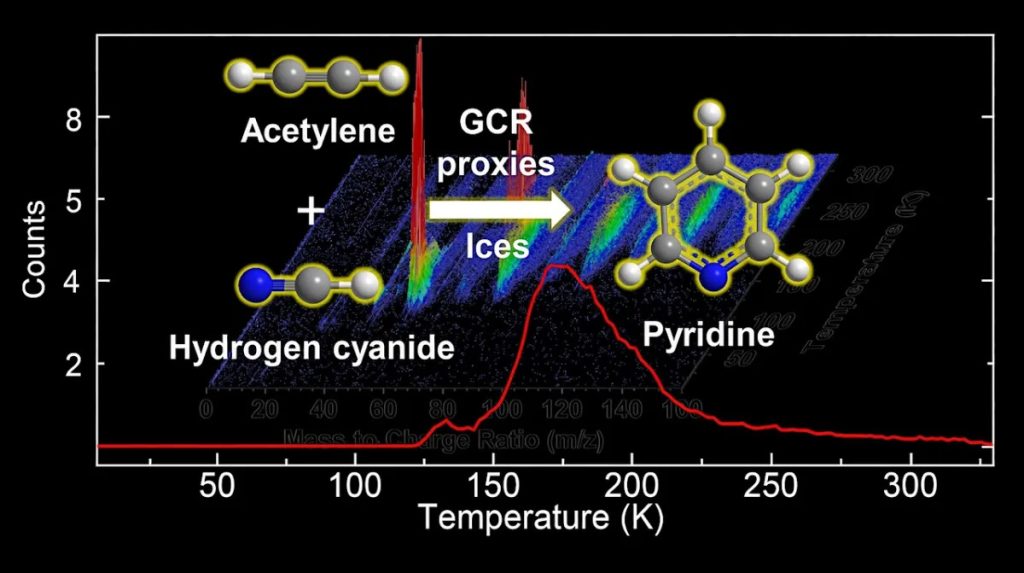
What follows from that is not sentiment but a testable expectation. If the same elements are distributed through every galaxy, and the same chemistry works everywhere, then the raw ingredients for biology are not rare and never were. Molecular clouds turn out to contain formaldehyde, methanol, hydrogen cyanide and dozens of other organic molecules. Meteorites like Murchison, which fell in Australia in 1969, carry amino acids that formed in space without any help from a planet.
Ingredients are not organisms. Sagan was careful about that distinction, and the gap between the two is still the largest hole in astrobiology.
Against chauvinism
The fullest statement of all this came early. In 1966 he published Intelligent Life in the Universe together with the Soviet astrophysicist Iosif Shklovskii, an odd collaboration for the middle of the Cold War: Shklovskii had written a book on the subject in Russian, and Sagan expanded it with his own chapters and commentary rather than simply translating it. The result reads like two scientists arguing amiably in the margins of each other’s work. It ran through planetary chemistry, the origin of life, the plausibility of interstellar travel and the case for radio searches, and it set the agenda for a lot of what followed.
He had a favourite accusation for colleagues who assumed life elsewhere would look like life here: chauvinism. Carbon chauvinism, water chauvinism, oxygen chauvinism, planetary chauvinism. The point was not that alternatives were likely — he thought carbon and liquid water genuinely were the best bets, for solid chemical reasons — but that the assumption should be stated out loud and defended rather than smuggled in.
In 1976 he and Edwin Salpeter took the idea for a walk. They published a paper modelling an ecology in the atmosphere of Jupiter, populated by what they called sinkers, floaters and hunters: organisms that drift on convection currents, giant gasbags that stay aloft by keeping themselves warm, and predators that feed on both. Nobody has ever thought this was a prediction. It was an exercise in working out whether the physics forbade it, and the physics did not.
That exercise aged into something more serious. Extremophiles found since the 1970s live in hydrothermal vents at temperatures above boiling, in acid mine drainage, kilometres down in solid rock, and in Antarctic lakes sealed under ice for millions of years. The habitable envelope on our own planet turned out to be far wider than anyone assumed when Carl Sagan started asking the question.
Mars, and then the moons
Mars occupied him for decades, first through Mariner 9’s dust-shrouded arrival in 1971 and then through Viking’s ambiguous biology results in 1976. He argued for landers that could rove rather than sit, on the reasonable grounds that a fixed platform samples one square metre of a planet.
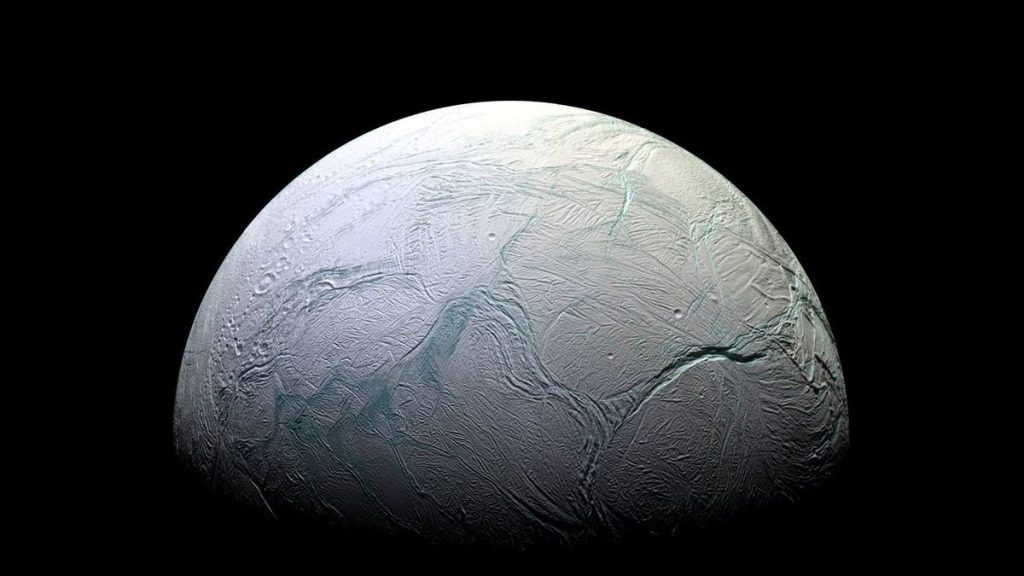
The interesting shift in his thinking, and in the field, was outward. Voyager’s flybys showed Europa wrapped in fractured ice, and by the 1990s Galileo’s magnetometer data had made a strong case for a salty ocean underneath it — more liquid water than Earth holds, kept warm by tidal flexing rather than sunlight. Enceladus went further: Cassini flew through plumes erupting from its south pole and found water, salts, silica grains implying hot rock contact, and organic molecules.
Neither moon sits in the classical habitable zone. Both are better candidates for life than most planets that do.
The term nobody can measure
Sagan’s optimism about intelligence elsewhere was always hedged at one specific point, and it was not the biology. It was longevity.
The Drake equation ends with L, the average time a technological civilization stays detectable. Sagan pointed out that if L is short — a few centuries, say — then the galaxy could produce civilizations steadily and still be effectively empty at any given moment, because they never overlap. His interest in this was not abstract. In 1983 he was one of the five authors of the TTAPS study, which modelled the atmospheric consequences of nuclear war and concluded that soot lofted into the stratosphere could drop global temperatures enough to wreck agriculture worldwide. He spent much of the decade arguing the case publicly, and taking considerable professional abuse for it.
The connection he drew was direct: our own value of L was under negotiation, by us, in real time. The silence overhead might be telling us something about how these stories usually end.
That is a hypothesis, not a finding. It has never been tested and may never be.
The skeptic’s discipline
His public reputation as a believer irritated him, because most of his actual writing on the subject was about how easily people convince themselves. He worked through flying saucer reports, ancient astronaut claims and abduction accounts, and found in each case that the evidence dissolved when handled carefully. The Demon-Haunted World, published the year before he died, is essentially a manual for telling a real anomaly from a satisfying story.
None of that scepticism was aimed at the search itself. He drew a hard line between claiming aliens have visited, which requires physical evidence nobody has produced, and proposing that they might exist somewhere, which is a hypothesis you test with telescopes. Carl Sagan wanted the second and had no patience for the first.
The questions, handed forward
He died in December 1996, months after 51 Pegasi b broke open the exoplanet era and years before anyone could read the air of another world. Almost every question he framed is now a funded programme.
Europa Clipper launched in October 2024 and will make dozens of close passes over that ice. Dragonfly, a nuclear-powered rotorcraft, is being built to hop across the dunes of Titan, the one other place in the Solar System with liquid on its surface, even if that liquid is methane. JWST is pulling molecular signatures out of atmospheres tens of light-years away, including the disputed dimethyl sulfide claim at K2-18b that has been fought over since 2023 — the sort of argument he would have enjoyed, since the fight is exactly what turns a claim into knowledge.
The vision was never a prediction that we are not alone. It was a bet that the question is answerable, and that answering it is worth the instruments and the decades. SETIworld keeps up with the missions and the disputed detections carrying that work forward, if you want to watch the answers arrive slowly.