Posted by
 Darren Williams, James Kasting and Richard Wade put the question in Nature in 1997, before a single rocky exoplanet was known: could a moon orbiting a giant planet be a habitable world in its own right? Nearly three decades later the honest answer is still that it depends on details nobody has measured. But the case for alien moons as competitors to exoplanets — not just alternatives — has got sharper, and so has the case against.
It is worth laying both out properly, because the popular version usually presents only half.
The Case for the Moon: You Get a Roof
Start with the problem that dogs every rocky planet around a red dwarf. M-type stars are the most common in the galaxy, their habitable zones are close in, and they flare. A large flare from Proxima Centauri can brighten the star by a factor of thousands in the ultraviolet for minutes at a time. Over billions of years that repeated battering erodes atmospheres and destroys any ozone layer trying to form. A planet with an exposed surface takes all of it.
A moon with a few kilometres of ice over a liquid ocean does not. Ice is superb radiation shielding. Whatever happens at the surface — sterilising doses, chemistry stripped apart by ultraviolet — the ocean underneath carries on at a stable temperature, insulated from the star’s tantrums entirely. Europa is the working demonstration: its surface is bombarded hard enough to kill a person in under a day, and the water below is apparently untouched.
That is a real structural advantage, though it comes with a catch. Subsurface oceans are excellent habitats and terrible advertisements. Anything living down there produces no atmospheric biosignature we could detect across thirty light years.
You Also Get a Second Boiler
Tidal heating is the other asset, and it is genuinely something planets cannot have. A moon flexed by its planet’s gravity generates internal heat continuously, independent of starlight, sustained by orbital resonances with sibling moons that keep the orbit from circularising.
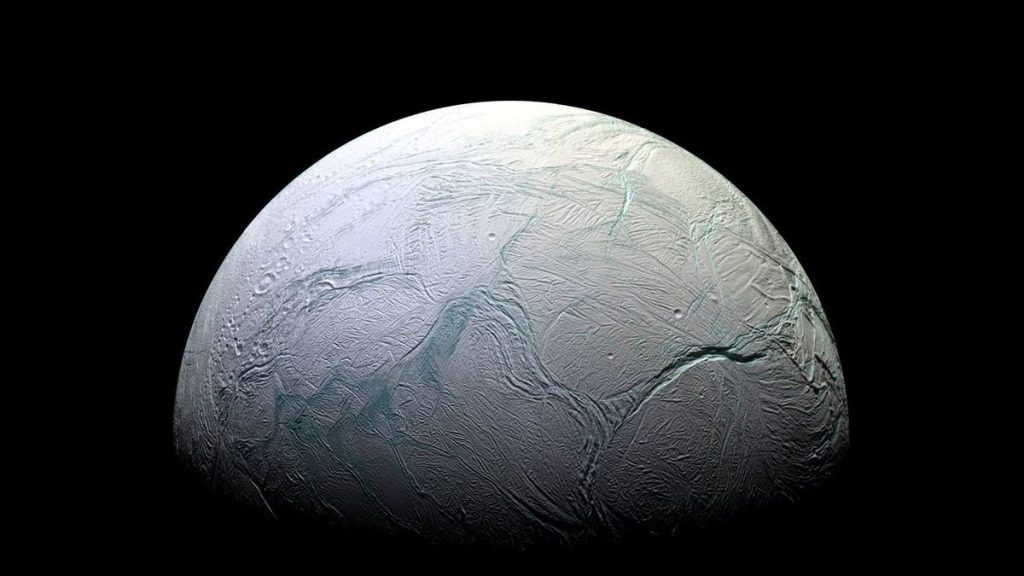
The practical consequence is that a moon can stay liquid far outside the classical habitable zone. Enceladus sits nearly ten times further from the Sun than Earth and keeps an ocean. Push that logic outward and a giant planet on a cold orbit around any reasonably long-lived star could be carrying warm satellites, in a region telescopes currently treat as dead space.
And You Get Several Rolls of the Dice
One planet is one experiment. One giant planet with five substantial moons is five, in the same system, sharing a star and a formation history but differing in orbital distance, composition and internal heating.
There is a climate argument tucked in here as well. A moon would almost certainly be tidally locked to its planet rather than to the star, so its day-night cycle is set by how long it takes to go round the planet, not by an eternal noon on one hemisphere. That is a real advantage over rocky planets in an M dwarf’s habitable zone, which get locked into permanent day and permanent night with all the atmospheric collapse problems that brings. Add planetshine, thermal infrared from a warm giant, and regular eclipses, and the moon’s climate is complicated but not obviously worse.
Jupiter alone demonstrates the spread: Io molten, Europa an ocean under ice, Ganymede large and magnetised with an ocean of its own, Callisto cold and probably wet, all four in a single family. If alien moons come in comparable sets, the number of independent chances for chemistry to do something interesting per star goes up considerably.
The Case Against: Making a Big Moon Is Hard
Here is where the argument gets uncomfortable. Robin Canup and William Ward showed in the mid-2000s that satellites forming in a disc around a giant planet are limited to roughly one ten-thousandth of the planet’s mass in total. For Jupiter that ceiling comes out at about the Galilean system — which is to say, nothing bigger than Ganymede, which is about two and a half percent of Earth’s mass.
Titan is the partial exception worth noting. It holds a nitrogen atmosphere denser than Earth’s on a body barely larger than Ganymede, and it manages that mainly because it is so cold that the molecules simply move too slowly to escape. Move Titan into a habitable zone and the atmosphere goes away. Cold is doing the work, not gravity.
A body that small cannot hold a substantial atmosphere at habitable-zone temperatures. Without an atmosphere there is no surface pressure, no stable liquid water at the surface, no greenhouse, no protection. So the standard formation route delivers ice moons with hidden oceans, not second Earths.
Getting an Earth-mass moon requires something unusual: capture of a large body, as Neptune apparently did with Triton, or a giant impact of the kind that produced our own Moon. Both happen. Neither is routine. Whether they happen often enough to matter is unknown, and that single unknown carries most of the uncertainty in the entire debate.
Radiation, Orbits and Other Ways to Lose
A giant planet’s magnetosphere is not a shelter. It traps and accelerates charged particles into radiation belts that can be far worse than the naked stellar wind, which is exactly what Europa lives inside. A moon would want to orbit outside the harshest belts, or generate a magnetic field of its own — Ganymede does, and it is the only known example among more than two hundred moons.
Orbital stability adds another filter. A satellite has to sit inside its planet’s Hill sphere to stay bound, and tidal interaction slowly pushes moons outward or inward depending on the planet’s spin. Around a giant that migrated close to its star, that process runs fast enough to strip the satellite system entirely within a fraction of the system’s lifetime. Hot Jupiters are therefore probably moonless. The giants worth examining are the ones on wider orbits — which are also the ones hardest to detect by transit.
The Detection Asymmetry
Whatever the theory says, the search is decided by what instruments can see, and right now that is a rout. Thousands of exoplanets are confirmed. Exomoons: none, with two contested candidates from David Kipping’s group, around Kepler-1625b and Kepler-1708b, both still argued over on grounds of data processing rather than astrophysics.
So even if alien moons are the better habitats in principle, exoplanets will keep dominating the literature simply because we can find them, characterise them and take their atmospheric spectra. Any moon-based biosignature is at least a generation of instruments away, and a subsurface one may be permanently out of reach from a distance.
The Verdict Nobody Can Give Yet
Better is the wrong frame, really. Moons and planets fail differently. A rocky planet in an M dwarf’s habitable zone has surface area, atmosphere and a detectable spectrum, and risks being flayed by its star. A large moon has shielding, an extra energy supply and siblings, and risks being too small to hold air and impossible to see.
The most likely outcome is that both categories contain habitable worlds in numbers we would find surprising, and that the first confirmed one is whichever we happen to be able to measure. Astrobiology does not get to pick its evidence.
What would change the picture fastest is a single unambiguous exomoon with a measured mass. Until then this stays a well-posed argument with no data on one side of it. SETIworld tracks the candidates and the rebuttals as they land, which is the more informative half of the story anyway.