Posted by
 Earth is still the only world known to carry life, and the slice of the universe explored closely enough to challenge that statement is embarrassingly small. Astrobiology therefore spends most of its energy on a practical question rather than a grand one: given limited telescope time, limited spacecraft and a galaxy of several hundred billion stars, where exactly should anyone point the instruments? The answer has changed a great deal since the 1970s, when Viking landed on Mars and the shortlist was basically one planet long.
Today the shortlist runs from a crater floor 225 million kilometres away to atmospheric spectra of planets forty light years out, with a few icy moons in between.
Start With What Life Here Actually Needs
Terrestrial biology is the only working example available, so it sets the search criteria by default. Liquid water comes first, because every known organism uses it as a solvent. After that: carbon chemistry, a usable energy gradient, and a handful of elements — nitrogen, phosphorus, sulfur — that biology cannot substitute away. None of that is controversial.
The fourth requirement gets less attention and may matter most. Time. A puddle that lasts ten thousand years is not the same as an ocean that lasts three billion, and if the origin of life needs long stretches of stable chemistry, then a world’s history counts for as much as its present temperature. This is why researchers keep asking when a planet was wet rather than simply whether it was.
Mars, Because You Can Touch It
Mars keeps its place at the top of the list for an unglamorous reason: it is the only promising target where rocks can be examined directly. Orbiters and rovers have mapped river valleys, delta deposits, clay minerals and sulfate beds that require standing or flowing water. Curiosity has spent since 2012 driving through the sedimentary record of an ancient lake in Gale Crater. Perseverance landed in Jezero Crater in February 2021, on the fan of a river delta, and has been drilling and sealing core samples in titanium tubes on the assumption that a later mission collects them.
The modern surface is a bad place for anything living — thin cold air, no ozone, ultraviolet and cosmic radiation reaching the ground. The interest is in what came before, and in what might survive below.
Meteorite ALH 84001 is the cautionary tale everyone in the field remembers. In 1996 a NASA team argued that structures inside it were fossilised Martian microbes; the announcement reached the White House lawn. Three decades of follow-up work has left most specialists unconvinced, with non-biological explanations available for each feature. Nobody has proved the original claim wrong in every particular either, which is roughly how these arguments tend to end.
Two Moons Keeping Oceans Under the Ice
Europa is about the size of our Moon and almost certainly holds a salt-water ocean beneath a shell of ice, kept liquid by tidal flexing as Jupiter’s gravity kneads the interior. The estimated volume exceeds every ocean on Earth combined. That ocean sits under kilometres of ice, which is both the obstacle and the shielding — surface radiation around Jupiter would sterilise anything exposed, while the water below is protected from it.
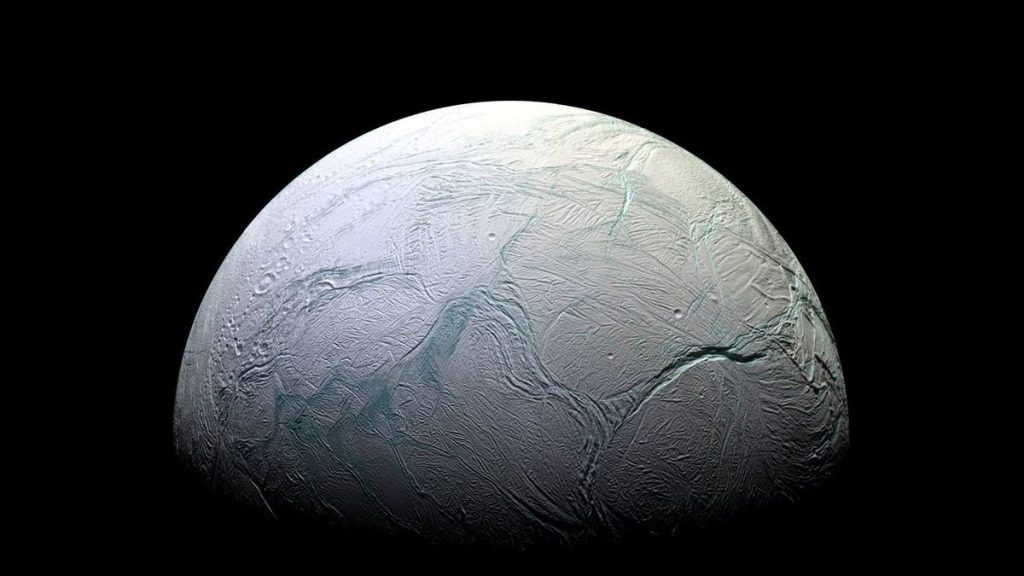
Enceladus solved the access problem on its own. The little Saturnian moon, barely 500 kilometres across, sprays material from its interior sea through fractures near the south pole, and Cassini flew directly through the plumes rather than landing or drilling. The spacecraft found water ice, salts, silica nanograins, methane and molecular hydrogen. Hydrogen matters because it suggests hot water reacting with rock on a seafloor, which on Earth is exactly the setting that feeds vent ecosystems in total darkness.
Both moons now have hardware aimed at them. Europa Clipper left Earth in October 2024 for a series of close flybys, and ESA’s JUICE, launched in April 2023, is on a long cruise toward Ganymede and the Jovian system. Neither is a life-detection mission in the strict sense. They are habitability missions, which is a more modest and more honest description.
Titan Is Running a Different Experiment
Titan has a thick nitrogen atmosphere, weather, dunes, and lakes and seas of liquid methane and ethane at temperatures near minus 180 degrees Celsius. The Huygens probe landed there in January 2005 and returned pictures of a shoreline made of water ice pebbles. Whatever chemistry runs on that surface, it is not the chemistry that runs here.
That is the appeal. Titan lets researchers watch complex organic synthesis proceed on a planetary scale in conditions nothing like Earth’s, which is useful whether or not anything on the moon is alive. NASA’s Dragonfly rotorcraft is being built to fly between sites there in the 2030s, and its main job is chemistry rather than biology.
Out Where You Cannot Send Anything
Beyond the Solar System, everything depends on light. Thousands of confirmed exoplanets have made the selection problem harder rather than easier, so astronomers filter aggressively — planet radius, orbital period, stellar type, whether the system is close enough for follow-up. The habitable zone is one of those filters and a crude one. Venus and Earth receive broadly comparable stellar energy and ended up as different planets; orbital distance predicts almost nothing on its own.
Red dwarfs complicate the picture in an interesting way. They are the most common stars in the galaxy, they last far longer than the Sun, and their planets are easier to detect because the star is small and the orbits are tight. TRAPPIST-1, about forty light years off, carries seven roughly Earth-sized worlds. Proxima b orbits the nearest star to us. The catch is that these stars throw powerful flares, and a planet close enough to be temperate may have had its atmosphere stripped long ago. Whether such worlds hold onto air is an open question that JWST is actively testing.
When a planet transits its star, a thin ring of starlight passes through its atmosphere first and arrives carrying the absorption fingerprints of whatever gases are there. JWST has turned that measurement into something close to routine for a small set of targets. The universe explored this way is genuinely tiny — a few dozen atmospheres characterised in any detail — but it is the only technique that reaches across interstellar distance and returns chemistry.
A biosignature would be a gas, or a combination of gases, hard to explain without biology. Oxygen with methane is the textbook pair, since the two should react away. The trouble is that almost every candidate molecule has an abiotic route as well, which is why the K2-18b dimethyl sulfide claim of 2023 produced enormous headlines and an immediate, unresolved statistical argument among specialists. Any real detection will need several independent lines of evidence and probably several instruments.
Listening as Well as Looking
SETI runs on a different logic: skip the microbes and look for the engineering. Radio remains the workhorse, because a narrow-band transmission is cheap to send across light years and nature does not produce one. Green Bank, the Allen Telescope Array and the Parkes dish have all carried Breakthrough Listen observations, and the Square Kilometre Array will eventually widen the net considerably. Arecibo, which did much of this work for half a century, collapsed in December 2020.
Interference is the constant enemy. The universe explored by radio SETI is full of our own satellites, microwave ovens and telemetry, and the BLC1 candidate from 2020 — a narrow signal from the direction of Proxima Centauri — turned out to be terrestrial after months of careful analysis. That was a success for the method, not a failure.
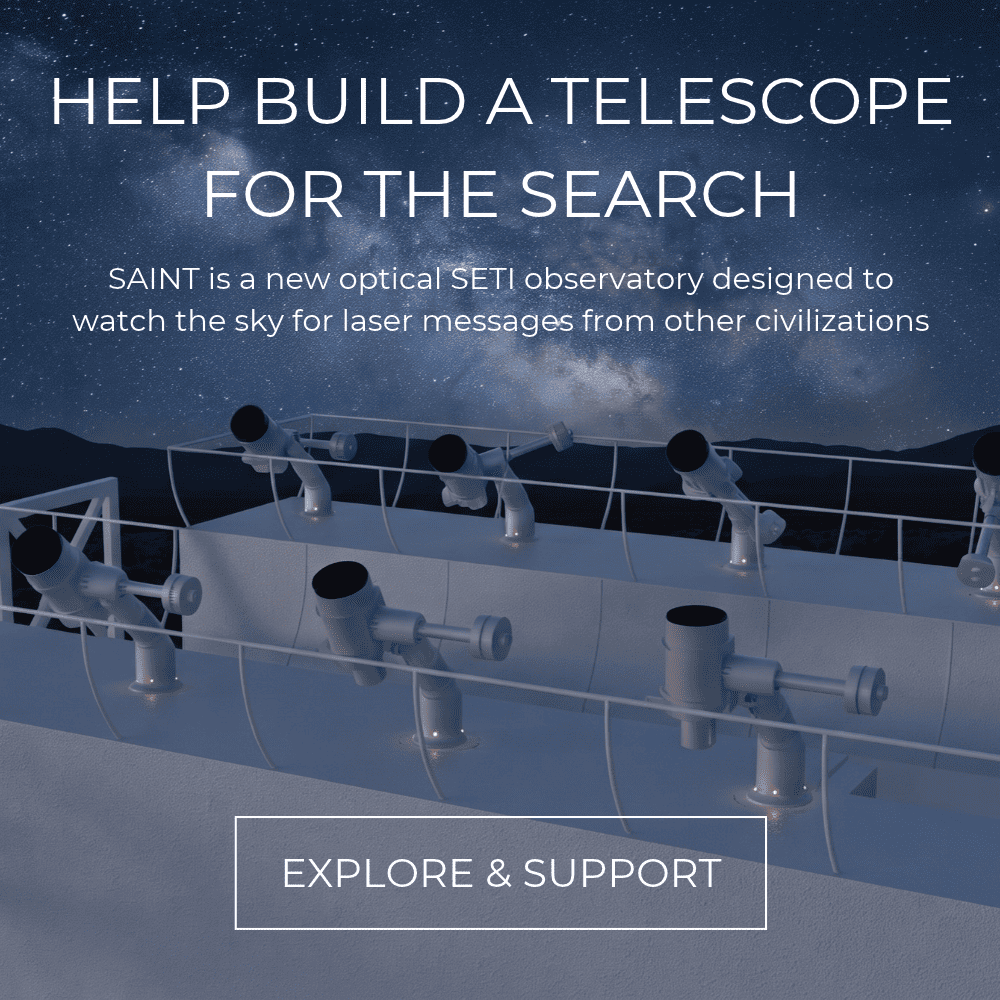
Optical searches look for something different: a laser pulse bright enough, for a few nanoseconds, to outshine its own star at one wavelength. Beams that narrow have to be aimed deliberately, which is either a fatal weakness or the entire point, depending on whether you assume anyone is trying to be found.
No Single Best Place
The honest strategy is a diversified one. Mars gives direct access to ancient sediment. Europa and Enceladus offer liquid water and chemistry outside the habitable zone entirely. Titan supplies organic complexity under alien rules. Exoplanet spectroscopy covers volume that no spacecraft will ever reach, and SETI checks a possibility none of the others can. The first detection could come from any of them, and predictions about which have not aged well in the past.
What is worth remembering is the scale of the sampling. The universe explored so far, by every method combined, is a rounding error against the galaxy. SETIworld follows the missions, the spectra and the arguments as they develop, and there is usually more going on than the headlines suggest.