Posted by
 Ask most people to picture extraterrestrial life and they picture someone. A face, a ship, a signal with intent behind it. Ask an astrobiologist and you get something closer to a smear of cells in brine two kilometres under a Martian crater floor. Both are on the table, but they are not equally likely, and the gap between them is one of the more interesting things Earth’s own history has to say on the subject.
The record here is thin but suggestive. Life appeared on this planet almost as soon as it could. Everything after that took an extraordinarily long time.
Life Showed Up Fast. Everything Else Took Ages.
Earth formed roughly 4.54 billion years ago and spent its first few hundred million in a state no organism would survive. By 3.5 billion years ago there were stromatolites in what is now the Pilbara region of Western Australia — layered mats built by microbial communities, visible to the naked eye. Carbon isotope ratios in rocks from Isua in Greenland have been read by some researchers as pushing the origin back further still, though that interpretation is contested.
Call it a few hundred million years from cool surface to functioning biosphere. On geological timescales that is quick, and it is the main reason many astrobiologists suspect simple life may be relatively easy.
Then the pace collapses. Complex cells with nuclei and mitochondria do not show up convincingly in the fossil record until somewhere around two billion years ago. Animals large enough to leave obvious traces arrive around 600 million years ago. Anything capable of building a radio transmitter arrives in the last hundred thousand, and actually builds one in the last hundred and thirty years.
The Bottleneck Nobody Can Locate
Something in that sequence is a hard step, and there is no consensus on which. The origin of life itself is one candidate — we have no working account of how chemistry becomes a self-replicating system, and everything on the topic remains a hypothesis in search of a demonstration.
Another candidate is the eukaryotic cell. As far as anyone can tell from genetics, the merger between an archaeon and a bacterium that produced mitochondria happened exactly once in four billion years, and every complex organism alive descends from that single event. If that reading holds, complex life may be a fluke even on worlds where microbes are ordinary.
Oxygen is a third. The Great Oxidation Event around 2.4 billion years ago transformed the atmosphere and made high-energy metabolism possible, but it took photosynthetic bacteria more than a billion years to bring it about.
Any of these could be the filter. Possibly none of them is, and we are simply reading far too much into a sample of one.
Where the Microbes Would Be
The practical searches follow the fast step rather than the slow ones. Mars is the primary target because it kept water on its surface for a long stretch of its early history and then stopped resurfacing itself, so the rocks from that era are still there. Perseverance has been coring sediments in Jezero Crater since 2021 with the express purpose of getting them into terrestrial laboratories eventually.
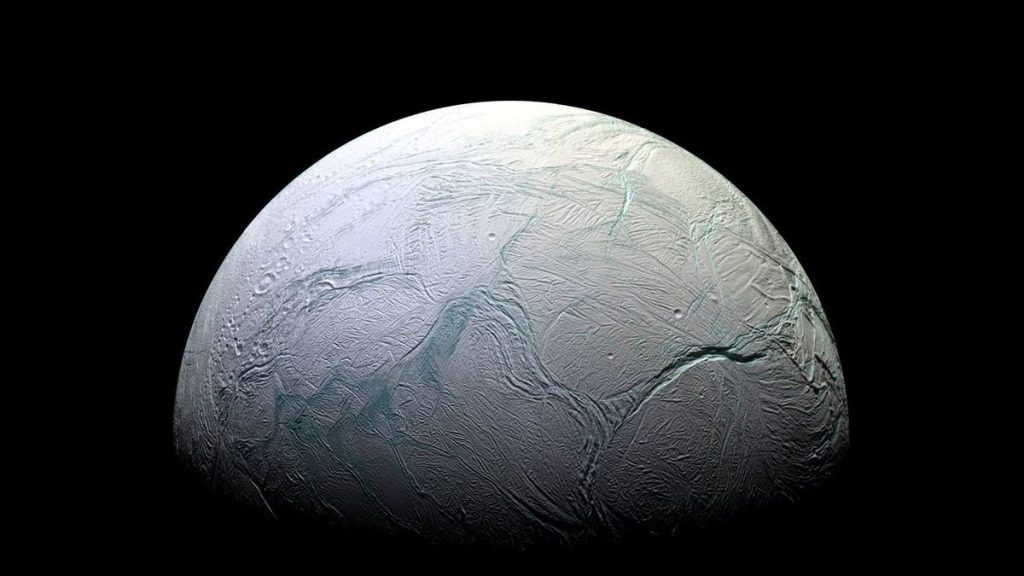
Enceladus is the other strong case. Cassini flew through the plume erupting from its south pole and found salts, silica implying hot water reacting with rock, molecular hydrogen, and — in a 2023 analysis of grains from Saturn’s E ring — phosphates. That last one mattered, because phosphorus was the element astrobiologists were most worried might be missing.
Europa holds more liquid water than Earth does, under an ice shell of unknown thickness, and Europa Clipper arrives around 2030. None of these places is expected to produce anything visible to the naked eye. The realistic prize is a chemical signature, argued over for a decade before anyone accepts it.
Intelligence Is Not the Top of a Ladder
Evolution does not aim at anything, which is worth restating because the word “advanced” smuggles in a direction that natural selection does not have. Large brains are metabolically ruinous. Human brains burn about a fifth of our resting energy budget. Selection paid that bill in one lineage under a specific set of ecological pressures; sharks have done fine for 400 million years without it.
So a biosphere could run for billions of years, produce ecosystems of real complexity, and never generate anything that builds a telescope. There is no principle in biology saying otherwise. Extraterrestrial life could be abundant and permanently silent, and that scenario is entirely consistent with everything we currently observe.
Detectable Is a Different Question From Alive
Even granting intelligence, the visibility window is a separate problem. For 99.999 percent of Earth’s history a distant astronomer would have seen an oxygen-rich atmosphere and nothing else — no transmitters, no waste heat, no artificial light. Marconi sent his first transatlantic signal in 1901. Frank Drake pointed a dish at Tau Ceti and Epsilon Eridani in 1960. The Arecibo message went out in 1974.
That is a sliver, and there is no guarantee it widens. Terrestrial broadcasting is already moving to fibre, tight beams and low-power digital signals that leak far less into space than mid-century television did. A civilisation might be radio-loud for two centuries and then go quiet, not through catastrophe but through efficiency.
Two civilisations also have to overlap in time, and be within range. Proxima Centauri is 4.24 light years away, which is the nearest case and already means an eight-and-a-half-year round trip on a conversation.
Drake, Fermi and the Honest Uncertainty
Frank Drake wrote his equation in 1961 as an agenda for a small meeting at Green Bank, not as a calculator. Its virtue is that it separates the terms astronomy has nailed down — star formation rates, the fraction of stars with planets, which we now know is most of them — from the terms nobody can constrain: how often life starts, how often it gets complex, how often it gets technological, how long any of it lasts. Three of those four are biology and sociology, and the error bars span orders of magnitude.
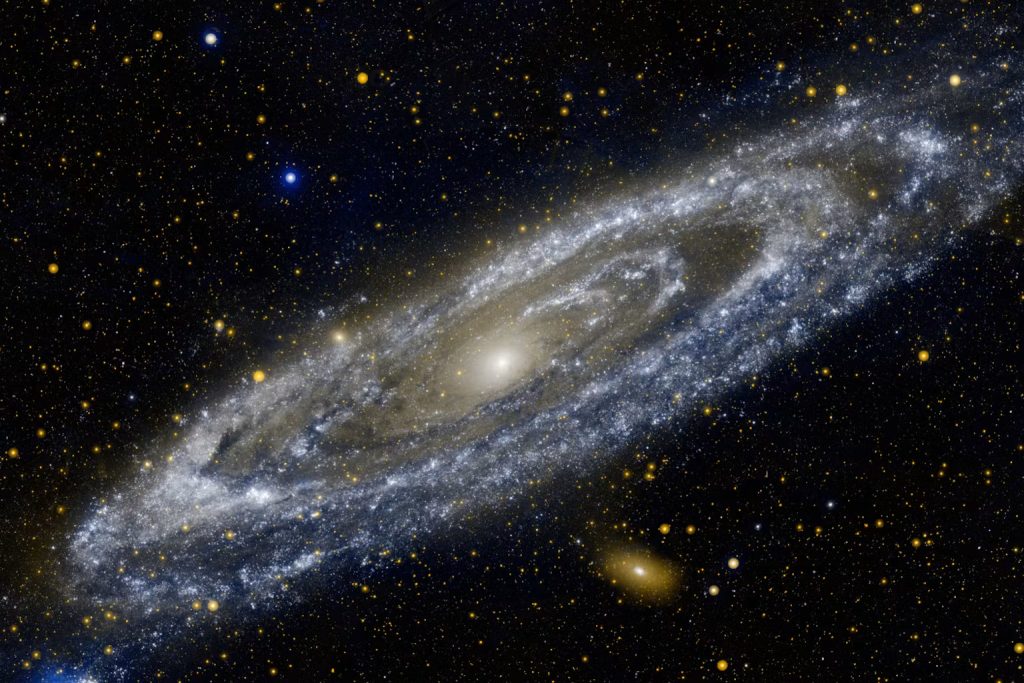
Enrico Fermi’s question over lunch at Los Alamos in 1950 pushes from the other end. If the galaxy is old and civilisations are common, where is everybody? Every proposed answer — life is rare, complexity is rare, technology is rare, civilisations are short-lived, we have barely searched — remains live. Breakthrough Listen, running since 2015 on Green Bank and other facilities, has covered a genuinely tiny fraction of the available frequency, sky and time volume.
Two Searches, Not One
It helps to remember these are separate scientific enterprises that happen to share a headline. A geochemist arguing over carbon isotopes in a Martian core and a radio astronomer sifting for narrowband signals are doing unrelated work with different instruments, timescales and failure modes.
Either could produce the first result. Finding microbes would tell us biology is not a one-off, and if their chemistry turned out to be genuinely independent of ours, we would finally have a second data point for the whole of biology. Finding a technosignature would answer a question that has been open since people first wondered about it, in a single afternoon.
Neither has happened. SETIworld covers both halves of the search, which is more interesting than picking a side.