Posted by
 If extraterrestrial life is ever found, the odds are heavily against it looking like anything with a face. The realistic first discovery is a chemical anomaly in a plume, a strange texture inside a Martian core, or a combination of gases in a spectrum that refuses to be explained by geology. Microbes, in other words, or the residue of them — and quite possibly in a place that looks nothing like Earth.
That shift in expectation is the most important thing to understand about the modern search. Astrobiologists are not hunting for a second Earth. They are hunting for liquid solvent, usable chemical energy, the right elements and enough time, and those four things turn up in some genuinely strange locations.
Mars, where the interesting part is underground
The surface of Mars is a bad place to be alive. Thin carbon dioxide atmosphere, no magnetic field to speak of, ultraviolet and cosmic radiation reaching the ground, and perchlorate salts in the soil that turn destructive under that radiation. Nothing terrestrial would last long exposed on it.
Ancient Mars was another planet entirely. Curiosity’s mudstones at Gale Crater formed in a lake with near-neutral pH and low salinity; Perseverance is working sediments in Jezero Crater that were laid down by a river entering a standing body of water. Both missions have found the chemistry and the environments. Neither has found an organism, and neither was really built to.
The live question is the subsurface. A few kilometres down, rock shields against radiation and temperatures rise enough that briny water could persist. Radar sounding from Mars Express produced a claim in 2018 of liquid water beneath the southern polar cap, though later work suggested hydrated clays could mimic the same signal — an argument still unresolved. Drilling deep is far beyond current landers. If anything is alive on Mars today, it is somewhere no spacecraft has yet been able to reach.
Oceans without sunlight
Europa carries roughly twice the liquid water of every ocean on Earth, sealed under an ice shell of uncertain thickness. The evidence is indirect but strong: Galileo’s magnetometer measured a field induced in a conducting layer, which is what a salty ocean does inside Jupiter’s magnetic environment. Tidal flexing from Jupiter supplies the heat, so the energy budget has nothing to do with sunlight.
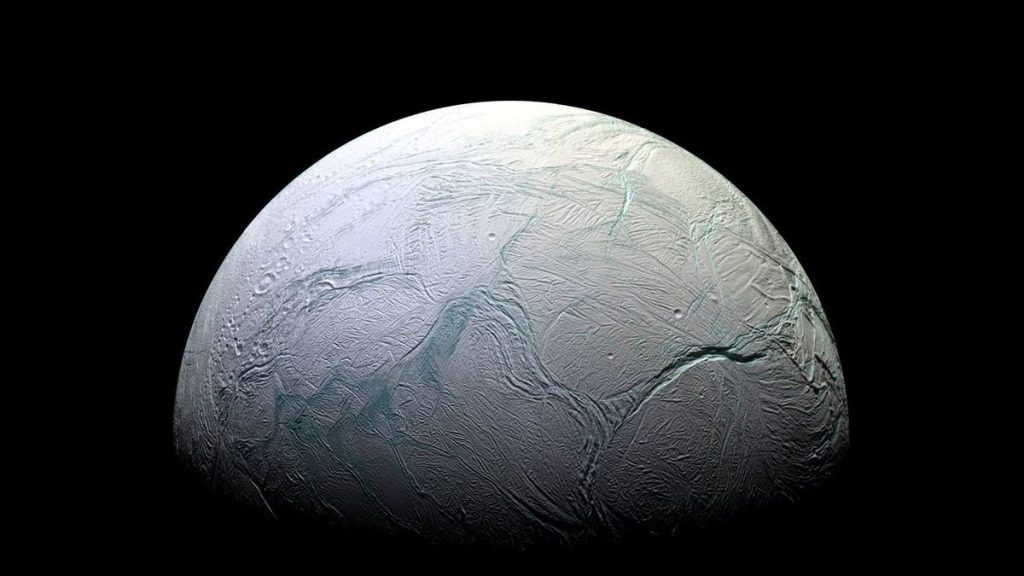
Enceladus is smaller, stranger and much more accessible. Fractures near its south pole vent water into space continuously, and Cassini simply flew through the spray. In that material: salts, organic compounds, silica grains implying water hot enough to react vigorously with rock, molecular hydrogen usable as a chemical energy source, and phosphates, whose absence had been one of the standard objections. A moon 500 kilometres across is throwing samples of its own ocean into orbit for free.
Europa Clipper launched in October 2024 and reaches the Jupiter system in 2030. It will not look for extraterrestrial life directly. It will measure the ice, the ocean and the chemistry, and decide whether a lander is worth building.
Titan asks a different question
Titan is the outlier and the most philosophically interesting target in the Solar System. Surface temperature around minus 179 Celsius. Thick nitrogen atmosphere, denser than Earth’s. Rain, rivers and seas of liquid methane and ethane, with a complex organic haze drizzling down from the upper atmosphere and pooling into dunes of tholin sand.
Water ice on Titan is bedrock. So the question is not whether Titan is habitable in the usual sense — it is whether any chemistry at all can be self-sustaining in a hydrocarbon solvent, at temperatures where familiar reactions crawl. Nobody knows. That is the point of going.
Dragonfly, a nuclear-powered rotorcraft, is scheduled to fly there in the 2030s and hop between sites sampling surface composition. There is also a water ocean beneath Titan’s ice, which makes the moon two candidate habitats stacked on top of each other.
The exoplanet problem is harder than the brochure suggests
Thousands of confirmed planets later, the habitable zone — the orbital band where liquid water could sit on a surface — has turned out to be a useful first filter and a poor final answer. Venus is inside the Sun’s habitable zone. So, arguably, is Mars. A runaway greenhouse cooks one and a lost atmosphere freezes the other.
Red dwarfs make this sharper. They are the most common stars in the galaxy, small planets around them are the easiest to detect and characterize, and a temperate orbit sits close in, which improves everything about the observations. The trouble is flares. Proxima Centauri, host to a roughly Earth-mass planet found in 2016, has produced outbursts that brightened it by orders of magnitude in minutes, and repeated events like that can strip an atmosphere over geological time.
JWST has started delivering verdicts. Its measurements of TRAPPIST-1b are consistent with a bare rock carrying essentially no atmosphere. That is a negative result about one planet in a seven-planet system, but it bears directly on whether the most numerous stars in the Milky Way can hold onto the conditions extraterrestrial life would need. Answering that for the other TRAPPIST-1 worlds is one of the field’s live projects.
Reading a planet by its light
Since nobody is visiting, everything comes down to spectroscopy. A transiting planet lets a thin ring of starlight pass through its atmosphere, and molecules there absorb at specific wavelengths, leaving a coded record in the spectrum. Water vapour, carbon dioxide and methane have all been detected this way on various worlds.
Biosignature claims are harder than detections. A single gas proves nothing, since abiotic processes make methane, oxygen and much else. What would carry weight is a combination that should not coexist — gases that react with each other found together in quantities requiring constant replenishment, on a planet whose star and climate are well enough characterized to rule out the alternatives. That standard has not been met anywhere yet, which is worth remembering every time a spectrum makes headlines.
Microbes are one question, minds are another
Life appeared on Earth remarkably early, within a few hundred million years of the surface becoming survivable. Technological intelligence took over four billion more, and arrived exactly once. Those two facts point in opposite directions: biology may be easy, complexity may be rare, and a galaxy full of microbial worlds with almost no radio transmitters is entirely consistent with everything currently known.
SETI attacks the second question directly by looking for technosignatures rather than biosignatures — radio, optical pulses, industrial gases, waste heat. It could succeed before any biosignature is confirmed, or it could stay silent while a plume sample settles the first question next decade. There is no rule about which comes first.
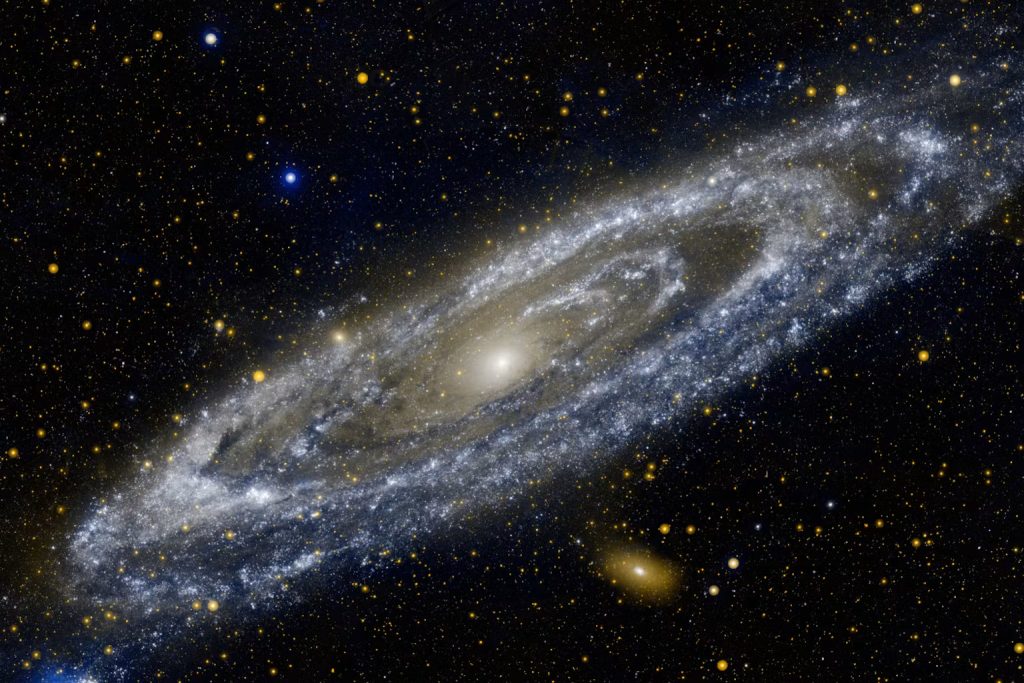
Scale that up and the speculation gets thinner still. The idea of a galactic habitable zone, a region of the Milky Way with enough heavy elements to build rocky planets but without the radiation environment of the crowded inner galaxy, is a reasonable thought with very soft boundaries. Nobody should treat it as established.
What is solid: the ingredients are common, the habitats are more varied than anyone assumed in 1990, and several of the best candidates are close enough to visit with spacecraft already flying or under construction. SETIworld follows those missions and the results as they come in — a decent way to watch the search for extraterrestrial life narrow, one measurement at a time.