Posted by
 Suppose intelligence isn’t held back mainly by biology — by improbable evolutionary steps — but by the planet itself. Maybe the bottleneck is that worlds capable of supporting the long, stable development of complex life are simply uncommon. This is the “Rare Earth” hypothesis, and it shifts the whole question from biology to planetary science.
The Rare Earth Argument
In their 2000 book Rare Earth, geologist Peter Ward and astronomer Donald Brownlee made a provocative case: simple microbial life may be common in the universe, but complex life — animals, and eventually intelligence — may require such an unusual combination of planetary conditions that it’s extremely rare. The galaxy could be full of bacteria and nearly devoid of anything more.
Their argument is essentially a checklist of lucky features that Earth happens to have, each of which, they argue, may be necessary for complex life to develop and persist over the hundreds of millions of years it requires. Remove any one, and the long climb to intelligence might stall.
Plate Tectonics
Earth is, as far as we know, the only planet in our solar system with active plate tectonics — the slow churning of crustal plates. This isn’t a minor detail. Plate tectonics drives the carbon-silicate cycle, the geological thermostat that has kept Earth’s climate roughly stable for billions of years by regulating atmospheric carbon dioxide. It also recycles nutrients and builds the continents.
Without this thermostat, a planet’s climate can run away toward a frozen or a scorched state, as may have happened to Mars and Venus. A world that can’t regulate its own temperature over geological time is a world where complex life has little chance to develop. And we don’t yet know how common plate tectonics is on rocky planets elsewhere — it may depend on a delicate balance of size, water, and internal heat.
The Moon
Earth has an unusually large moon for a planet its size, the result of a giant impact early in its history. That moon does something quietly essential: it stabilizes the tilt of Earth’s axis. Work by Jacques Laskar and colleagues showed that without the Moon, Earth’s axial tilt would wander chaotically over time, driving wild and rapid climate swings.
A stable tilt means stable seasons and a steady climate over the long spans complex life needs. The Moon-forming impact was a chance event; a planet that didn’t experience a similar collision might lurch through climate chaos that complex ecosystems couldn’t survive. How often rocky planets acquire large stabilizing moons is, again, unknown.
A Magnetic Shield and a Distant Guardian
Earth’s molten iron core generates a magnetic field that deflects much of the solar wind, helping protect the atmosphere from being stripped away and shielding the surface from radiation. Mars, lacking a strong global field, lost much of its atmosphere to space over billions of years. A planet that can’t hold onto its air is a hard place for complex life.
Then there’s Jupiter. Some researchers have argued that the giant planet’s gravity helps shield the inner solar system from comet impacts — a cosmic bodyguard reducing the rate of catastrophic collisions. The picture is more complicated than the simple “Jupiter shield” story (it can also fling objects inward), but the architecture of the wider planetary system plausibly affects how often an inner world gets battered.
The Right Neighborhood
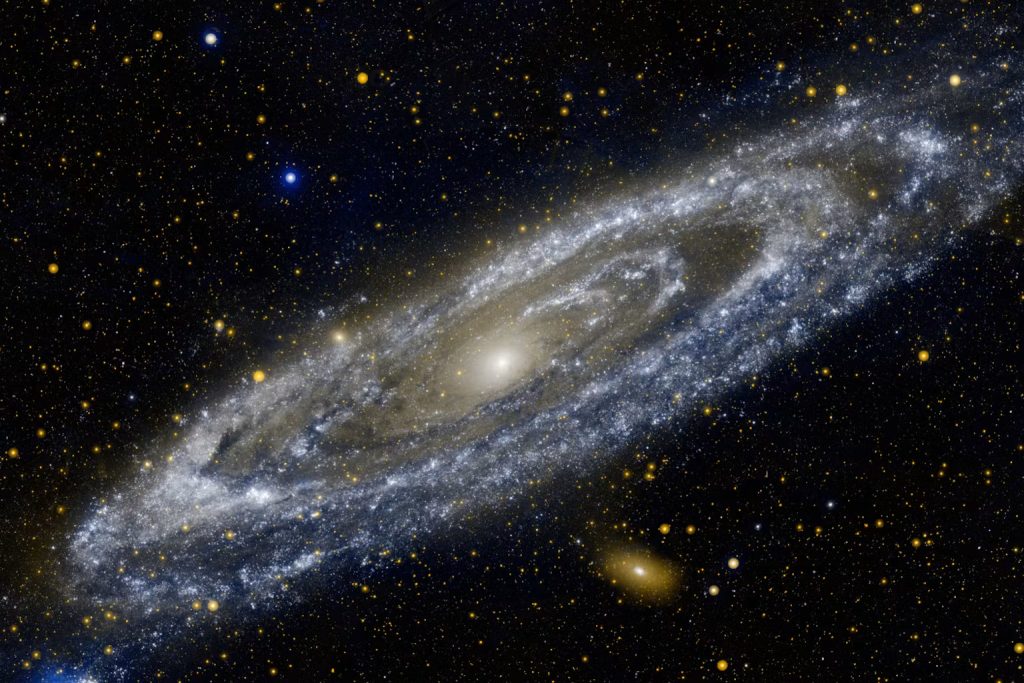
Location matters too. The “galactic habitable zone,” proposed by Charles Lineweaver and colleagues in 2004, is the region of the galaxy with enough heavy elements to build rocky planets but far enough from the dense, violent galactic center to avoid frequent sterilizing radiation events. Too far in, and supernovae and instability threaten any biosphere; too far out, and there may not be enough heavy elements for Earth-like planets at all. The Sun sits in a relatively favorable band.
How Strong Is the Argument?
Rare Earth is a hypothesis, not a proven theory, and it has serious critics. Skeptics point out that we’re reasoning from a single example and may be mistaking “the way it happened here” for “the only way it could happen.” Complex life might tolerate a wider range of planetary conditions than Earth’s specific recipe suggests. Plate tectonics might not be strictly required; other mechanisms might regulate climate; life might adapt to chaotic tilts.
The honest assessment is that we don’t yet know how many of these features are truly necessary versus merely the particular path Earth took. Each one is a research question, and the answers will come partly from studying other rocky planets as our instruments improve. What Rare Earth contributes is a reframing: maybe the scarcity of intelligence in the galaxy, if it’s scarce, isn’t about evolution being hard but about suitable planets being rare. The bottleneck might be in the geology, not the biology — and the search for habitable worlds is, slowly, the way we’ll find out.
How Exoplanet Data Is Starting to Test Rare Earth
For two decades, the Rare Earth hypothesis was hard to evaluate because we had only our own solar system to reason from. That’s changing. The growing catalog of exoplanets lets researchers begin checking, statistically, whether Earth’s special features are genuinely rare or just unexamined. Does plate tectonics occur on larger rocky “super-Earths”? Theoretical models disagree — some argue higher gravity and internal heat make tectonics more likely on bigger worlds, others the opposite — and atmospheric studies of rocky exoplanets may eventually settle it by revealing which planets have the climate-regulating carbon cycle tectonics enables.
The frequency of large stabilizing moons is another testable claim. Moon-forming giant impacts should leave statistical signatures in planetary spin and system architecture that future surveys could detect. Even the galactic habitable zone is being refined as we map the distribution of heavy elements across the galaxy. The point is that Rare Earth is graduating from a philosophical argument into a set of empirical questions. Each of Earth’s “lucky” features is becoming a hypothesis that exoplanet science can probe. Over the coming decades, we’ll learn whether the conditions that produced us are cosmic flukes or common arrangements — and that answer bears directly on how alone we’re likely to be.
The Goldilocks Amount of Water
One Rare Earth ingredient deserves special attention because it’s so counterintuitive: a planet may need not too little water, but not too much. We tend to assume more water means more habitable, yet a world drowned under a deep global ocean — with no exposed land at all — faces real problems for developing complex, and eventually technological, life.
Without exposed continents, the carbon-silicate weathering cycle that regulates Earth’s climate may not function properly, since that cycle depends on rainwater chemically weathering exposed rock. A waterworld might lose its long-term thermostat. It would also lack the tidal pools, riverbanks, and shorelines that may have been important staging grounds for life’s transitions on Earth, and an aquatic species would face the fire barrier that blocks the path to metallurgy and technology. Earth is, by cosmic standards, a relatively dry planet for one with oceans — water makes up a tiny fraction of its mass, leaving continents above the waves. That balance, enough water for oceans but enough land for weathering and fire, may be another narrow requirement. Too dry and you get Mars; too wet and you get a global ocean; the habitable middle may be a narrow target.
Are We Typical, or Special?
Rare Earth collides head-on with one of science’s most trusted principles: the Copernican idea that we are not in a special place or time. Copernicus removed Earth from the center of the cosmos; modern astronomy has relentlessly reinforced the lesson that we’re ordinary — an average star, an unremarkable galaxy. Rare Earth pushes back, arguing that when it comes to complex life, Earth might genuinely be special after all.
Both instincts can’t be fully right, and the tension is productive. The Copernican principle warns us against assuming Earth is unique just because it’s all we know. Rare Earth warns us against assuming Earth is typical just because uniqueness feels arrogant. The honest resolution is that we don’t yet have the data to know which framing fits complex life — and that the exoplanet revolution is precisely the tool that will, eventually, tell us. Until then, the question of whether worlds like ours are common or vanishingly rare remains genuinely open, with serious science on both sides.
SETIworld follows the planetary ingredients that may be required for complex life — join the portal to track how rare or common worlds like ours really are.
References
- Ward & Brownlee, Rare Earth: Why Complex Life Is Uncommon in the Universe, Copernicus 2000
- Laskar et al., Stabilization of the Earth’s obliquity by the Moon, Nature 1993
- Lineweaver, Fenner & Gibson, The Galactic Habitable Zone, Science 2004
- Korenaga, Plate tectonics and planetary habitability, Phil. Trans. R. Soc. 2012
- Horner & Jones, Jupiter: friend or foe?, International Journal of Astrobiology 2008
- Dauphas & Morbidelli, Geochemical and Planetary Dynamical Views, Treatise on Geochemistry 2014