Posted by
 For most of human history, the question of whether we’re alone was a matter for philosophers and poets. Now it’s a measurement problem. Over the last few decades the search for extraterrestrial life has quietly turned into one of the most data-heavy corners of modern astronomy, and the reason is simple: we finally have the instruments to look. Thousands of planets around other stars have been catalogued, some not so different in size from Earth, and a handful sit at just the right distance from their star for liquid water to be possible. That single fact rewired the whole field.
Astrobiology today runs on telescopes, on the chemistry of starlight, and increasingly on machine learning that sifts the flood of data no human could read by hand.
From listening for a signal to reading a planet’s air
The early search was mostly an act of listening. Point a radio dish at a promising star, scan the frequencies, and hope something artificial comes back. That approach is still going, and it still matters. But it turned out to be a narrow doorway into a very large house.
The shift came when we stopped assuming the only life worth finding was life that could build a transmitter. Microbes ran this planet for billions of years before anything grew a spine, let alone an antenna. So the modern question broadened: not just “is anyone broadcasting?” but “does that world over there have chemistry that only living things tend to produce?” Frame it that way and every rocky planet with an atmosphere becomes a candidate.
Why exoplanets sit at the center of all this
You can’t search for life beyond Earth without somewhere to search. Exoplanets — worlds orbiting other stars — are that somewhere, and the count keeps climbing. Kepler did the heavy lifting first, staring at a single patch of sky and watching for the tiny dip in brightness when a planet crossed its star. TESS took over with a wider survey of nearer, brighter stars. Between them and the ground-based radial-velocity work, the tally now runs into the thousands.
A lot of the attention goes to planets in the so-called habitable zone, the band of orbital distance where a world could, in principle, hold liquid water on its surface. The TRAPPIST-1 system is the poster child: seven Earth-sized worlds around a small cool star, several in or near that zone. Proxima Centauri b, orbiting the closest star to the Sun, is another obvious target, along with TOI-700 d and the more Earth-like Kepler-452b further out.
But “habitable zone” is a starting filter, not a verdict. A planet can sit at the perfect distance and still be a dead furnace or a frozen rock, depending on its atmosphere, its magnetic field, how much radiation its star throws at it, what it’s actually made of. Venus is arguably inside the Sun’s habitable zone and it’s a crushing greenhouse hell. Distance gets a world onto the shortlist. Not much further than that.
Biosignatures: the fingerprints life leaves in the sky
Here’s where it gets genuinely clever. When a planet passes in front of its star, a sliver of that starlight filters through the planet’s atmosphere on its way to us. Different gases absorb different colours, so the light that reaches our telescopes carries a kind of chemical barcode. Read it and you can start to say what the air is made of, from many light-years away, without ever going there.
The gases people watch for are oxygen, methane, carbon dioxide, water vapour. None proves life on its own — geology and plain chemistry can make all of them. What raises eyebrows is imbalance: oxygen and methane together, for instance, react and destroy each other fairly quickly, so finding both in quantity suggests something is constantly topping them up. On Earth, that something is biology.
The James Webb Space Telescope is the instrument that made this feel real rather than theoretical. It has already teased apart the atmospheres of distant worlds, and the argument around K2-18b — where researchers have debated the possible presence of molecules associated with life — is exactly the kind of careful, contested reading these measurements produce. And it should be contested. A tentative gas detection is a headline waiting to embarrass everyone; the phosphine-on-Venus saga a few years back is a good reminder of how fast a claimed biosignature can be challenged and walked back. The honest state of things: no confirmed biosignature anywhere. What we have is a method that finally works, pointed at targets that are finally reachable.
The other kind of search: technosignatures
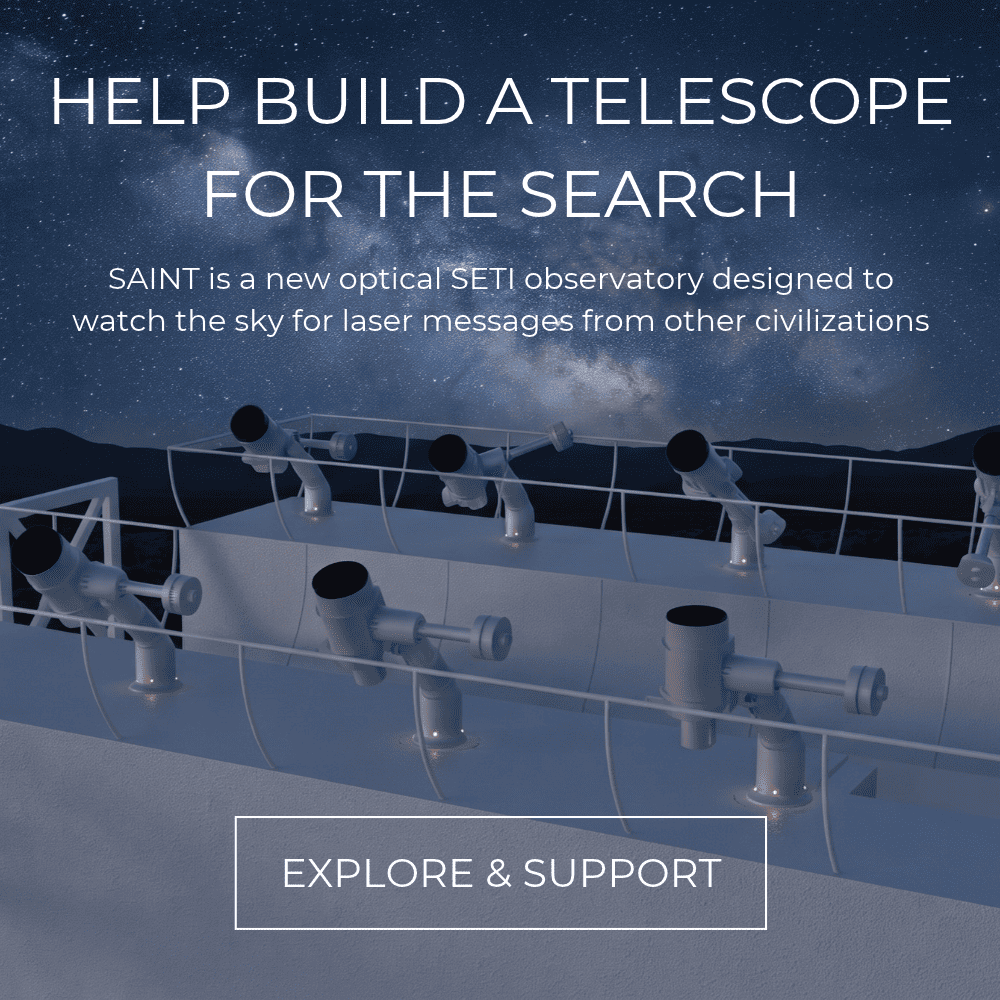
Biosignatures look for life of any kind. Technosignatures look specifically for the by-products of technology — and this is where the old radio search lives on, now far more sensitive. Structured radio bursts, narrow laser pulses, maybe someday the industrial pollution or waste heat of a civilization at scale. Radio telescopes still comb the sky for anything too regular to be natural.
Nothing confirmed has ever turned up. Every promising blip has, so far, dissolved into interference or instrument noise once people looked harder. That’s not failure so much as the shape of the problem — the sky is vast, we’ve searched a vanishingly small fraction of it, and we don’t actually know what a signal would look like. The Fermi paradox nags at the whole enterprise: if the galaxy is old and huge, where is everybody? Nobody has a good answer, and the only way to get one is to keep looking.
Telescopes, algorithms, and the near future
Space telescopes are the backbone of all of this. Kepler and TESS built the catalogue of worlds; Hubble did early atmospheric work; JWST reads the air of individual planets in a way that was science fiction a decade ago. The next wave is already being built. The Extremely Large Telescope and the Square Kilometre Array should sharpen the picture, especially for the smaller Earth-sized planets that today sit right at the edge of what we can measure.
None of it works without software to match. The data volumes are absurd, so machine learning now does a lot of the first-pass sorting — flagging the real transit signals, throwing out the false ones caused by a star’s own flickering, scrubbing noise out of a spectrum. AI isn’t finding aliens. It’s making the haystack searchable.
And no single technique is trusted alone. A transit tells you a planet’s size; radial velocity gets at its mass; direct imaging can catch the planet’s own light; spectroscopy reads the atmosphere. Stack these methods on the same target and the answer gets sturdier. Rely on just one and you’re a stellar hiccup away from fooling yourself.
Why bother, given how hard it is
Make no mistake, this is brutally difficult. The nearest exoplanets are staggeringly faint, drowned in the glare of their stars, and natural processes love to imitate the very signals we’re hunting for. Any real claim will need repeat observations, independent confirmation, and a long, unglamorous fight against every mundane explanation first. That’s as it should be.
But even the quiet years pay off. A survey that finds no life still tells us how common the right conditions are, and how atmospheres behave across worlds we’d never otherwise study. Frameworks like the Drake equation get real numbers plugged into terms that were pure guesswork a generation ago. Every null result narrows the possibilities a little. We’re building the map either way.
Whether the honest answer turns out to be “yes, and it’s everywhere” or “we still don’t really know” — and right now it’s firmly the latter — the search itself keeps reshaping what we understand about planets, about chemistry, about our own strange life-bearing corner of the galaxy. To follow where it goes next, SETIworld is a good place to keep reading and dig into the science yourself.