Posted by
 The Modern Search for Life in the Universe
For most of history, the search for life beyond Earth was a matter of imagination. There was nothing to measure and nowhere to point a telescope with any real hope. That has changed completely in a single generation. We now know of thousands of planets around other stars, we have probes sitting on Mars and circling the outer worlds, and we have instruments capable of reading the chemistry of an atmosphere light-years away. The question of whether life exists elsewhere has finally become an experiment instead of a daydream.
The work splits naturally into two big strategies. One looks close to home, in our own Solar System, where we can send spacecraft and study samples directly. The other looks outward, at exoplanets we will never visit but can study from afar. Together they form a search that runs from the soil of Mars to the atmospheres of distant worlds, and scientists pursue both because nobody knows which one will pay off first.
Two Things Worth Looking For
When researchers talk about signs of life, they usually mean one of two categories, and the distinction shapes everything that follows. Biosignatures are evidence of biology of any kind, even the simplest microbes: gases, chemical imbalances, or surface features that living things tend to produce. Technosignatures are evidence of intelligence and technology: radio signals, lasers, waste heat, or pollution that only a tool-using species would generate.
The two searches use different instruments and rest on different assumptions. A biosignature hunt assumes life is probably microbial and common, since that is how life spent most of its history on Earth. A technosignature hunt assumes that at least somewhere, life became clever enough to build things we could notice. Most scientists consider simple life far more likely to be widespread, which is why biosignatures get the larger share of attention, but the payoff of a technosignature would be so enormous that the search continues in parallel.
Searching Inside Our Own Solar System
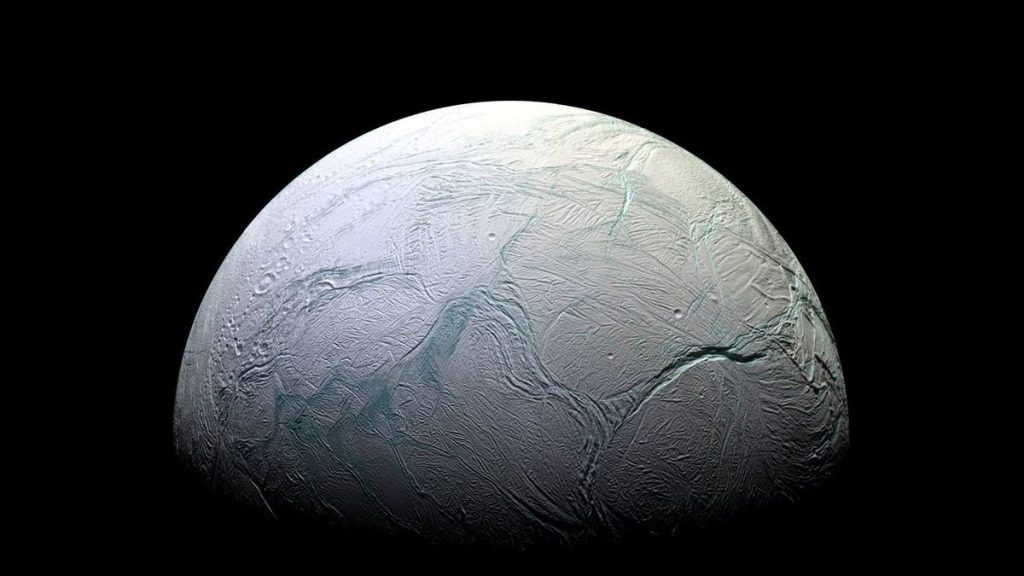
The nearest places to look are right next door. Mars is the obvious target; it once had rivers and lakes, and rovers like Perseverance are collecting rock samples that may preserve traces of ancient microbes. But the more exciting candidates may be moons. Europa, orbiting Jupiter, hides a salty ocean beneath its icy shell, and Enceladus, a small moon of Saturn, actively sprays plumes of water into space that spacecraft have flown through and sampled. Titan, another Saturnian moon, has lakes of liquid methane and a thick chemical atmosphere unlike anywhere else.
What makes these worlds special is access. We cannot fly to an exoplanet, but we can send a probe to Europa, and missions are being built to do exactly that. If life turns up in one of these nearby oceans, it would prove that biology arose independently twice in a single solar system, which would tell us the galaxy is almost certainly full of it.
Reading the Atmospheres of Distant Worlds
Beyond the Solar System, direct visits are off the table, so scientists rely on light. When a planet passes in front of its star, a sliver of starlight filters through its atmosphere on the way to us, and different gases absorb different colors. By splitting that light into a spectrum, researchers can identify what the air is made of without ever leaving Earth. The James Webb Space Telescope has pushed this technique further than ever, detecting water vapor and carbon dioxide in the atmospheres of planets trillions of kilometers away.
The prize would be a combination of gases that life keeps out of balance, the way Earth’s atmosphere holds oxygen and methane together when chemistry says they should cancel each other out. Spotting that pairing on a rocky planet in its star’s temperate zone would be one of the most important measurements in the history of science.
The Role of Habitable Zones
With so many planets to choose from, scientists need a way to prioritize, and the habitable zone provides it. This is the band of orbits around a star where temperatures allow liquid water to exist on a surface, neither boiling away nor freezing solid. Water is the one ingredient every form of life on Earth depends on, so worlds in this zone jump to the front of the line.
The idea has limits worth admitting. A planet in the habitable zone might still be a lifeless rock, and life might exist in places the simple definition ignores, such as the subsurface oceans of icy moons far outside any star’s warm band. The habitable zone is not a guarantee. It is a filter that turns an overwhelming list of planets into a manageable set of best guesses.
Catching a Planet’s Light Directly
Reading an atmosphere during a transit is powerful, but it only works for planets whose orbits happen to pass in front of their star from our view. A newer ambition is to photograph a planet directly, separating its faint glow from the overwhelming glare of its sun. The challenge is brutal; a rocky planet is billions of times dimmer than the star beside it, like spotting a firefly next to a lighthouse from across an ocean.
The solution is hardware that physically blocks the starlight, a coronagraph inside the telescope or a separate star-shading spacecraft flown thousands of kilometers ahead of it. Once the star’s glare is suppressed, the planet’s own reflected light can be captured and split into a spectrum, revealing its atmosphere and even hints of its surface. Observatories now on the drawing board are being built specifically to do this for temperate, Earth-sized worlds, something no current telescope can manage.
The Limits We Still Work Against
For all the progress, it is worth being clear about the obstacles. The distances are crushing; even the nearest exoplanets are light-years away, far beyond the reach of any probe we could build in a lifetime. The signals are faint, often pushing our best instruments to their limits, and they are frequently ambiguous, open to more than one explanation. A promising result can dissolve under closer inspection, and many have.
There is also the problem of expectation. We have exactly one example of life to work from, our own, so we tend to look for what we already know. Alien biology might run on different chemistry, leave different traces, or live in places our methods overlook entirely. The honest position is that the search is shaped as much by our limitations as by the universe itself, and acknowledging that is what keeps the science rigorous rather than wishful.
Why One Detection Would Change Everything
It is easy to treat this as just another branch of astronomy, but the stakes are unusual. Finding even microbial life on a single other world would answer a question humans have asked for as long as we have had language, and it would do so decisively. It would tell us that life is not a freak accident unique to Earth but something the universe does given the chance.
The consequences would ripple far past science. It would reshape how we think about our own significance, our future, and our responsibilities. That is precisely why researchers hold the evidence to such a punishing standard. A claim this large has to be unassailable, checked and rechecked by rival teams, before anyone is willing to say the word “life” out loud.
Machines That Help Us Search
The flood of data from modern telescopes is far too large for people to examine by hand, and this is where artificial intelligence has quietly become essential. Machine learning systems sift through enormous catalogues of starlight, flagging the subtle dips and chemical fingerprints that deserve a closer look while discarding the ordinary noise. Algorithms have already rediscovered known planets in old data and turned up new ones that human reviewers missed.
None of this replaces judgment. A computer can flag a candidate, but confirming it still takes careful follow-up, independent instruments, and a healthy dose of skepticism. The technology speeds up the search without lowering the standard of proof, which is exactly the balance the field needs.
A Search Worth Making
No confirmed sign of life beyond Earth has been found yet, on Mars, on the moons, or among the exoplanets. But the search has never been better equipped, and the targets have never been clearer. Each mission and each new telescope narrows the field a little further, turning a vast unknown into a list of specific places worth examining. Whether the answer comes from a Martian rock, a moon’s hidden ocean, or the air of a distant planet, the tools to find it are finally in our hands.
A Question Within Reach
What makes this moment different from every era before it is that the question has finally become answerable. The instruments exist, the targets are chosen, and the methods for telling biology apart from chemistry are maturing fast. Whether the first sign comes from a Martian rock, a hidden ocean on an icy moon, or the faint light of a distant atmosphere, the search has moved from wondering to actively looking, and that shift is the real breakthrough.
Register on our portal to explore more about astrobiology, habitable worlds, and the ongoing search for life beyond Earth.