Posted by
 Astrobiology has a reputation problem. People hear the word and picture someone scanning the sky for alien signals. The actual day-to-day work looks more like analytical chemistry — running samples through instruments, calibrating detectors, arguing about whether a faint signal is a molecule or a smudge in the data.
The field doesn’t search for life in the abstract. It searches with specific tools, each built to catch a specific kind of evidence. Here’s what’s in the kit.
Mass Spectrometers: The Workhorse
If astrobiology had a signature instrument, it would be the mass spectrometer. It sorts molecules by mass, letting researchers identify what a sample is made of down to individual compounds. The Sample Analysis at Mars (SAM) instrument suite aboard the Curiosity rover — operating in Gale Crater since 2012 — is essentially a portable chemistry lab built around mass spectrometry and gas chromatography.
SAM detected organic molecules in Martian mudstone in 2013, and later found seasonal methane fluctuations in the atmosphere. Neither is proof of life. Organics can form through non-biological chemistry, and methane has geological sources. But these are exactly the measurements you need to make before you can rule anything in or out, and SAM made them on the surface of another planet, autonomously.
Spectrometers That Read Light
For targets you can’t land on — exoplanets, distant moons — the tool is spectroscopy. Every molecule absorbs and emits light at characteristic wavelengths. Split the light from a planet’s atmosphere into a spectrum, and the dark absorption lines tell you what gases are present.
The James Webb Space Telescope is the most capable spectrometer ever pointed at exoplanets. Its infrared instruments can detect water vapor, carbon dioxide, and methane in planetary atmospheres hundreds of light-years away. In 2022 it confirmed CO2 on the exoplanet WASP-39b — the first unambiguous detection of that molecule on a world outside our solar system. The same technique, applied to a rocky planet in a habitable zone, is how a biosignature would eventually be found.
The Problem of Knowing What You’re Looking At
Here’s where it gets philosophically uncomfortable. To detect life, you need to know what life looks like as a signal. And the only example we have is Earth.
This is the central methodological tension in the field. Every instrument is, to some degree, tuned to find Earth-like biochemistry: carbon-based molecules, liquid water as a solvent, specific gas combinations. If alien life uses a different chemistry — a different solvent, a different information-carrying molecule — our tools might walk right past it. Researchers know this. There’s no clean solution, only the pragmatic decision to look for what we can recognize while staying alert to anomalies that don’t fit.
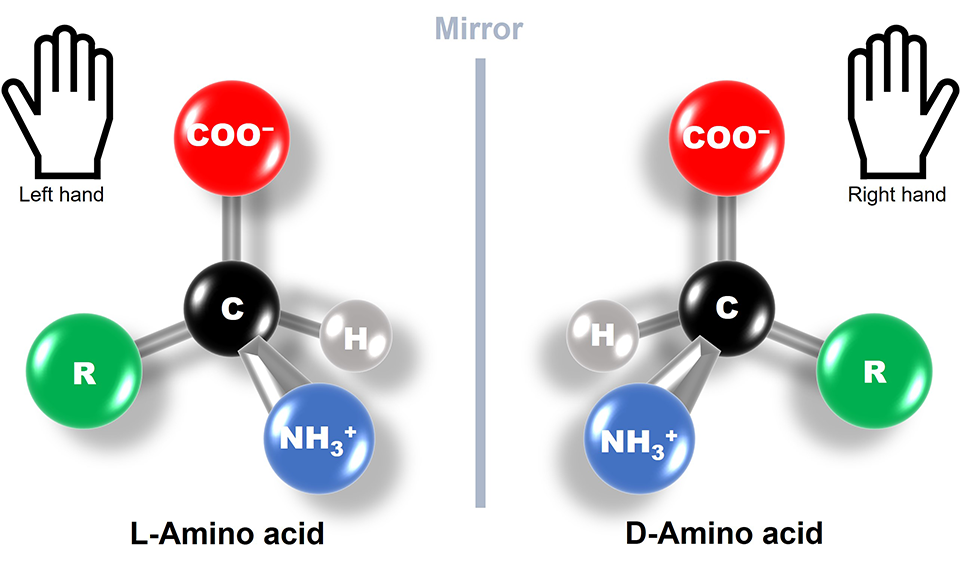
Chris McKay at NASA Ames has pushed for a different framing: instead of hunting for specific molecules, look for patterns that chemistry alone struggles to produce. An unexpected abundance of one chiral form of a molecule over its mirror image, for instance. Life on Earth uses left-handed amino acids almost exclusively. A sample showing that kind of imbalance would be hard to explain without biology — whatever that biology was made of.
In-Situ Analysis Versus Sample Return
There’s a long-running tradeoff in how astrobiology missions are designed. You can send the lab to the sample, or bring the sample to the lab.
In-situ analysis — instruments like SAM operating on Mars — gives you immediate answers but limits you to whatever you packed before launch. The instruments are miniaturized, power-constrained, and can’t be upgraded once they leave Earth. Sample return flips that. The Perseverance rover, working in Jezero Crater since 2021, is collecting and sealing rock cores for an eventual return mission. Material analyzed in an Earth laboratory can be examined with instruments far more sensitive than anything that fits on a rover, and re-examined for decades as techniques improve.
The catch is obvious: sample return is enormously expensive and slow, and the Mars Sample Return program has been under budget review with an uncertain timeline. The samples are sitting in Jezero. Whether they make it home is, as of now, a question of funding more than engineering.
Sampling Plumes Without Landing
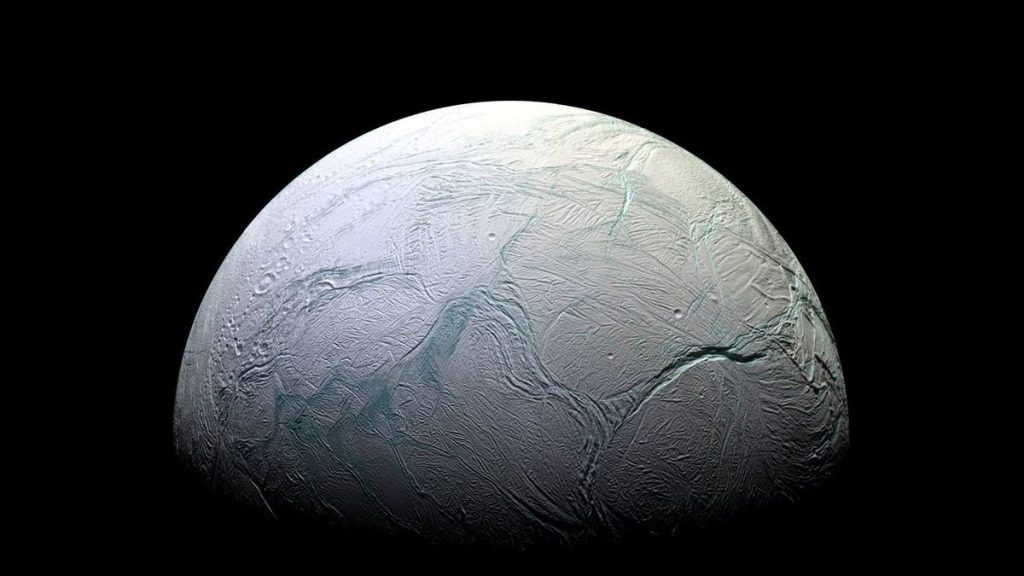
One of the more elegant tricks in the toolkit doesn’t require landing at all. Saturn’s moon Enceladus vents water from its subsurface ocean through cracks at its south pole — geysers that spray material directly into space. The Cassini spacecraft flew through those plumes between 2008 and 2015 and sampled them with onboard instruments, detecting water, salts, silica particles, and complex organic molecules.
That’s a subsurface ocean handing you samples for free, no drilling required. A dedicated Enceladus mission with modern instruments could fly the same maneuver and look specifically for biosignatures in the plume material. It’s one of the most promising and least technically insane ideas in the field.
Laboratory Simulation
Not all the work happens in space. A large part of astrobiology is done in labs that recreate alien conditions — chambers that simulate the Martian surface, the chemistry of Titan’s hydrocarbon lakes, the pressure of Europa’s ocean floor. Researchers grow extremophile organisms under these conditions to map the limits of what life tolerates, and run abiotic chemistry experiments to learn which “biosignatures” might be faked by geology.
This is the unglamorous foundation. Before any instrument can claim a detection, someone has to establish what a false positive looks like. Much of that happens in a basement lab with a vacuum chamber and a graduate student watching a pressure gauge.
The Ladder of Detection
A 2018 paper by Marc Neveu and colleagues proposed a “ladder of life detection” — a framework for ranking evidence from weak to strong. A single organic molecule sits near the bottom. A complex, ordered pattern of molecules that resists abiotic explanation sits higher. Direct observation of metabolism or reproduction would be near the top, and we have no realistic near-term way to get there off Earth.
The point of the ladder is discipline. It forces researchers to be honest about where any given measurement actually lands, and to resist the pull toward declaring victory on ambiguous data. The history of the field includes a few premature announcements that didn’t survive scrutiny. The toolkit keeps improving. The standard for what counts as proof, deliberately, keeps getting harder to clear.
Microscopes on Other Worlds
One instrument conspicuously missing from most planetary missions is a good microscope. It sounds like an obvious thing to send — if you want to find microbes, look for microbes — but imaging at the microbial scale on another planet is brutally hard, and morphology alone is treacherous evidence. Mineral grains, weathering pits, and tiny crystals can mimic the shapes of cells. The fossil-microbe claim for the Martian meteorite ALH84001 collapsed partly because shape is such a weak signal; structures that looked biological turned out to be explicable by non-living chemistry.
Newer concepts try to do better by pairing imaging with chemistry — a microscope that doesn’t just photograph a particle but also reads its composition, so a suspicious shape can be checked against whether it’s made of the right stuff. Some proposed Europa and Enceladus instruments would capture ice or plume grains and image them while measuring their molecular makeup. Seeing something cell-shaped means little; seeing something cell-shaped that is also built from ordered organic molecules means considerably more.
Detecting Life Without Assuming It’s Like Ours
The deepest design problem in the toolkit is that almost every instrument is, quietly, looking for Earth life. A DNA sequencer finds DNA. A test tuned to terrestrial amino acids finds terrestrial amino acids. If life elsewhere runs on a different molecular alphabet, these tools could pass straight over it.
This has pushed researchers toward more agnostic detectors — instruments that look for the general hallmarks of life rather than its specific Earthly molecules. One approach measures molecular complexity: living systems produce large, intricate, highly specific molecules that random chemistry struggles to assemble in quantity. Another looks at distributions — life tends to use a small, repeated set of building blocks rather than the broad smear of compounds abiotic chemistry produces. The goal is a measurement that would flag biology even if that biology is chemically alien. It’s an unsolved design challenge, and arguably the most important one in the field, because the worst possible outcome isn’t a false alarm — it’s walking past real life because it didn’t look like us.
No Single Instrument Closes the Case
The throughline across the whole toolkit is that no one device will ever announce “life found.” A mass spectrometer reports molecules. A spectrometer reports gases. A microscope reports shapes. Each measurement is a single rung, and a confident claim requires several of them pointing the same way, with every non-biological explanation eliminated. That’s why missions carry instrument suites rather than a single magic detector — and why the most important engineering decisions are made years before launch, when a team chooses which combination of tools gives the best chance of catching life in the act, or at least its unmistakable residue.
SETIworld follows the instruments, missions, and lab techniques driving the search for life — join to track what each new tool reveals.
References
- NASA Astrobiology Program — astrobiology.nasa.gov astrobiology.nasa.gov
- Mahaffy et al., The Sample Analysis at Mars Investigation, Space Science Reviews 2012
- Glavin et al., Detection of organics on Mars by SAM, JGR Planets 2013
- Hand et al., Report of the Europa Lander Science Definition Team, NASA JPL 2017
- Cable et al., The Science Case for a Return to Enceladus, Planetary Science Journal 2021
- Neveu et al., The Ladder of Life Detection, Astrobiology 2018