Posted by
 Is there life beyond Earth? The honest answer is that nobody knows, and anyone who tells you otherwise is selling something. Not one organism, not one fossil, not one confirmed transmission has ever been recovered from anywhere except this planet. What has changed over the last thirty years is not the answer but the status of the question. It used to be philosophy. It is now an observational programme with launch windows, instrument time, peer review, and a standard of proof that has already killed several famous claims.
So the useful thing is to walk the boundary and see exactly where evidence ends and hope begins.
Start With What Is Solid
Planets are ordinary. In October 1995 Michel Mayor and Didier Queloz reported a wobble in the star 51 Pegasi caused by a world about half the mass of Jupiter whipping around it once every four days. The object made no sense under the theories of the day, and a few astronomers assumed the measurement was broken rather than the theory. It was the theory. Kepler then spent four years staring at one patch of sky near Cygnus and Lyra, watching roughly 150,000 stars for dips of a few hundredths of a percent, and TESS has been sweeping nearly the whole sky since 2018. The catalogue now runs to thousands of confirmed worlds, and rocky planets on temperate orbits turned out to be common rather than lucky.
The second solid fact is that the raw chemistry travels. OSIRIS-REx dropped a capsule of asteroid Bennu into the Utah desert in September 2023, and the material sealed inside had never touched Earth’s biosphere. Analysts found amino acids in it, and nucleobases too. Organic molecules are neither rare nor fragile.
Then comes the gap nobody has closed: the step from chemistry to biology. That transition happened here at least once, more than three and a half billion years ago, and from a sample of one we cannot say whether it is routine or a freak accident. This is the honest core of the field. Every estimate of how much life beyond Earth might exist rests on that single unknown. The Drake equation, sketched by Frank Drake in 1961 for a small meeting at Green Bank, was never a calculator. It was a list of things we did not know, arranged in an order that made the ignorance easier to argue about.
Mars Keeps Almost Answering
Mars is where the near-misses pile up. In 1996 a team led by David McKay announced possible fossil traces inside ALH 84001, a Martian meteorite picked up in Antarctica twelve years earlier: magnetite crystals and tiny elongated structures that looked like microbes if you squinted. It made front pages worldwide. Two decades of follow-up work showed that essentially every feature could be produced without biology. The claim did not survive. The argument it started is the reason the field now demands several independent lines of evidence before anyone uses the word life.
Then there is the methane. Curiosity’s onboard chemistry lab has measured methane inside Gale crater more than once, at levels that rise and fall with the seasons and occasionally spike. Methane should not last long in the Martian atmosphere, so something must be topping it up, and that could be geology or microbes under the surface. The complication is awkward: ESA’s Trace Gas Orbiter, built specifically to be more sensitive than the rover, has never confirmed methane from orbit. Nobody has reconciled the two results.
Perseverance has been coring rock in Jezero crater since 2021, an ancient river delta chosen precisely because deltas bury things and preserve them. In July 2024 it found a rock in the Bright Angel formation, nicknamed Cheyava Falls, carrying leopard-spot markings and chemistry consistent with the kind of reactions microbes use to extract energy. Consistent with. Not proof of. That sample now sits in a sealed tube on Mars, waiting for a return mission whose schedule and budget are still being fought over. Nothing about Martian biology gets settled until those tubes reach a laboratory here.
The Oceans You Cannot See
Europa hides a saltwater ocean beneath an ice shell somewhere between roughly fifteen and twenty-five kilometres thick, and that ocean probably holds more liquid water than every sea on Earth combined. Europa Clipper left Florida in October 2024 and reaches Jupiter in 2030 for dozens of close flybys. Worth being clear about what it is, though: not a life detector, but an instrument for gauging the thickness of the ice, the saltiness of the water, and whether the chemistry down there could support anything at all.
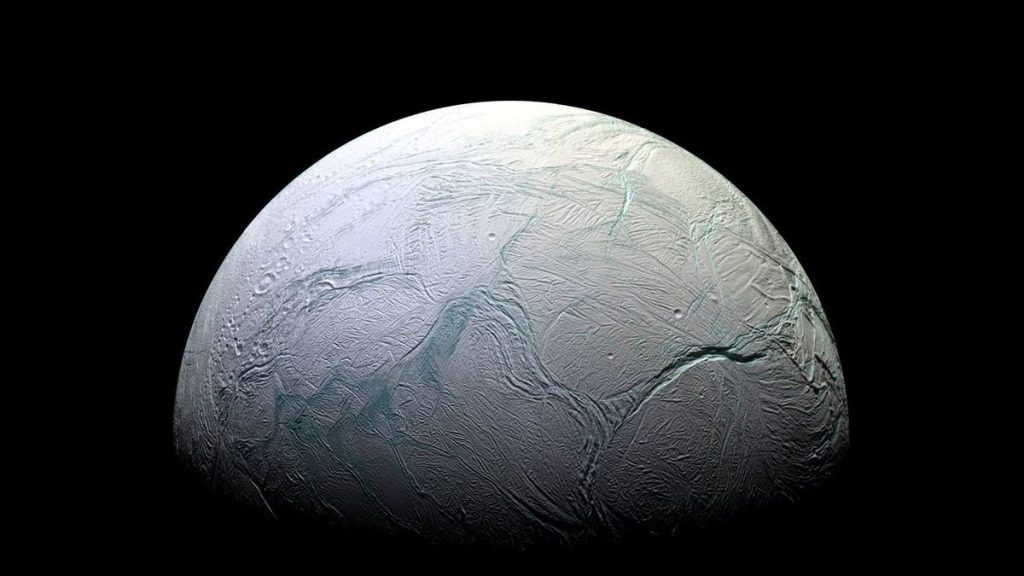
Enceladus made its case differently, by throwing its ocean at us. Cassini flew straight through the plumes erupting from the moon’s south pole and sampled them in flight. Molecular hydrogen turned up in 2017, pointing to hot water reacting with rock on a seafloor. Grains from Saturn’s E ring, fed by those same plumes, were later found to contain phosphates, the element everyone expected to be the hard one to find.
A moon barely 500 kilometres across, spraying water, energy and nutrients into space for free. No funded mission is currently on its way there.
Titan Refuses to Cooperate
Titan is the awkward one. Huygens landed on 14 January 2005 and photographed rounded pebbles on a damp plain, the unmistakable signature of a liquid that flows. That liquid is methane and ethane, pooled into seas like Kraken Mare and Ligeia Mare under a thick nitrogen atmosphere at roughly minus 179 degrees Celsius. There is a water ocean far below the crust as well, but it is the surface that breaks our rules, because every habitability checklist we have begins with liquid water and Titan runs a full liquid cycle without it.
Dragonfly, a nuclear-powered rotorcraft, is meant to launch in 2028 and start hopping between Titan sites in the mid-2030s. Either complex chemistry can assemble itself in a cryogenic solvent, in which case our definition of a habitable world has been far too narrow, or it cannot, which would be almost as valuable to establish.
Where the Claims Get Loud
The exoplanet side is where careful language matters most, because the targets are light-years away and the signals are minute. Proxima b, announced in 2016, circles the nearest star to the Sun at a distance where liquid water is thermally plausible. TRAPPIST-1, announced in 2017, has seven Earth-sized planets around a cool dwarf some forty light-years off, several of them candidates for temperate conditions. Kepler-186f and Kepler-452b were milestones for size and orbit, yet nobody has measured an atmosphere on either, and with no atmosphere there is nothing to test.
JWST changed that for a small number of worlds. When a planet crosses the face of its star, a sliver of starlight filters through its atmosphere and the molecules there leave fingerprints in the spectrum. Applied to TRAPPIST-1, the technique has so far suggested the inner planets may have no thick atmosphere at all. A real result, if a deflating one.
K2-18b is the cautionary tale still unfolding. A team reported a possible trace of dimethyl sulphide, a gas produced on Earth mainly by marine plankton, first at low confidence in 2023 and then far more assertively in 2025. Independent reanalyses of the same observations found the signal much weaker or absent, and the dispute runs all the way down: whether the molecule is there, whether ordinary chemistry makes it without biology, and whether the planet is even the warm water world the reading assumes. That is the system working exactly as designed, in public, and it is a fair preview of how the first serious claim about life beyond Earth will look from the outside.
Listening for Somebody
The other half of the search skips biology entirely and hunts for technology. Project Phoenix ran from 1995 to 2004 and examined around 800 nearby stars, finding nothing. The famous Wow! signal, caught by the Big Ear telescope in Ohio in August 1977, lasted 72 seconds and has never repeated, which means it can never be confirmed. More recently Breakthrough Listen flagged BLC1, a narrowband signal from the direction of Proxima Centauri in 2019 data; by 2021 the team had traced it back to human equipment.
Every candidate so far has ended like that. The instruments improve regardless. Arecibo collapsed in 2020, but the Green Bank Telescope, the Allen Telescope Array and the VLA all give time to the search, and the Square Kilometre Array is going up across South Africa and Australia. The hunt has widened past radio too, into laser pulses, industrial pollutants in planetary atmospheres, and waste heat glowing in the infrared.
What Would Actually Settle It
The bar is deliberately punishing. For microbes, it would take several independent signatures in one sample, reproduced by separate laboratories, with every geological explanation ruled out first. For a technosignature, it would take a persistent artificial transmission tracked by observatories on different continents using different hardware. Contamination and instrument error have swallowed so many candidates that suspicion is now the professional default.
So, is there life beyond Earth? Unknown. The uncertainty is not a failure of the science; it is the reason the next fifteen years are worth watching, with Clipper closing on Europa, Dragonfly bound for Titan, sample tubes waiting in Jezero, and the Extremely Large Telescope opening its eye in Chile.
If you would rather follow that as it happens than read about it once the headlines have flattened it, SETIworld covers it week by week: the missions, the contested spectra, the retractions, and whatever eventually survives them. Come read along.