Posted by
 Is there life outside of Earth? No one can answer that with a confirmed detection yet, and anybody who tells you otherwise is selling something. What astronomers and planetary scientists do have is a shortlist — a set of specific places where the question can be tested with instruments that already exist or are already being built. Some of those places are a few light-minutes away. Others are dozens of light years off and will only ever be studied as smudges of filtered starlight.
The shortlist looks nothing like it did in the 1970s. Back then the assumption was that a promising world had to resemble Earth: temperate, wet on the surface, orbiting a star like the Sun. Then microbiologists found thriving communities under Antarctic ice, inside basalt kilometres below the seafloor, and around scalding vents where no photon has arrived in a billion years. Habitability got wider. So did the target list.
Mars Is the One We Can Actually Touch
Modern Mars is a bad place to be alive — thin air, no magnetic shield, ultraviolet radiation sterilising the top few centimetres of soil. Its past was another matter entirely. Orbiters mapped branching valley networks and clay minerals that only form when rock sits in water for a long time. Curiosity, in Gale Crater since 2012, drilled into mudstones that settled at the bottom of a lake which may have persisted for millions of years, and found the carbon, hydrogen, nitrogen, oxygen, phosphorus and sulphur that terrestrial biochemistry runs on.
Perseverance has been working Jezero Crater since February 2021 for a narrower reason. Jezero held a lake fed by a river that built a delta, and deltas are excellent at burying fine sediment fast, which is exactly the condition under which faint chemical traces of microbes survive for three and a half billion years on Earth. The rover is filling sealed titanium tubes with cores. The analysis that could actually settle anything needs mass spectrometers the size of a room, so those tubes are waiting for a return mission whose budget and schedule remain genuinely uncertain.
There is a second Martian option that gets less attention. Whatever happened on the surface, the subsurface stayed comparatively sheltered — stable temperatures, shielding from radiation, possibly briny water in the pore space of the crust. Deep drilling on Mars has not been attempted. It is the kind of mission that would take a decade to design and would answer a question no orbiter can.
Two Moons With Oceans Under the Ice
Europa is roughly the size of our Moon and almost certainly holds more liquid water than every ocean on Earth combined, sealed beneath an ice shell of unknown thickness. Galileo’s magnetometer readings in the 1990s pointed to a salty conducting layer inside; the chaotic, refrozen terrain on the surface points to something moving underneath. Jupiter’s gravity flexes the moon on every orbit and that friction supplies the heat. Europa Clipper, launched in October 2024, will make dozens of close passes after it arrives around 2030, mapping the shell and looking for spots where ocean water reaches near the surface.
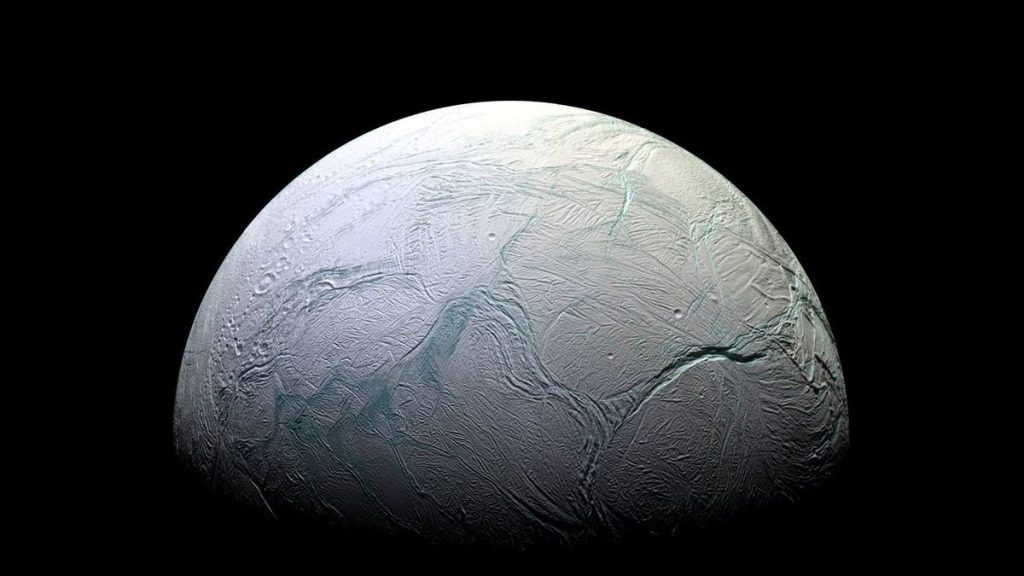
Enceladus is smaller, brighter and more cooperative. Cassini spotted jets of vapour and ice grains firing out of fractures near its south pole in 2005, then spent years flying straight through the plume. The material carried salts, silica particles that imply water reacting with hot rock, and molecular hydrogen — a chemical energy source that some Earth microbes live on. Whether anything is using it is completely unknown. The appeal is practical: you can sample an alien ocean without drilling, and mission concepts for a dedicated plume-flyby spacecraft have been near the top of planetary science priority lists for years.
Titan Is the Weird One
Saturn’s largest moon has a thick nitrogen atmosphere, weather, dunes, rivers and standing seas — all at about minus 180 degrees Celsius, and all made of methane and ethane rather than water. Huygens parachuted onto its surface in January 2005 and photographed rounded pebbles in what looked unmistakably like a dry streambed.
Nobody expects Titan biology to look like ours. Water ice is bedrock there. What makes it a serious destination is the chemistry: sunlight breaking methane and nitrogen apart in the upper atmosphere produces a haze of increasingly complicated organic molecules that drift down and pile up on the ground. Whether that chemistry ever crosses into something self-sustaining is exactly what nobody knows, which is why NASA’s Dragonfly rotorcraft, planned to fly between Titan’s dune fields later next decade, is the mission astrobiologists talk about most.
The Awkward Case of Venus
Venus is a cautionary example rather than a favourite. Surface temperature near 460 degrees Celsius, pressure like a kilometre underwater, nothing organic surviving for long. Around fifty kilometres up, though, the cloud deck sits at roughly Earth-like temperature and pressure, and that oddity has kept a small research community interested since Carl Sagan and Harold Morowitz wrote about it in 1967.
The 2020 announcement of a possible phosphine detection sharpened the argument considerably, and then largely dissolved into it — the signal has been reanalysed, contested, partially recovered and disputed again. Venusian clouds are also concentrated sulphuric acid with almost no free water, which is a serious problem for any biochemistry we can imagine. The value of Venus is that it stress-tests where we draw the line.
Then There Are the Other Stars
Thousands of confirmed planets later, the search for life outside of Earth is no longer confined to our own system. TRAPPIST-1, announced in 2017 and sitting about forty light years away, packs seven roughly Earth-sized planets around a single ultracool dwarf — the best natural laboratory anyone has for comparing rocky worlds that formed together. Early JWST measurements of the innermost planets found no sign of thick atmospheres, which was disappointing and also genuinely informative about how small red stars treat their planets.
Proxima b, detected in 2016, orbits the nearest star to the Sun at a distance where liquid water is at least thermodynamically allowed. Proxima Centauri is also a flare star, and a big enough flare can erode an atmosphere over geological time. Since red dwarfs make up around three quarters of the stars in the galaxy, the answer to whether their planets keep their air more or less determines how many habitable worlds exist.
None of these can be visited. They are studied by spectroscopy — watching which wavelengths vanish as starlight passes through a planet’s atmosphere during transit, and inferring what molecules did the absorbing. Water, carbon dioxide and methane have all been detected this way on various worlds. The goal is a combination of gases that chemistry alone struggles to maintain, and the K2-18b dimethyl sulphide argument shows how ferociously such a claim gets contested before anyone accepts it.
Where to Look First
There is no single best answer, and the honest position is that the targets are complementary rather than ranked. Mars preserves ancient rock we can hold. Enceladus hands out ocean samples for free. Europa has the volume and the longevity. Titan tests whether carbon chemistry needs water at all. The exoplanet population offers billions of independent trials of the same experiment, at the cost of never letting us look closely.
What Earth keeps teaching is that the unpromising-looking places are worth checking. Microbes live in rock two kilometres down, in brine pockets at minus 20 degrees, in water hot enough to cook. Is there life outside of Earth in equally improbable niches? Possibly, and the frozen worlds far beyond the classical habitable zone are where that possibility hides.
The first detection, whenever it comes, will most likely be ambiguous before it is convincing — a strange isotope ratio, an atmospheric mix that resists explanation, an anomaly argued over for a decade. SETIworld follows those arguments as they happen, mission by mission and paper by paper, if you would rather watch the evidence accumulate than wait for the headline.