Posted by
 No organism, no fossil, no verified signal. Asked plainly — is there life outside of Earth? — the scientific answer today is that there is no confirmed case. That sounds like a dead end, and it is not. The last thirty years produced a large body of evidence about where life could exist, what it would leave behind and how easily a careless observer could fool themselves, and that body of evidence is what any honest discussion has to work from.
The catalogue is genuinely impressive: thousands of planets around other stars, a Martian crater floor that used to be a lake, salt oceans under the ice of two moons, amino acids inside meteorites. None of it is life. All of it changes the odds a person should assign to the question.
The Line Between Habitable and Inhabited
Almost every argument in astrobiology turns on one distinction. A world with liquid water is habitable. A world with organisms is inhabited. The first is a statement about physics and chemistry; the second is a claim that has to defeat every alternative explanation before anybody accepts it, and alternative explanations are usually abundant.
Organic molecules form without biology. Methane comes out of rocks as well as microbes. Oxygen can build up photochemically when water vapour is split by ultraviolet light and hydrogen escapes to space. Even a structure that looks like a bacterium under an electron microscope can be a mineral artefact.
So what would count? Realistically: a chemical pattern with no plausible abiotic route, found by more than one instrument, in a planetary context well enough understood to rule out geology — or a signal with structure that nature does not make. Anything less stays a candidate. The field has learned this the hard way, several times.
Mars, and the Evidence That Keeps Not Quite Arriving
Mars supplies the clearest case of past habitability anywhere off Earth. Orbiters have mapped branching valley networks, and rovers have driven through the physical proof: clay minerals that form in standing water, sulfate beds, rounded pebbles that were tumbled by a current. Curiosity has spent years reading the sedimentary record of an ancient lake in Gale Crater. Perseverance landed on a river delta in Jezero Crater in 2021 and has been sealing rock cores into tubes, because the analysis that could settle the biology question needs laboratories on Earth.
In 1996 a NASA-led team announced that meteorite ALH 84001, blasted off Mars and collected in Antarctica, contained fossil microbes. The evidence was a set of carbonate globules, magnetite grains and structures a few tens of nanometres across. Nearly every element of that case has since been given a non-biological explanation, and most researchers no longer accept it, though the debate technically never closed.
Then there is methane. Curiosity has repeatedly measured low-level, seasonally varying methane at the Gale Crater surface, and ESA’s Trace Gas Orbiter, looking from above with greater sensitivity, has largely failed to see it. Both results are hard to dismiss. Whether the gas is being released and destroyed locally, or one instrument is misleading everyone, is unresolved — and either way, geology produces methane perfectly well without help.
Oceans Under Ice
Europa is roughly Moon-sized and almost certainly holds a global salt ocean under a shell of ice, kept liquid by tidal flexing from Jupiter rather than by sunlight. If the estimates hold, it contains more water than every ocean on Earth combined. Nobody has sampled it. Europa Clipper, launched in October 2024, will make repeated close flybys to characterise the shell and the water beneath.
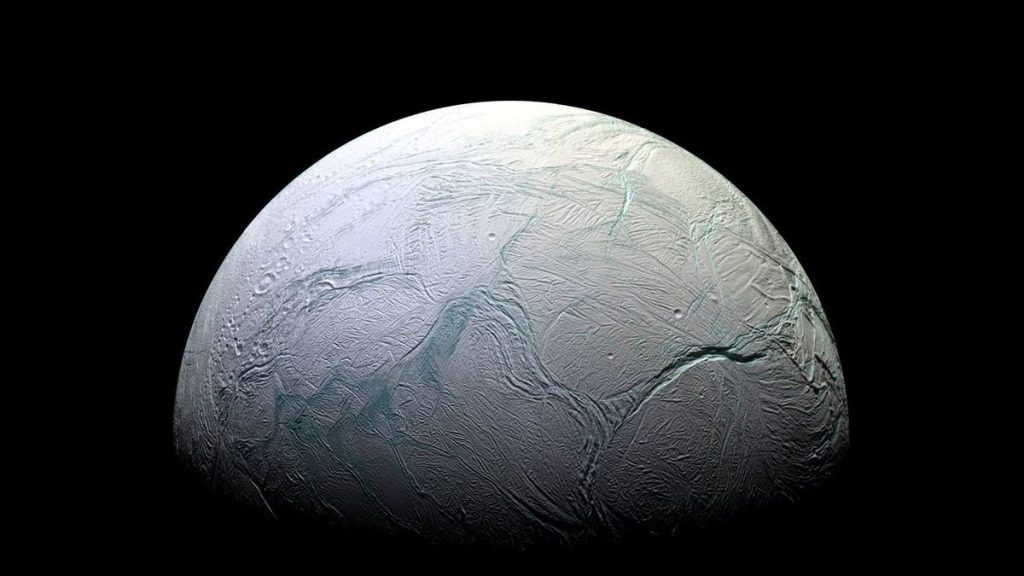
Enceladus gave away more, faster. Saturn’s small icy moon vents plume material into space through fractures at its south pole, and Cassini flew through those plumes and analysed what it caught: water, salts, silica grains, methane, organic molecules and molecular hydrogen. Hydrogen in that mixture points to hot water reacting with rock on a seafloor, which is the same chemical setting that powers vent communities in Earth’s deep ocean without any sunlight at all.
That is a habitable environment with an unusually convenient sampling method. It is not evidence of inhabitants, and Cassini carried no instrument capable of settling the difference.
Chemistry Arriving by Rock
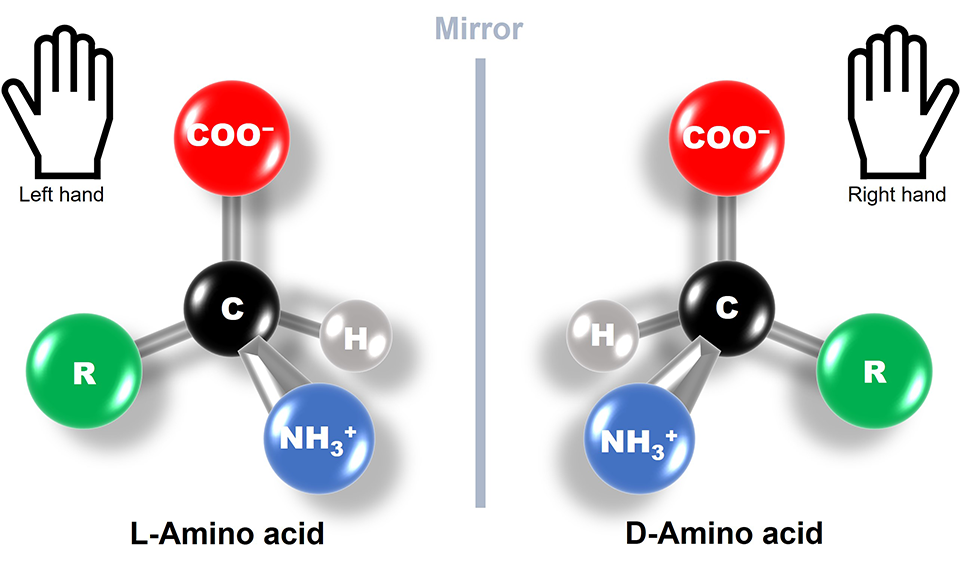
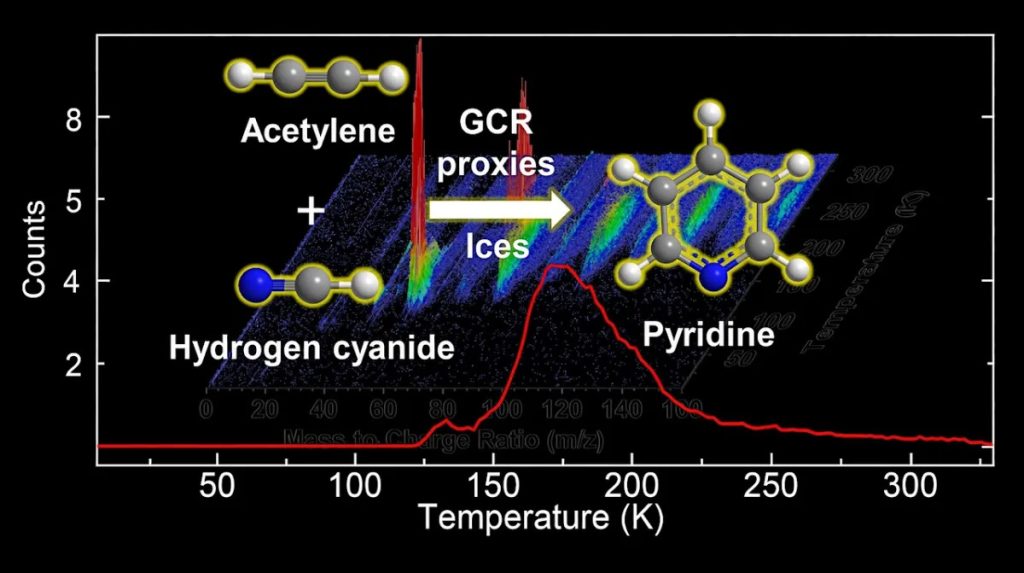
The Murchison meteorite fell in Australia in 1969 and has been picked over ever since. It contains dozens of amino acids, including many that terrestrial biology never uses — which is the detail that makes contamination an unconvincing explanation. Radio astronomers have since identified a long list of organic species in cold interstellar clouds.
Sample return has sharpened all of this. Hayabusa2 brought grains of the asteroid Ryugu back in 2020, and OSIRIS-REx delivered its Bennu sample in September 2023. Both are rich in carbon compounds and in minerals altered by liquid water, analysed in clean laboratories rather than scraped off something that fell through the atmosphere and sat in a field.
What this shows is supply, not biology. Young planets get water and complex carbon chemistry delivered as a matter of course. How often that chemistry crosses the line into something that copies itself is exactly the number nobody can measure, because we have one example and no way to date its improbability.
Thousands of Planets, a Few Dozen Atmospheres
Exoplanets changed the statistics rather than the evidence. Thousands are confirmed, planetary systems appear to be the rule, and rocky worlds are common. TRAPPIST-1, about forty light years away, has seven roughly Earth-sized planets around an ultracool dwarf. Proxima Centauri, the nearest star to the Sun, has one in a temperate orbit.
Being the right size at the right distance settles almost nothing, though. Venus sits near the inner edge of the Sun’s habitable zone with a surface at 460 degrees Celsius. Atmosphere, mass, geology and history all matter more than orbital radius, and for most of these planets we have none of that information.
Spectroscopy is the way in. JWST can read the gases in a transiting planet’s atmosphere for a small set of targets, and the K2-18b episode of 2023 shows the state of play — methane and carbon dioxide detected fairly solidly, a hint of dimethyl sulfide reported far less solidly, and a statistical argument among specialists that has not resolved. Venus produced a comparable story in 2020, when a phosphine detection was announced, then challenged on data-processing grounds, and left in limbo.
SETI and the Discipline of Ruling Things Out
Technosignature searches skip the microbes entirely. Radio remains the main channel: a narrow-band transmission is easy to send across light years and nature does not produce one. Optical searches hunt for nanosecond laser pulses. Neither has produced a confirmed detection.
The two famous candidates both taught the same lesson. The Wow! signal, recorded at Ohio State’s Big Ear telescope in August 1977, lasted 72 seconds, was never seen again, and remains unexplained rather than explained away. BLC1, flagged by Breakthrough Listen in 2020 from the direction of Proxima Centauri, looked excellent until months of follow-up traced it to human equipment. Ruling out is most of the job.
So Where Does the Evidence Actually Stand?
No single observation is accepted as proof. The strongest case is cumulative and it is a case about plausibility: planets are everywhere, water is everywhere, carbon chemistry is everywhere, Mars was habitable, and at least two moons in our own system have oceans with energy running through them. That is a long way from where the field stood in 1970, when all of this was speculation with no data attached.
Is there life outside of Earth? The question has moved from philosophy into the class of problems that instruments can attack, which is the real achievement of the past three decades. The answer will probably arrive as a slow accumulation of independent measurements rather than a single dramatic morning, and there is a fair chance the first candidate will be argued over for a decade before anyone agrees.
If you want to watch that process rather than the headlines about it, SETIworld follows the missions, the sample analyses and the biosignature disputes as they unfold — including the ones that quietly fall apart.