Posted by
 Most of the latest news about aliens turns out, on inspection, to be news about instruments. No confirmed technosignature exists as of 2026. What does exist is a search that has become faster, broader and considerably more self-aware than the one Frank Drake started in 1960, and the past two years have produced a run of results that are genuinely interesting even though every one of them is a non-detection.
That distinction matters more than it sounds. A search that finds nothing but records exactly what it could have found is doing science. A search that finds nothing and shrugs is doing nothing.
An interstellar visitor got the full treatment
3I/ATLAS, spotted in July 2025, is only the third object confirmed to have entered the Solar System from outside it, after 1I/’Oumuamua in 2017 and comet 2I/Borisov in 2019. Its behaviour has been consistent with a comet — outgassing, a coma, the usual cometary chemistry — and there is no evidence whatsoever that it is anything artificial. It was still an obvious target, because an object built somewhere else is exactly the sort of thing worth pointing a receiver at.
The SETI Institute took more than seven hours of Allen Telescope Array time on it across 1 to 9 GHz. The pipeline threw up something on the order of 74 million detections; every surviving candidate traced back to terrestrial radio interference. Breakthrough Listen ran its own campaign using the Green Bank Telescope from 1 to 12 GHz, along with MeerKAT and the ATA, and reported no artificial emission localized to the object.
Public speculation ran ahead of all of it, as it did with ‘Oumuamua, whose odd non-gravitational acceleration and flattened shape produced a small library of exotic proposals. The pattern repeats: an unusual object appears, the observational constraints arrive months later, and by then the headline has moved on. Anyone reading the latest news about aliens in late 2025 saw considerably more speculation about 3I/ATLAS than the radio limits ever received.
Two useful things came out of the campaign. First, a quantitative ceiling on how powerful any transmitter aboard 3I/ATLAS could have been. Second, proof that the community can mobilize several major facilities onto a rare, fast-moving target within weeks, which is precisely the capability a genuine candidate would demand.
Stellar weather may be smearing the signals
A subtler development concerns what happens to a signal on the way here. Radio waves crossing the ionized plasma around a star, and then the interstellar medium, get scattered and broadened. A transmission that left home as a razor-thin tone can arrive smeared across a wider band, weaker per channel and less obviously artificial.
Narrowband is the primary thing SETI pipelines are tuned to notice. If the medium routinely widens those signals, then decades of searches have been optimized for a signal shape that may not survive the journey, and search strategies need to allow for broadening rather than treating narrowness as the defining fingerprint of technology. That is not a small revision.
The machines got much faster
Modern radio observatories record data at rates no team can inspect by hand. Work involving Breakthrough Listen, NVIDIA and the Allen Telescope Array demonstrated a machine-learning pipeline for fast radio bursts running roughly 600 times faster than the previous system and well over a hundred times faster than real time.
Speed is not the only gain. Classical SETI algorithms search for what they were told to look for — narrowband tones, particular drift rates, specific pulse patterns — and are structurally blind to anything else. Anomaly detection trained on what normal data looks like can flag the thing nobody wrote a filter for. Whether that ever produces a technosignature is unknown, but it widens the net in a direction the field has needed for years.
Interference remains the tax on all of it. Satellite constellations, aircraft transponders, mobile networks and consumer electronics fill the spectrum, and the 74-million-candidate figure from the 3I/ATLAS run is a fair picture of the ratio between noise and anything worth a second look.
Exoplanets turned a blind search into a targeted one
Drake pointed at Tau Ceti and Epsilon Eridani because they were nearby and Sun-like, with no idea whether either had planets. Tau Ceti, incidentally, does appear to host planet candidates now. Thousands of confirmed exoplanets later, target selection is a different discipline: astronomers can prioritize rocky planets in temperate orbits, or systems whose geometry happens to be favourable, and TESS keeps adding to the list.
One elegant idea gets used in target selection — the Earth transit zone, the band of sky from which our planet can be seen crossing the face of the Sun. Any observers there would have the same detection method we use, applied to us. It is not an argument that anyone is there. It is a way of ranking a million stars when telescope time is finite.
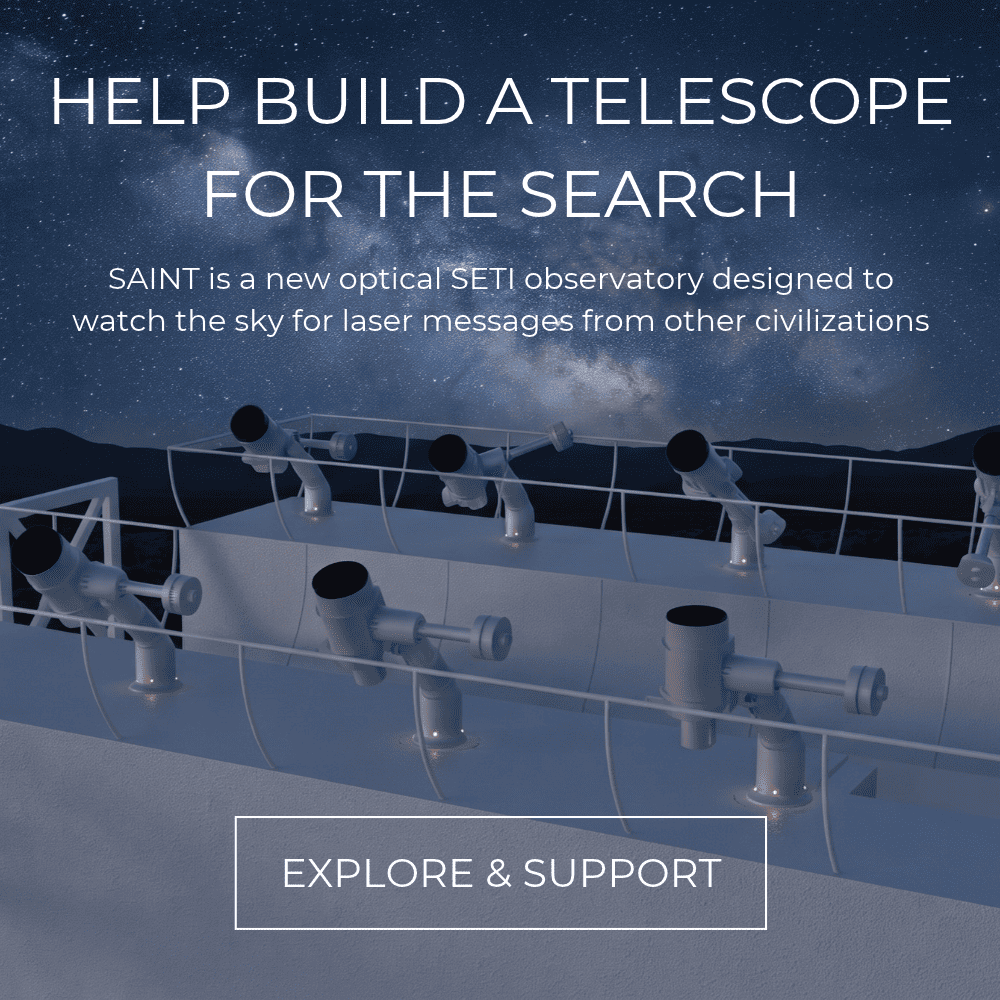
Optical searches have grown alongside the radio work. A laser pulse lasting a nanosecond, aimed deliberately, could briefly outshine its own star at that wavelength, and dedicated instruments now watch for exactly that kind of flash. Broader technosignature ideas — waste heat, industrial pollutants in an atmosphere, structures that dim a star oddly — are speculative, but they extend the search beyond the assumption that anyone out there would choose to broadcast at all.
Learning to recognize a mind that isn’t ours
An odd branch of current work looks inward. Whale and dolphin communication, cephalopod cognition, corvid problem-solving — intelligences that evolved independently of ours and organize information in ways human language does not. Researchers connected to the SETI Institute have been pushing this line because it attacks a real weakness: our detection algorithms encode assumptions about what a message looks like, and those assumptions come from one species with one communication system.
If we cannot reliably parse the structure in a humpback song recorded from a boat, the confidence that we would recognize a transmission from another star deserves some trimming.
What happens if something survives the tests
Post-detection principles were updated in 2026, and the revisions read like a response to the information environment rather than to astronomy. Independent verification before announcement, transparency about uncertainty, and a plan for the hours between a credible candidate and a public statement — a window in which a screenshot and a confident caption can outrun the science entirely.
The older principle survived intact: no reply on behalf of humanity without broad international consultation first. Whether that is enforceable is a separate question, since nothing stops a private group with a transmitter.
Meanwhile the search space stays enormous. Which star, which frequency, which bandwidth, how much power, aimed where, switched on when. Every survey carves out a thin slice and reports its limits, and the total volume examined so far remains a fraction of what is physically plausible. Nobody honest calls the silence evidence of absence yet.
The next generation of hardware should help. The Square Kilometre Array is under construction across Australia and South Africa, the next-generation Very Large Array is in planning, and much technosignature work now runs commensally — riding along on observations booked for pulsars or galaxies, costing almost no dedicated time.
So the honest summary of the latest news about aliens is this: the field is getting better at looking, better at explaining what it did not find, and more careful about what it would take to convince anyone. SETIworld follows those results as they land — the interstellar-object campaigns, the new limits, the arguments over verification — for readers who would rather have the latest news about aliens with the uncertainties left in.