Posted by
 A Toolkit, Not a Single Trick
There is no one instrument that detects life on another planet. There is no dial you turn, no alarm that rings. Instead there is a growing toolkit, a set of methods that each catch a different kind of clue. Some read the chemistry of a planet’s air. Some hunt for the heat and light of machinery. Some watch how a world behaves over hours and days, the way it brightens and dims as it turns. No single one of these is decisive on its own, and that is the whole point. Scientists run several at once and look for answers that agree.
The reason this matters is simple. A planet around another star is a faint speck pressed up against a blinding sun, often dozens of light-years away. You cannot fly there. You cannot scoop up a sample. Everything you learn has to be teased out of the handful of photons that survive the trip to your detector. So the field has built a catalog of techniques, each with a sweet spot, a kind of planet and a kind of signal it handles well, and each with blind spots where it goes silent. Knowing the methods is the best way to understand what the search can actually do right now, and what it still cannot.
What follows is that catalog, method by method. Think of it less as a ranking and more as a set of tools hanging on a wall. You reach for a different one depending on the planet in front of you, and the experienced searcher reaches for more than one.
Transit Transmission Spectroscopy: Reading Light Through Air
The workhorse of the field takes advantage of geometry. A small fraction of planets happen to orbit so that, from our line of sight, they pass directly in front of their star. As a planet crosses, a thin sliver of starlight grazes through its atmosphere before continuing on to us. The gases in that atmosphere each absorb their own specific colors, leaving dark gaps in the spectrum like missing teeth. Split the light apart finely enough and you can read which gases are present without ever leaving Earth. This is transmission spectroscopy, and it is how the James Webb Space Telescope has picked out water vapor, carbon dioxide, and other molecules in the air of distant worlds.
Its strength is exactly where you want it. It probes atmospheric chemistry, and chemistry is where biosignatures are expected to show up, an oxygen, a methane, some combination that life would refresh and dead rock would not. When the method works it works on the right thing. The catch is that it only works for the minority of planets whose orbits line up with our view, which is a small slice of all the planets out there. And even for those, a single pass is not enough. The signal buried in one transit is tiny, swamped by noise, so astronomers stack many transits on top of each other to build a picture they can trust. A patient method, in other words, that rewards repeated looks at the same lucky target.
It has another quiet limitation worth naming. Transmission spectroscopy reads the high, thin ring of atmosphere along the planet’s edge, not the dense air near the surface where weather and oceans live. Clouds and hazes high up can draw a gray curtain across the whole spectrum and flatten the features you were hoping to measure. So even on a perfect target, the method sometimes hands you less than you wanted.
Direct Imaging: Catching a Planet’s Own Light
A bolder approach skips the star’s silhouette and photographs the planet itself. The trouble is glare. A star can be billions of times brighter than the rocky world beside it, so taking the picture means physically blotting out the starlight while letting the planet’s faint glow through. Instruments called coronagraphs do this from inside the telescope, masking the star with precisely shaped optics. A more dramatic idea, the starshade, would fly a separate spacecraft tens of thousands of kilometers ahead of the telescope, unfurling a giant petal-shaped screen to cast the star into shadow while the planet stays in view.
Once you have isolated that light, it too can be spread into a spectrum, and now you are reading the planet’s own atmosphere and even hints of the surface underneath, rather than a thin ring at the edge. Unlike transits, direct imaging needs no lucky alignment. Any planet far enough from its star to be teased apart in the image is fair game. That freedom is the appeal. The price is sensitivity. Today the method works best on big, hot, young planets sitting well away from their suns, worlds still glowing from the heat of their own formation. A small, cool, temperate planet, the kind most interesting for life, is far dimmer and far closer to its star, and pulling it out of the glare is the central goal of the next generation of observatories.
It helps to picture the scale of the problem. Imaging an Earth-like planet beside a Sun-like star has been compared to spotting a firefly next to a searchlight from across a continent. The fact that anyone has photographed exoplanets at all, even the easy bright ones, is the proof of concept that makes the harder version worth chasing.
Thermal and Emission Measurements: Taking a Planet’s Temperature
Not every clue is a gas. A planet also radiates heat, and that heat carries information. By measuring the infrared light a world gives off, especially the dip in starlight when the planet slips behind its star, astronomers can estimate its temperature and trace how energy moves through its atmosphere. A world that runs scorching hot or bitterly cold is unlikely to hold liquid water on its surface, and liquid water is the first thing most life-detection strategies insist on. Emission measurements are how you take that temperature from light-years away.
This is a coarser tool than spectroscopy. It tends to yield broad properties, a temperature, a rough sense of how thick and reflective the air is, rather than a fine inventory of molecules. But coarse is exactly what you need at the start. Habitability is the first filter in the search, the question you ask before you spend precious telescope time on delicate chemistry. Knowing a planet’s energy balance tells you whether the harder, more expensive analysis is even worth attempting. It is the triage step, and triage saves the whole effort from drowning in targets that were never going to pan out.
Brightness Variations: Watching a World Turn
If you keep watching a planet long enough, its light flickers in a telling way. As a world rotates, different faces swing into view, and if those faces differ, the total brightness rises and falls on a regular beat. A planet half-covered in dark ocean and half in bright land would not glow evenly as it spun. From the rhythm and color of that variation, scientists can begin to infer clouds, continents, even oceans rotating into and out of sunlight. Map the changes carefully over many rotations and you start, faintly, to sketch a globe.
This is delicate work, and today it lives more in proof of concept and careful modeling than in routine results for small planets. The signals are minute and easily confused. But the payoff is a kind of information none of the other methods give: not the average chemistry of a world but its texture, the hint that its surface is patchy and changing rather than uniform. A planet that shows a steady, repeating brightness pattern tied to its spin is a planet with structure, and structure is a thing worth a closer look. Pair it with a glint of specularly reflected starlight off a flat surface and you have one of the few remote signs that liquid might be sitting out in the open.
Hunting for Technosignatures
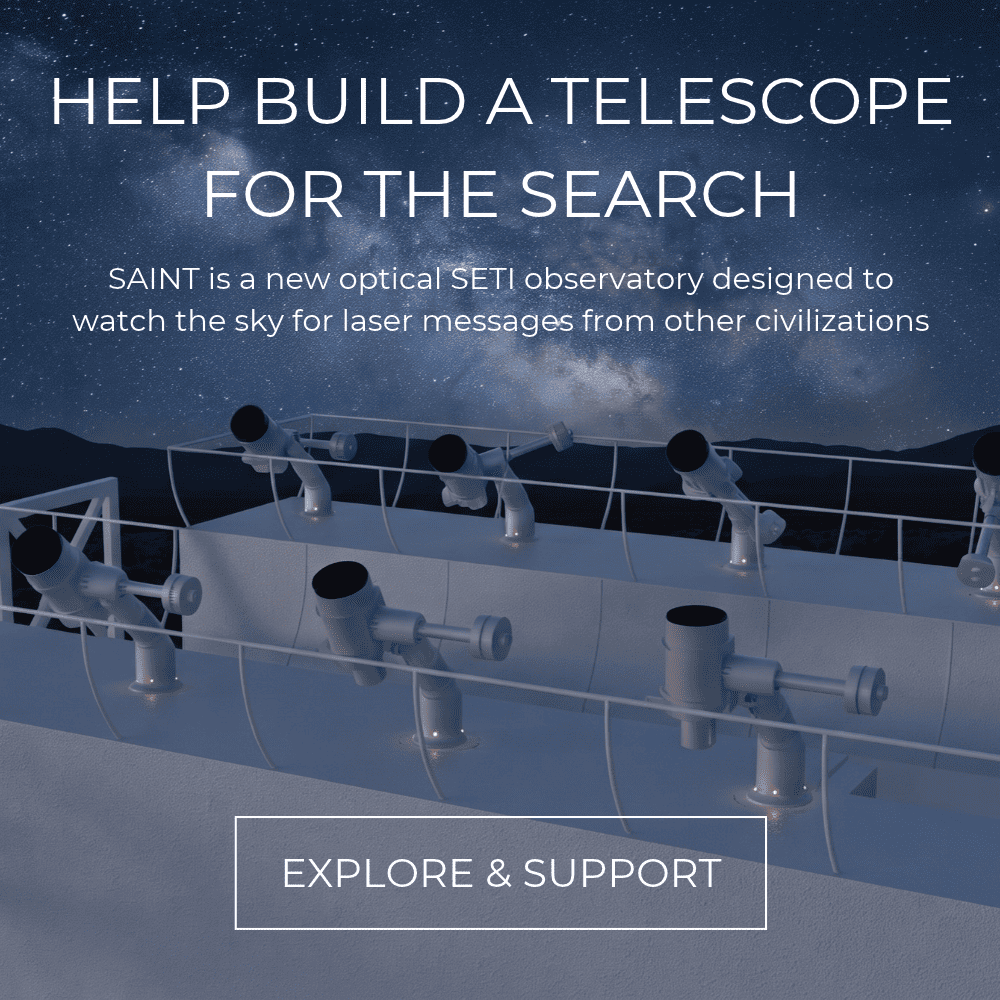
Every method above looks for life of any kind, including pond scum that never builds anything. A separate branch of the search aims higher and goes straight for intelligence, by looking for the byproducts of technology. Radio telescopes scan for narrow-band signals, transmissions squeezed into a sliver of frequency the way human broadcasts are and the way nature never bothers to be. Optical searches watch for brief, intense laser pulses that could briefly outshine a star. Other researchers ask whether the waste heat of vast machinery, or strange industrial gases that have no business existing naturally, might give a civilization away.
Technosignature methods have a feature the others lack. A single clean detection would settle the question instantly, with none of the slow, arguable accumulation of ambiguous chemistry. You would not need a committee to debate whether a megawatt laser pointed your way is artificial. The trade-off is the assumption baked in. These methods bet on the rare case, a species advanced enough and willing enough to leave a detectable mark, while biosignature methods only bet that life exists at all. Nobody knows which bet the universe will pay out, which is why both branches run side by side. The radio search in particular has been going since 1960, when Frank Drake first pointed a dish at two nearby stars and listened, and it carries the SETI name into the exoplanet era.
Sampling Worlds We Can Reach
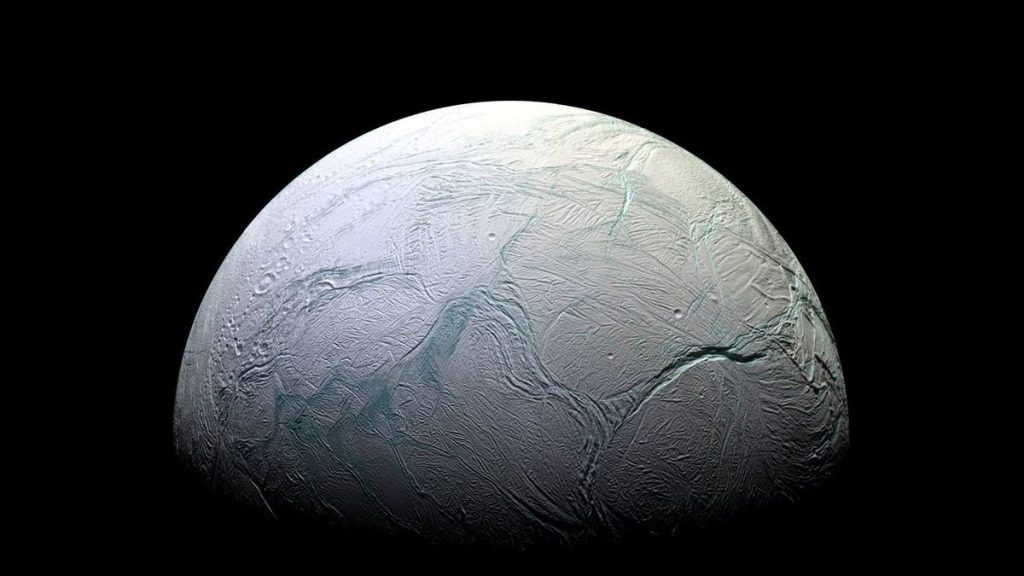
For the planets and moons inside our own Solar System, there is a method available nowhere else: go there and touch the thing. Probes can land, drill, scoop, and run the sample through onboard chemistry. Rovers have been doing exactly this on Mars for years, sniffing the soil and air for organic molecules and signs that the planet was once wet. Future missions are aimed at the icy moons, Europa with its hidden ocean under a crust of ice, and Enceladus, which conveniently sprays plumes of that ocean into space where a passing spacecraft could fly through and taste them.
This in-situ approach is the gold standard, because it removes the guesswork that haunts everything done from a distance. You are not inferring a gas from a faint dip in a spectrum; you are measuring it in a chamber. None of this applies to exoplanets, which sit hopelessly far beyond any probe we could build. But it shapes the entire field anyway. Whatever we learn by examining life, or by confirming its absence, on a world we can actually reach becomes the ground truth that calibrates the remote methods. It tells us what a real biosignature looks like up close, so we know better what faint echo to hunt for on the worlds we will only ever study through a telescope.
Supporting Measurements: Sizing and Weighing a Planet
Before any of the life-hunting methods get their turn, a planet has to be found and characterized, and two techniques do most of that groundwork. The transit method itself, the dimming of a star as a planet crosses it, gives the planet’s size from how much light it blocks. Missions like Kepler and TESS were built to catch exactly these dips across hundreds of thousands of stars at once. The second technique, radial velocity, measures the tiny wobble a planet’s gravity induces in its star, a back-and-forth tug that shifts the starlight slightly toward the blue and then the red. From the size of that wobble you get the planet’s mass.
Neither of these reads chemistry or looks for life directly, so it would be easy to leave them off the list. That would be a mistake. Size and mass together give density, and density separates the dense, rocky candidates worth a closer look from the lightweight gas balls that are not. A biosignature claim means little if you do not even know what kind of planet you are standing on, metaphorically speaking. These measurements set the stage, narrow the targets, and tell the spectroscopists where to point. They are the unglamorous half of the toolkit, and the rest of it would be lost without them.
Why the Methods Work Best Together
The real power shows up when the tools are stacked. Picture how a single promising world moves through the pipeline. It is first spotted by the dimming of a transit, which fixes its size. The wobble it induces in its star is measured next, which fixes its mass, and the two together say it is rocky. Its infrared glow is checked, which puts it in a temperate range where water could survive. Only then, having earned it, does the planet get the expensive treatment, a transmission spectrum read across many transits to inventory its air. Each method checks and constrains the ones before it, and a conclusion propped up by several independent measurements is far sturdier than one balanced on a single number.
This layering is also the field’s main defense against fooling itself. The history of the search is littered with signals that looked exciting until a second line of evidence cut them down, an oxygen that turned out to come from sunlight splitting water rather than from anything alive, a methane with a dull geological source. When an independent method contradicts a tantalizing result, it forces a rethink, and that is healthy. When several methods point the same way at once, confidence grows in a way no one instrument could justify alone. If the detection of life beyond Earth ever happens, it will almost certainly not be a single eureka from a single telescope. It will be a slow convergence, many tools telling the same story until the story becomes impossible to dismiss. That is the standard the methods are built to meet, and it is why the catalog of them keeps growing.
Register on our portal to explore more about exoplanet detection methods, the instruments behind the search, and the science of finding life beyond Earth.