Posted by
 The reason to fly to an asteroid is that the inner Solar System destroyed its own paperwork. Earth melted, differentiated, grew an atmosphere, sprouted a biosphere and has been recycling its crust ever since; almost nothing survives from the four hundred million years when the chemistry that preceded life was being assembled. Small bodies never got hot enough to erase anything. Every NASA asteroid mission is, in effect, an archive retrieval operation.
The results have been more chemically interesting than anyone promised when these missions were being sold.
Learning to land on something that barely has gravity
NEAR Shoemaker went first. Built to orbit 433 Eros and never designed to touch it, the spacecraft was talked down onto the surface in February 2001 anyway, at the end of its mission, and kept transmitting from the ground. Nobody knew whether an asteroid surface was rock, rubble or dust. The answer turned out to vary enormously from object to object, which matters more than it sounds: a solid body and a loosely bound pile of gravel have completely different histories of heating, water and impact.
Stardust took the next step by bringing something home. It flew through the coma of comet Wild 2 in 2004, caught grains in blocks of aerogel, and dropped a capsule into the Utah desert in January 2006. Analysis of that dust later turned up glycine, the simplest amino acid, in cometary material. The debate about contamination ran for years until isotopic work indicated the carbon was not terrestrial.
Bennu, and the sample that justified the decade
OSIRIS-REx is the mission that changed the conversation. Launched in September 2016, it reached the near-Earth asteroid Bennu in December 2018 and spent nearly two years mapping a surface that turned out to be an unwelcoming field of boulders rather than the smooth regolith the plan assumed. The touch-and-go collection at the Nightingale site in October 2020 lasted seconds; the sampling head sank into the surface far deeper than modelled, because Bennu behaves less like rock and more like a loosely packed ball pit.
The capsule landed in Utah on 24 September 2023 carrying roughly 122 grams. Two stuck fasteners then kept the curation team out of the main sampler head for months while they designed new tools to work inside a sealed nitrogen glovebox.
What came out of it: 14 of the 20 protein-forming amino acids, all five nucleobases used by DNA and RNA, ammonia in unusual abundance, and a set of evaporite salts — sodium carbonates, halite, sylvite — that record brines drying out on a much larger parent body long since destroyed. Those salts had never been seen in a meteorite, because they dissolve in humid air. Sealing the sample in space was the whole point.
The spacecraft itself did not stop. Renamed OSIRIS-APEX, it is now heading for Apophis, the asteroid making an unusually close pass by Earth in 2029.
Why handedness is the detail that matters
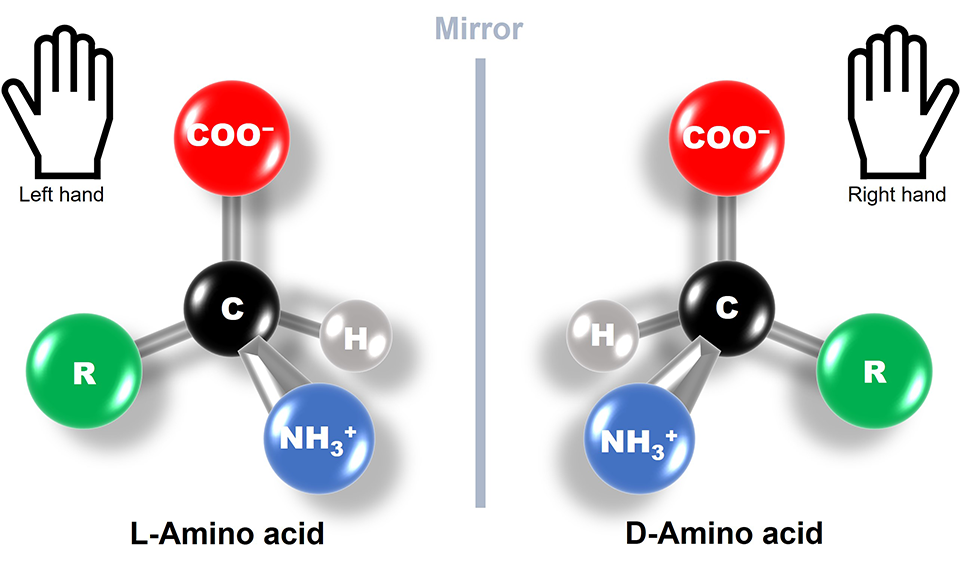
The amino acids in Bennu come in nearly equal left- and right-handed forms. Terrestrial biology uses the left-handed set almost exclusively, so a sample skewed that way would have raised immediate suspicion of contamination. An even split is what non-biological chemistry produces, and it is the strongest indication that these molecules genuinely formed out there.
Japan’s missions provide the independent check that any single result needs. Hayabusa returned grains from the stony asteroid Itokawa in 2010, and Hayabusa2 brought back material from the carbon-rich Ryugu in December 2020, in which researchers identified uracil and vitamin B3 among other organics. Two agencies, two asteroids, two curation chains, converging conclusions.
The missions that are not about chemistry, and why they still count
Not every NASA asteroid mission is hunting for organics. Dawn spent 2011 and 2012 at Vesta and then settled into orbit around Ceres, where it found bright deposits of sodium carbonate in Occator Crater — salts left by briny water reaching the surface — and organic material near Ernutet Crater. Ceres is large enough to have held a subsurface layer of liquid, which puts it in a different category from a rubble pile.
Lucy launched in 2021 on a twelve-year tour of the Jupiter Trojans, the swarms of bodies trapped ahead of and behind the giant planet, which formed farther from the Sun and preserve colder, more volatile-rich material. On the way it flew past a small main-belt asteroid, Dinkinesh, and discovered it has a contact-binary moon nobody expected — a reminder of how little is known about objects that size.
Psyche, launched in 2023, is heading for a metal-rich body that may be the exposed core of a shattered planetesimal. DART deliberately crashed into Dimorphos in September 2022 to test whether a small impact can shift an asteroid’s orbit. Neither is astrobiology, and both feed into it, because understanding how these bodies form, break up and move is what tells you how much of their material ended up hitting the early Earth.
What a sample buys that a flyby cannot
Spacecraft instruments are compromises. Everything has to survive launch, run on a power budget measured in tens of watts, and fit inside a mass allowance that engineers guard fiercely. A mass spectrometer flown to an asteroid is a fraction as capable as one bolted to a laboratory bench, and it cannot be recalibrated when a result looks strange.
A returned sample removes all of those constraints at once. It can be handed to competing laboratories on three continents, examined with techniques that had not been invented when the spacecraft launched, and re-examined when somebody disputes the first answer. For a claim as consequential as the chemistry that preceded life, that adversarial process is the only thing that makes a result stick.
Delivery is the actual hypothesis
None of this suggests anything lived on an asteroid. The claim being tested is narrower: that carbon-rich bodies were arriving at the young Earth in enormous numbers, and that they carried water bound into clay minerals along with a substantial organic inventory.
Hydrogen isotope ratios are the tool for testing the water half. Comparing the deuterium content of asteroid material with Earth’s oceans constrains how much of our water came from which population of small bodies, and carbonaceous asteroids currently look like a better match than most comets. Sample return gives that comparison a clean anchor instead of relying on meteorites that spent millennia soaking in Antarctic ice.
Rosetta added the cometary side of the picture at 67P, detecting glycine and phosphorus in the coma. Phosphorus is worth flagging: it is comparatively scarce, biology depends on it heavily, and finding it distributed in primitive bodies removes one specific objection.
What is still missing
A parts list is not a mechanism. Amino acids, nucleobases, sugars, ammonia and water-altered minerals tell you the shelves were stocked. They say nothing about how any of it assembled into something with a membrane, a metabolism and a way of copying itself, and that step remains unsolved in laboratories with far better conditions than a drying brine on a doomed planetesimal.
Roughly a quarter of the Bennu material is being held untouched for scientists not yet born, following the precedent of Apollo lunar samples that stayed sealed for fifty years until instruments caught up. That is the quiet argument for sample return over remote sensing: the archive keeps paying out.
SETIworld follows this work as the papers land — the Bennu analyses, the Ryugu comparisons, whatever OSIRIS-APEX finds at Apophis — for anyone who wants the chemistry of origins reported without the leap to conclusions.