Posted by
 About 122 grams of black gravel sits in a nitrogen-filled cabinet in Houston, and it has quietly rearranged part of the origin-of-life argument. That gravel is the NASA asteroid sample brought home by OSIRIS-REx from Bennu, and the reason it matters is not that anything on Bennu was alive. Nothing was. The reason it matters is that a lifeless rock, four and a half billion years old, turns out to be stocked with a startling proportion of the molecular parts that terrestrial biology runs on.
Earth destroyed its own evidence. Plate tectonics, weathering, oceans and four billion years of biology have recycled almost everything from the period we most want to study. Asteroids did not do any of that. Small, cold and geologically dead, they hold onto chemistry from before there were planets to speak of.
Why the sample was worth eight years of trouble
OSIRIS-REx launched in September 2016, spent two years cruising to Bennu, then two more mapping a body barely half a kilometer across whose surface turned out to be a boulder field rather than the smooth beach the mission had planned for. The touch-and-go collection at a site called Nightingale in October 2020 lasted a few seconds; the spacecraft’s sampling head sank into the surface far deeper than expected, and the asteroid behaved more like a loose ball pit than solid ground.
The capsule came down on the Utah Test and Training Range on 24 September 2023. Then the curation team spent months unable to open the sampler head because two of thirty-five fasteners refused to move, and they had to design new tools inside a sealed glovebox to get at the rest of the material.
All of that tedium buys one thing: provenance. Meteorites arrive contaminated, weathered and anonymous — you rarely know which body they came from or what they picked up sitting in Antarctic ice for millennia. NASA asteroid samples collected in space and sealed under nitrogen come with a known parent, a known collection date and a documented list of every material the spacecraft was built from, so contamination can be subtracted rather than guessed at.
Fourteen amino acids and all five bases
The analyses published in early 2025 reported 14 of the 20 amino acids that terrestrial organisms use to build proteins, plus all five nucleobases of DNA and RNA: adenine, guanine, cytosine, thymine and uracil. Ammonia showed up in quantities far above what is typical in Earth rocks, which matters because ammonia feeds the reactions that build amino acids in the first place.
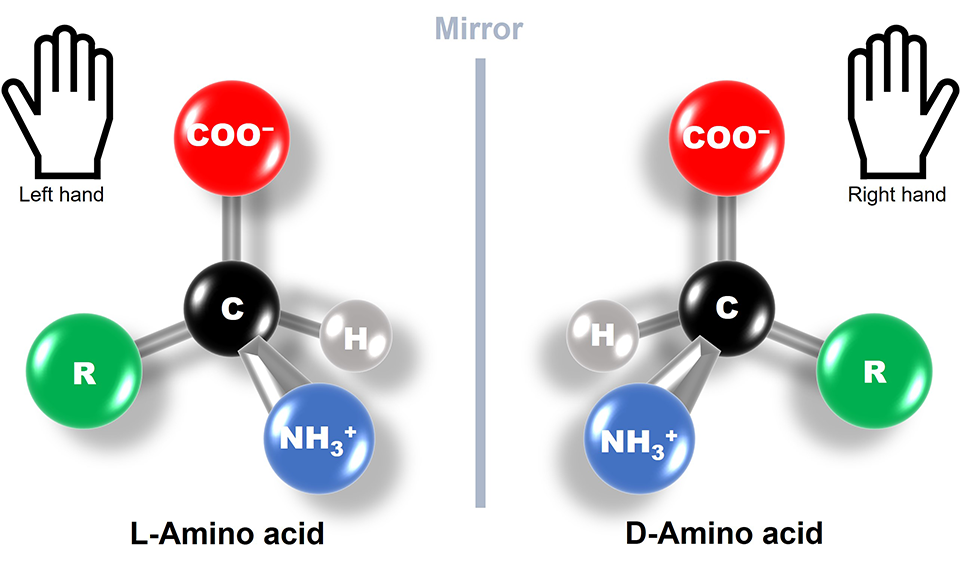
Then comes the detail that keeps this honest. The amino acids in Bennu are essentially racemic — left-handed and right-handed forms in roughly equal amounts. Life on Earth uses the left-handed set almost exclusively, and that asymmetry is one of the deep unexplained facts of biochemistry. A sample dominated by one handedness would have been suspicious, either as contamination or as something extraordinary. An even mixture is exactly what abiotic chemistry produces, and it is the strongest available argument that these molecules are genuinely Bennu’s rather than ours.
Organic does not mean biological. It never has.
Salt flats on a vanished world
The mineralogy may be the more surprising half of the story. Researchers found a suite of evaporite minerals in the Bennu dust — sodium carbonates including trona, along with halite, sylvite and several others — assembled in a sequence that records brine drying out step by step. That combination had never been seen in a meteorite, largely because those salts dissolve on contact with humid air, which is precisely why a sealed return capsule was worth the effort.
Bennu itself is a rubble pile too small to hold liquid water. Its parent body was not. Somewhere in the early Solar System, a larger object accreted ice, warmed enough to melt it through radioactive decay, and hosted pockets of salty water that circulated through rock, dissolved minerals, concentrated as they evaporated and left these deposits behind. Concentration is chemically interesting on its own: dilute solutions react sluggishly, while a drying brine forces molecules together.
The parent body was eventually smashed apart, and Bennu is one of the fragments.
Delivery, not creation
Nobody is claiming asteroids made life. The claim is narrower and more testable: bodies like Bennu were arriving at the young Earth constantly, and if their chemistry resembled what came home in that capsule, they were dropping amino acids, nucleobases, ammonia and water-altered minerals onto a planet that was still assembling its first oceans.
The Murchison meteorite, which fell in Australia in 1969, hinted at all this decades ago — dozens of amino acids were identified in it, many with no terrestrial counterpart. The objection was always contamination. JAXA’s Hayabusa2 undercut that objection when it returned material from asteroid Ryugu in December 2020 and researchers found uracil in it. The Bennu results extend the same picture with a cleaner sample and a longer molecular list.
Water fits into the story here too. Comparing hydrogen isotope ratios in carbonaceous asteroid material against Earth’s oceans is one of the main tools for working out where our water came from, and hydrated minerals in NASA asteroid samples give that comparison a much better anchor than meteorites alone.
What the sample cannot tell us
The gap between ingredients and organisms is enormous and largely unbridged. A cell requires a boundary, a metabolism, a way to store information and a mechanism to copy it with enough fidelity for selection to act. Bennu supplies none of that. It supplies a parts inventory, which changes the shape of the question: the mystery is no longer where the molecules came from, but which environments let them assemble into systems that maintain and reproduce themselves.
Some of the returned material will not be analyzed at all. Roughly a quarter of the Bennu sample is being held in reserve for scientists who have not been born yet, using instruments nobody has designed. That is a deliberate feature of sample return, and it descends directly from the Apollo lunar samples, portions of which stayed sealed for fifty years until analytical chemistry caught up with them.
What this means for other stars
Telescopes see protoplanetary disks around young stars laced with carbon-bearing molecules and water ice. If planetesimals form in those disks the way they formed here, then icy bodies elsewhere are probably running the same aqueous chemistry inside themselves and delivering the products to whatever rocky planets end up in the warm zone. The ingredients may be close to universal.
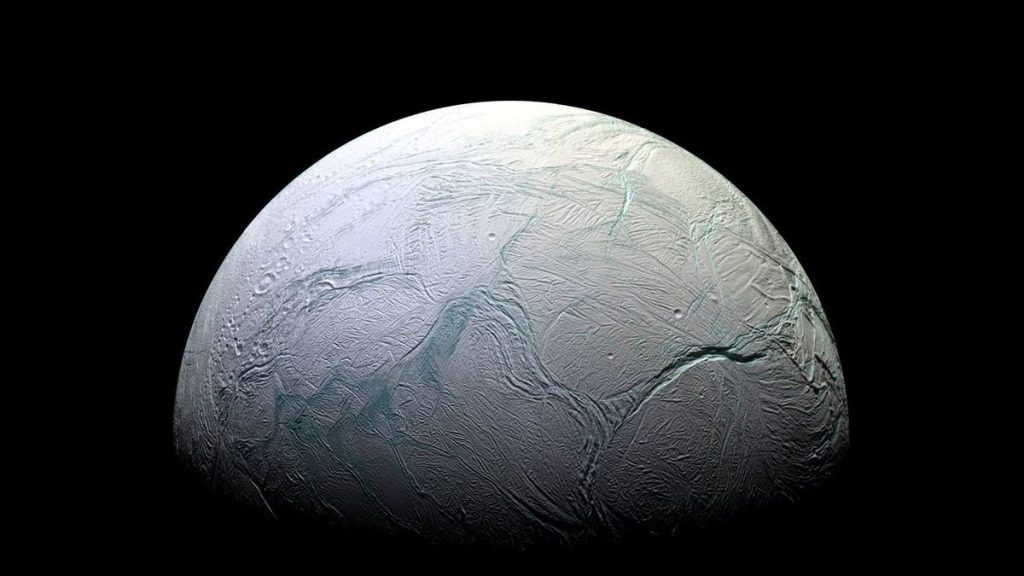
Whether the next step is also common is completely unknown, and pretending otherwise would be dishonest. One planet with biology is not a statistic. It is why the argument has to be settled by finding a second example, whether that turns out to be a biosignature in an exoplanet atmosphere, something under the ice of Enceladus, or a fossil in a Martian core waiting for a return mission.
SETIworld follows this work as it develops — the Bennu papers, the Ryugu comparisons, the Mars sample debate and the exoplanet spectra that keep arriving. If the chemistry that preceded biology interests you more than the tidy version told after the fact, that is a good place to keep reading.