Posted by
 Almost every diagram of our solar system tells a small lie. The planets sit in a tidy row, evenly spaced, all more or less comparable in size, with the Sun parked politely at one edge of the page. Shrink the Sun to the size of a grapefruit and the truth comes back: Earth becomes a grain of sand about eleven meters away, Neptune is three hundred meters down the street, and everything in between is empty. The real system is a furnace surrounded by an enormous amount of nothing, with a few interesting specks in it.
Those specks are where the science lives. We have spent sixty years flying machines at them, and the picture that came back is stranger and less orderly than the textbook version.
The Sun Is Basically the Whole Thing
Start with mass, because mass is what decides who is in charge. The Sun holds about 99.8 percent of everything in the system. Eight planets, several hundred moons, every asteroid, every comet, all the dust between them — they split the remaining fraction of a percent, and Jupiter takes roughly two-thirds of that leftover. In any honest accounting, our solar system is one star plus debris.
Inside the core, hydrogen fuses into helium at a rate of something like 600 million tons a second, and a few million tons of that mass simply becomes energy. The energy does not escape quickly. A photon born in the core ricochets through the overlying plasma for tens of thousands of years before it reaches the surface and leaves in eight minutes. The sunlight on your hands right now started its journey before anyone had domesticated a goat.
The Sun also blows. A steady wind of charged particles streams outward and carves a bubble in the surrounding interstellar medium, and that bubble is arguably the true boundary of the system. Voyager 1 crossed it in 2012, Voyager 2 in 2018, and both are still transmitting from beyond it on power supplies that will not last the decade.
Where the Disk Drew a Line
Everything formed about 4.6 billion years ago from a collapsing cloud that flattened into a spinning disk. The important detail is temperature. Close to the young Sun it was hot enough that water, methane and ammonia stayed as vapor, so only rock and metal could condense — which is why Mercury, Venus, Earth and Mars are small, dense and dry by comparison. Farther out, past what astronomers call the frost line, ice condensed into solid grains and there was suddenly far more building material available.
The cores out there grew fast enough to grab hydrogen and helium straight from the disk before it dispersed, which took only a few million years. Jupiter and Saturn won that race and became gas giants. Uranus and Neptune arrived late or grew slower, ended up with far more water, methane and ammonia in their interiors than gas, and are classed separately as ice giants.
Juno has been in orbit at Jupiter since 2016, and one of its more awkward findings is that Jupiter’s core may not be a core in the way anyone drew it — the heavy elements appear smeared out through a diffuse region rather than concentrated in a neat ball. Planet formation models have been arguing about it ever since.
Uranus and Neptune, meanwhile, have each been visited exactly once, by Voyager 2 in 1986 and 1989. Everything we know about the interiors of the two ice giants rests on a pair of flybys conducted by a spacecraft designed before the personal computer.
The Belt That Hollywood Got Wrong
Between Mars and Jupiter there is a ring of rock and metal that films have taught everyone to imagine as a shooting gallery. It is not. Add up every object in the main belt and you get something like four percent of the mass of the Moon, with Ceres alone accounting for about a third of it. The typical gap between one belt object and its nearest neighbor runs to hundreds of thousands of kilometers. Spacecraft cross it routinely without anyone at mission control breaking a sweat.
What makes the belt valuable is that it never finished. Jupiter’s gravity stirred the region too violently for the material to assemble into a planet, so those bodies preserve chemistry from the system’s first few million years. Dawn orbited Vesta in 2011 and Ceres in 2015 and found bright deposits on Ceres that turned out to be salts left by briny water reaching the surface.
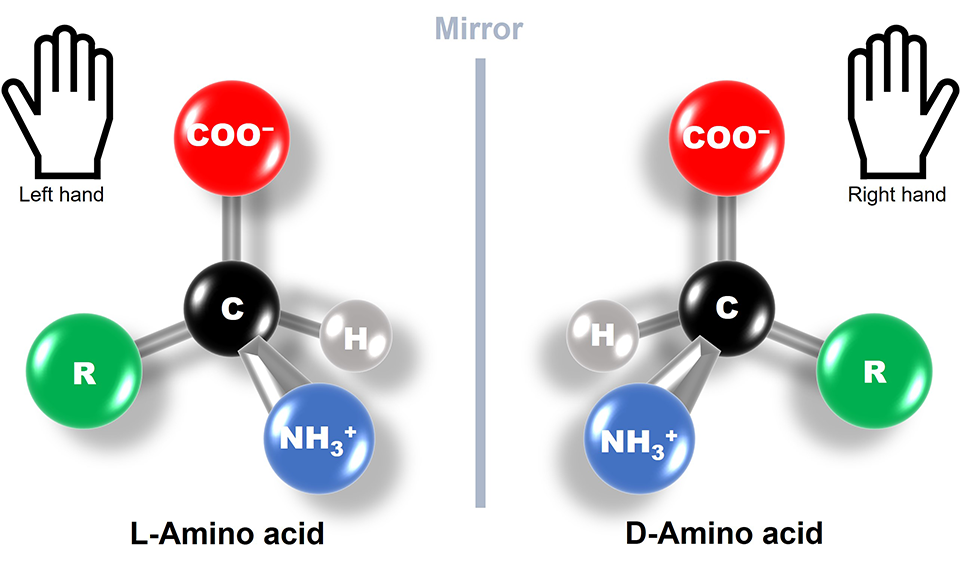
Then there is the sample. OSIRIS-REx dropped a capsule of asteroid Bennu into the Utah desert in September 2023 — around 120 grams of unheated, unweathered carbon-rich rock. Laboratory teams have since reported amino acids and nucleobases in it. That is not life, and nobody serious has claimed it is. It is the raw chemical alphabet, sitting on a rock that has been drifting since before Earth had a surface.
The Ocean Worlds Changed the Question
For most of the twentieth century, the search for life in the solar system meant Mars. Then the outer moons happened.
Europa, slightly smaller than our Moon, appears to hold a salty ocean beneath fifteen to twenty-five kilometers of ice — plausibly more liquid water than every ocean on Earth combined. It stays liquid because Jupiter’s gravity kneads the moon on every orbit and the friction makes heat. No sunlight required. Europa Clipper launched in October 2024 and arrives in 2030 for dozens of close passes.
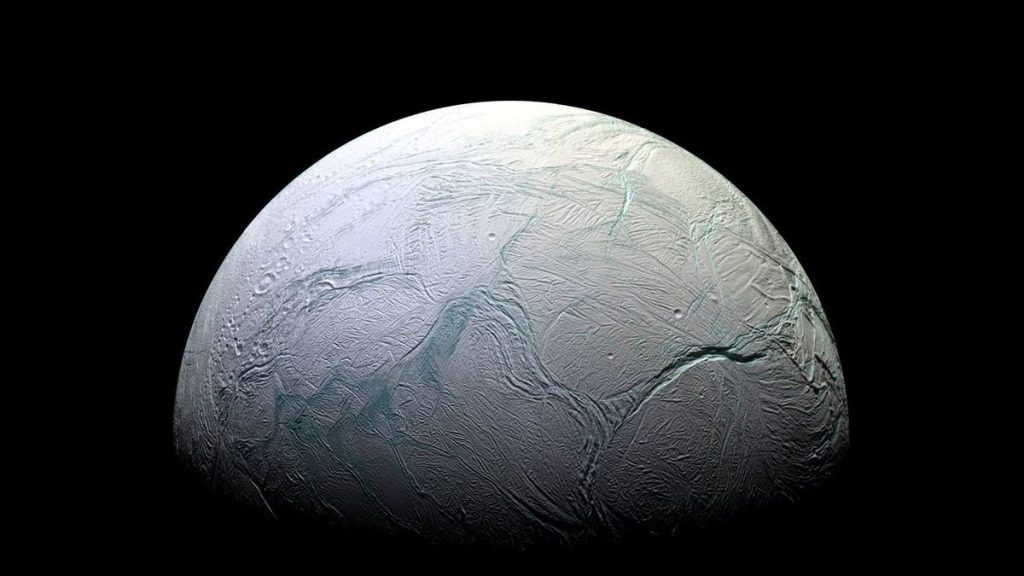
Enceladus is smaller still, barely 500 kilometers across, and it is spraying its ocean into space through fractures near the south pole. Cassini flew straight through those plumes in 2015, dipping to within fifty kilometers of the surface, and detected molecular hydrogen — the signature you would expect from hot water reacting with rock on a seafloor. Later analysis of the same data turned up phosphates. Every ingredient chemists list as necessary for life as we know it has now been measured coming out of a moon you could drive across in a week.
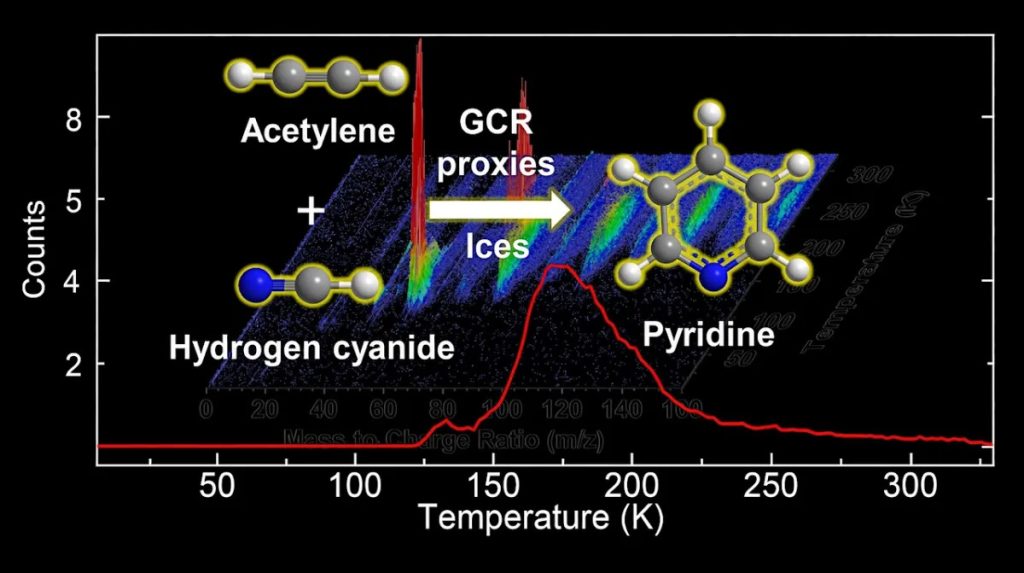
Titan is the odd one. It has a thicker atmosphere than Earth does, mostly nitrogen, and a surface where methane and ethane pool into lakes and seas like Kraken Mare. Huygens landed there on January 14, 2005 and returned the only pictures ever taken from the ground in the outer solar system. NASA’s Dragonfly, a nuclear-powered rotorcraft, is meant to fly between sites on Titan in the 2030s.
None of this is evidence of life. It is evidence of habitability, which is a much weaker claim and a much harder one to argue with.
Past Neptune the Map Goes Soft
Beyond Neptune sits the Kuiper Belt, a broad population of icy leftovers. New Horizons reached Pluto on July 14, 2015 and found nitrogen glaciers flowing across a basin the size of Texas and mountains made of water ice, on a world that everyone had quietly expected to be a dead cratered rock. Three and a half years later the same spacecraft passed Arrokoth, a lumpy object built from two pieces that appear to have merged at walking pace — direct physical evidence for how gently the first planetary building blocks came together.
Farther out, the evidence thins to inference. The Oort Cloud has never been imaged, and there is no realistic prospect of imaging it. Astronomers know it is there because long-period comets keep arriving from every direction on orbits that trace back to somewhere between roughly 2,000 and 100,000 astronomical units. At that distance the Sun is not a disk in the sky. It is the brightest star, and nothing more.
We Might Be the Weird Ones
The first planet found around a normal star elsewhere was 51 Pegasi b, announced in 1995 by Michel Mayor and Didier Queloz. It had roughly half Jupiter’s mass and completed an orbit in a little over four days. Nothing in solar system theory allowed for that, and the theory had to move.
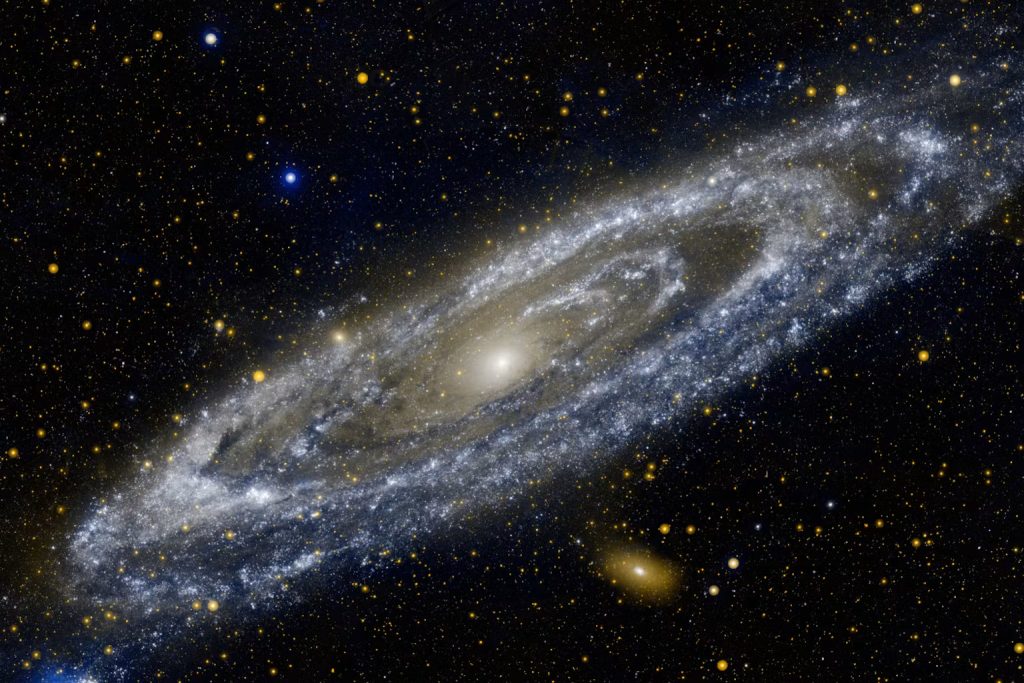
Thousands of confirmed planets later, the most common type in the galaxy appears to be something between Earth and Neptune in size — super-Earths and mini-Neptunes. Our solar system contains not one. There is a conspicuous gap in our lineup exactly where nature apparently likes to build. TRAPPIST-1, with seven roughly Earth-sized planets announced in 2017, packs the entire system inside an orbit smaller than Mercury’s. Proxima b, found in 2016, orbits the nearest star to the Sun in eleven days. K2-18b has spent years at the center of an argument over whether JWST really detected dimethyl sulfide there; the honest summary is that the signal is contested and unresolved.
Whether our arrangement — small rocky worlds inside, giants outside, orbits nearly circular, everything comfortably spaced — is unusual or merely unusually easy to overlook is not settled either. Detection methods favor big planets on short orbits, so a system like ours is exactly the kind that surveys are worst at finding. Nobody knows yet how rare we are.
That uncertainty is why the neighborhood matters. It is the only planetary system where we can land on the surface, drill the rock, taste the plume and carry samples home, and every model applied to a planet a thousand light years away is calibrated against what we learn here first. If you want to follow that work as it happens — the ocean-moon missions, the sample returns, the exoplanet results that keep rearranging the picture — SETIworld is a good place to stand and watch, and an even better one if you join the conversation rather than just reading it.