Posted by
 Most planetary science news arrives sounding like a verdict — a world declared promising, a moon called a good bet for life, a planet ruled out. The actual work behind those headlines is slower and considerably more sceptical. It involves geologists arguing about mineral assemblages, atmospheric modellers running the same planet a thousand times with slightly different starting conditions, and instrument teams trying to work out whether their own hardware is lying to them.
Habitability is not a property you measure. It is an inference built from surface geology, interior structure, atmospheric chemistry, orbital dynamics, stellar behaviour and roughly four billion years of history you have to reconstruct from what survived.
A Field Stitched Together From Other Fields
Nobody sets out to become a planetary scientist in the way one sets out to become a chemist. People arrive from geology, atmospheric physics, astronomy, isotope chemistry, orbital mechanics. A single paper on whether a Martian crater once held a lake might need someone who reads sedimentary bedding, someone who models groundwater, and someone who knows how the crater counting statistics translate into an age.
That mongrel structure is exactly what astrobiology needs. Size and orbital distance are cheap to measure and tell you almost nothing on their own. Venus and Earth are near twins by mass and radius. One of them has oceans.
Mars as a Time Machine
The reason Mars dominates so much planetary science news is that it preserves its own past better than Earth does. Plate tectonics has recycled almost all of our planet’s first billion years of surface rock. Mars stopped resurfacing itself early, so terrain that was already ancient when life on Earth was getting started is still sitting there, exposed, waiting for a camera.
Curiosity’s mudstones in Gale Crater came from a lake bed. Clay minerals across Mars require prolonged contact between rock and water. Jezero Crater, where Perseverance has been coring since 2021, holds a delta that dumped fine sediment into standing water — the depositional setting that on Earth is most likely to trap and preserve organic material. That is a geological argument, made entirely from rock textures and mineralogy, and it is what places a rover in one crater rather than another.
Radiation is the counterweight. Cosmic rays break down complex organics in the top layers of Martian soil over hundreds of millions of years, which is why the ESA Rosalind Franklin rover was built around a two-metre drill rather than the shallow scoops used before. Depth buys preservation.
The Moons Rewrote the Definition
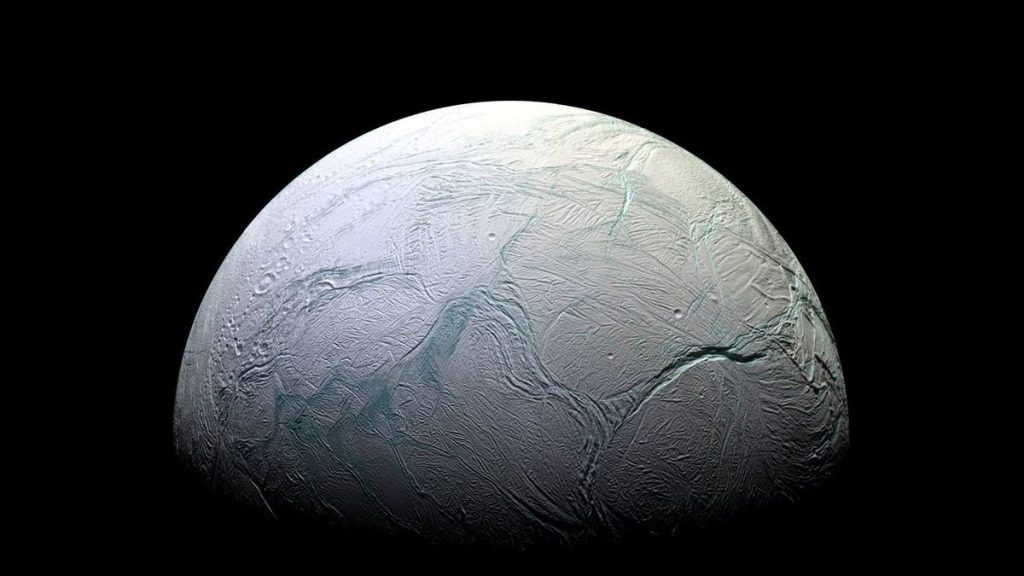
Before Voyager, an icy moon was assumed to be a dead rock with a frozen shell. Then Galileo’s magnetometer detected an induced field at Europa that is hard to explain without a salty ocean under the crust, and Cassini watched Enceladus vent that ocean into space through fractures at its south pole. Tidal flexing, not sunlight, supplies the energy in both cases.
The consequence for the field is structural. Habitable zone calculations assume starlight heats the surface; tidal heating ignores the calculation entirely. Ceres, studied by Dawn between 2015 and 2018, turned out to have brines moving through its interior. Titan runs a full hydrological cycle on methane at minus 180 degrees. Each of these forced planetary scientists to separate two things that used to be treated as one question: is there liquid, and is there an energy gradient something could feed on.
Why Planetary Scientists Model Dead Planets
Here is the part that surprises people. A large fraction of habitability research is spent simulating worlds with no life on them at all.
The logic is straightforward once you see it. If a telescope finds oxygen and methane together in an exoplanet atmosphere, that combination is chemically unstable and on Earth is maintained by biology. To claim it as evidence, you first have to demonstrate that no plausible lifeless planet produces the same signal. Photochemistry can build up oxygen when ultraviolet light splits water and the hydrogen escapes to space. Volcanism releases methane. Serpentinisation — water reacting with olivine-rich rock — produces it too, with no organisms involved.
So the community builds abiotic models deliberately, hunting for false positives before anyone announces a false positive. The phosphine claim at Venus in 2020 and the dimethyl sulphide argument over K2-18b both played out this way, publicly and messily. Neither has been settled to general satisfaction, and that unresolved state is a reasonable picture of how the field actually operates.
The Star Is Half the Story
A planet cannot be assessed apart from what it orbits. Stellar ultraviolet and X-ray output drives atmospheric escape; flares strip gas and destroy ozone; the star’s output changes over billions of years, brightening as it ages.
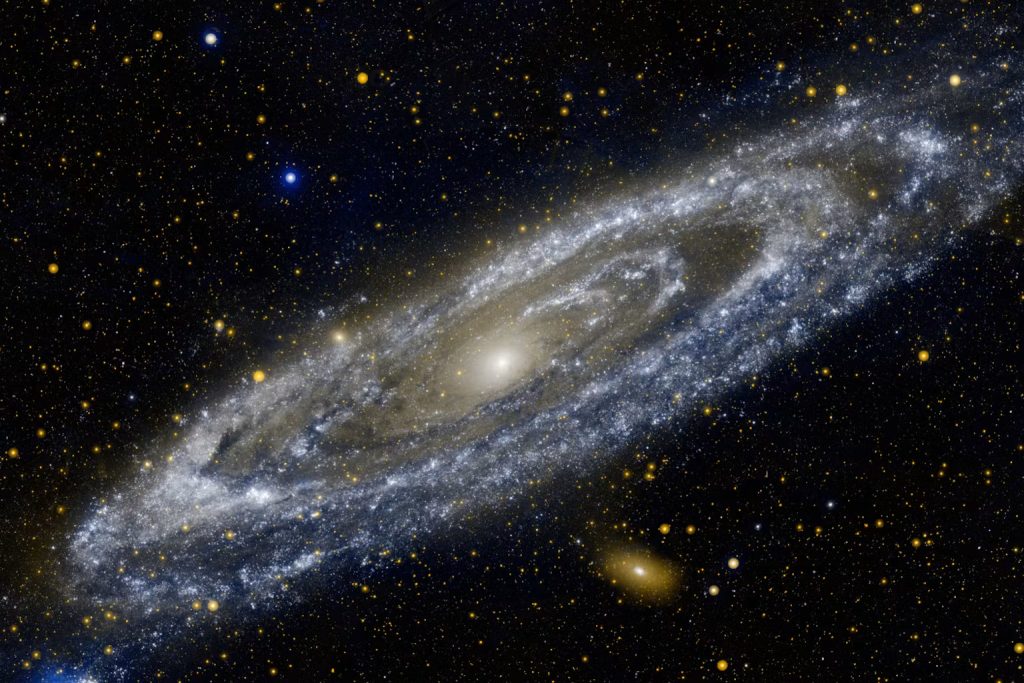
Red dwarfs make this urgent rather than academic. They are the most common stars in the galaxy and their habitable zones sit close in, which is convenient for detection and dangerous for atmospheres. JWST observations of the inner TRAPPIST-1 planets have so far found no evidence of substantial atmospheres, and Proxima Centauri is a documented flare star. If small red stars routinely strip their planets bare, the galactic count of habitable worlds drops by an order of magnitude. If they don’t, it rises. Nobody has enough measurements yet to say.
Where the Water Came From
Habitability gets decided partly during formation, before a planet has a surface worth talking about. Water, carbon and nitrogen have to be delivered to a rocky world forming in a region too warm for ice to condense, and the leading candidates for that delivery are asteroids and comets scattered inward by the migration of giant planets.
This is why sample return matters so much to the field. Hayabusa2 brought Ryugu material home in December 2020; OSIRIS-REx delivered a sample from Bennu in September 2023. Both asteroids are carbonaceous, both contain hydrated minerals and organic compounds, and — critically — both samples were collected and sealed without ever touching Earth’s atmosphere. Laboratory instruments can measure isotope ratios in those grains at a precision no spacecraft payload will ever match, and isotope ratios are how you trace where a planet’s water originated.
Feeding the Target List
There is a practical handoff between this work and the search for intelligence. SETI observations cost telescope time, and telescope time is allocated by pointing somewhere specific. Knowing which nearby systems contain rocky planets, which of those planets plausibly kept an atmosphere, and how old the host stars are gives the technosignature searches a ranked list instead of a random sweep of the sky. Breakthrough Listen has run exactly this way, prioritising nearby stars with known planets.
The next decade should sharpen things considerably. Europa Clipper reaches Jupiter around 2030. ESA’s JUICE is on its way to Ganymede. Ground-based extremely large telescopes are under construction, and the concepts for a direct-imaging observatory capable of studying Earth-sized planets around Sun-like stars are moving from sketch to design.
None of it guarantees an answer. What it guarantees is better questions, asked of specific worlds, with instruments built for the purpose — which is the only way this has ever worked. SETIworld covers that grind as it happens, and the arguments in the planetary science news are usually more interesting than the conclusions.