Posted by
 Sixty years ago the search for alien life had essentially one address: Mars, and a debate about what the seasonal darkening of its surface meant. The list is longer now, and stranger. It includes moons that never see much sunlight, a planet whose surface would melt lead but whose upper clouds sit at room temperature, and rocky worlds around stars so dim you could stare at one from close range without squinting. What follows is a tour of where the money and the telescope time are actually going, and why.
Mars, because the rocks are still there
Mars keeps its place at the top for a boring reason: it is reachable. We can put instruments on the ground, drill a few centimetres, and eventually bring samples home. Nowhere else in the search for alien life offers that.
The case rests on the ancient version of the planet. Curiosity’s mudstones in Gale crater came out of standing water that was neither strongly acidic nor strongly alkaline, and contained the elements terrestrial life is built from. Perseverance has been working the delta in Jezero since 2021, caching cores of sediment in sealed tubes. Whether those tubes ever reach a laboratory depends on a sample return mission that has been redesigned and rescoped more than once.
Current Mars is a different matter. The surface is bathed in ultraviolet light and cosmic rays, the soil holds perchlorates, and liquid water is unstable at that pressure. If anything survives, it is underground, in brine or rock pores, and would need a drill rather than a camera to find.
Europa: an ocean with a lid
Jupiter’s fourth-largest moon has a shell of water ice somewhere between a few and a few tens of kilometres thick, and underneath it, on the best available evidence, a global salty ocean perhaps 60 to 150 kilometres deep. That is more liquid water than every ocean on Earth combined.
The evidence is indirect but strong. Galileo’s magnetometer, orbiting Jupiter from 1995 to 2003, detected a magnetic field induced in Europa by Jupiter’s own — the signature of a conducting layer, most plausibly salty water, close beneath the surface. The tangled reddish cracks across the ice suggest a shell that moves.
Europa Clipper launched in October 2024 and will reach the Jupiter system around 2030, then make dozens of close passes to measure ice thickness, ocean depth and surface chemistry. It is not a life-detection mission and NASA is careful to say so. Europe’s JUICE, launched in April 2023, is heading for Ganymede with a similar remit.
Enceladus, which does the sampling for you
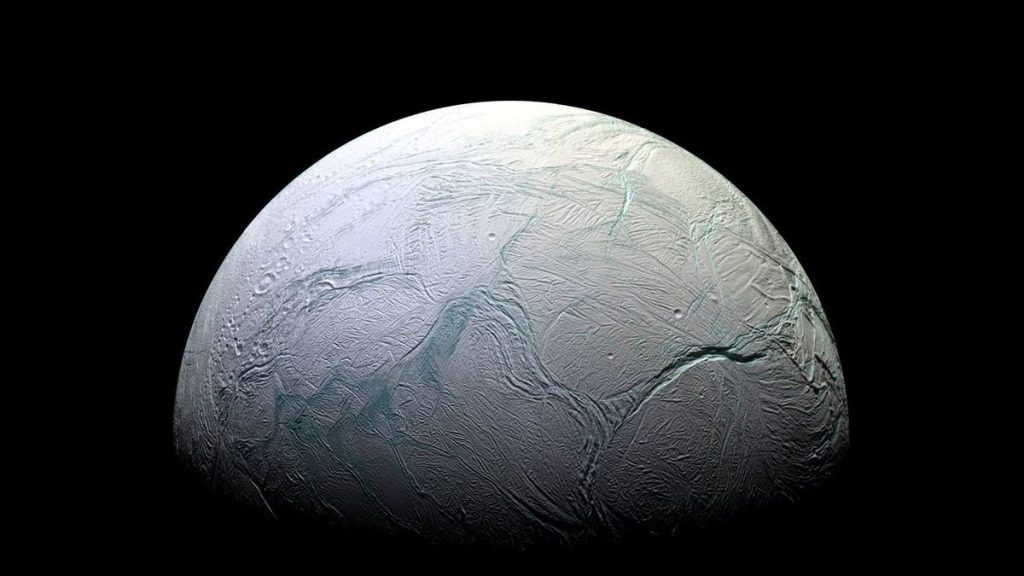
Saturn’s small moon Enceladus is barely 500 kilometres across and should have frozen solid long ago. Instead it vents plumes of water vapour and ice grains from fissures near its south pole, and Cassini flew straight through them.
What came back is the most encouraging chemistry anyone has measured off Earth. The plumes contain water, salts, silica nanograins that imply hot rock in contact with liquid, methane, and molecular hydrogen — a usable energy source for the sort of metabolism that runs at terrestrial hydrothermal vents. In 2023, a team led by Frank Postberg reported phosphates in grains from Saturn’s E-ring, which sourced from Enceladus, filling in one of the last missing elements on the checklist.
An ocean, warmth, organics, energy and phosphorus, all being flung into space where a spacecraft can catch it without landing. No mission is currently on the way, which is the frustrating part.
Titan is not like the others
Titan has a thicker atmosphere than Earth’s, mostly nitrogen, and weather. It also has rivers, lakes and seas — Kraken Mare and Ligeia Mare among them — filled with liquid methane and ethane at about minus 180 degrees Celsius. The Huygens probe landed there in January 2005 and photographed rounded pebbles on what looked like a dry riverbed.
Any biology in that liquid would have to work without water, using solvents and reaction rates nothing on Earth uses. Most researchers rate it a long shot. Titan also probably holds a conventional water ocean deep under its ice, which is the more conservative target.
Dragonfly, a nuclear-powered rotorcraft designed to fly between sites on the surface, is being built for launch later this decade and arrival in the mid-2030s.
The Venus argument
The surface of Venus runs at around 460 degrees Celsius under crushing pressure and is not a candidate for anything. Roughly fifty kilometres up, though, the temperature and pressure are close to conditions at Earth’s surface — inside droplets of concentrated sulfuric acid.
In 2020 Jane Greaves and colleagues reported phosphine in those clouds, a gas with no obvious abiotic source on a rocky planet. The claim has been picked apart, re-reduced, contested and partially defended ever since, and the honest summary is that nobody has settled whether the detection is real, let alone what it means. Missions including DAVINCI and EnVision are meant to go and look, on schedules that keep slipping.
Out past the Solar System
Everything above involves places we can visit. The rest of the search for alien life is done at a distance, on the thousands of confirmed exoplanets found since Michel Mayor and Didier Queloz reported 51 Pegasi b in 1995.
TRAPPIST-1 is the showcase system: seven roughly Earth-sized planets around a cool red dwarf about forty light-years away, announced in 2017, with three or four of them in the range where liquid water is conceivable. JWST has been working through them, and the early results are sobering — the innermost planets appear to have thin atmospheres or none at all, which fits the concern that red dwarfs strip their close-in planets with flares and ultraviolet radiation over billions of years.
Proxima b, found in 2016 around the nearest star to the Sun, has the same problem plus a host known for violent flaring.
K2-18b is where the argument currently runs hottest. It is a sub-Neptune roughly eight times Earth’s mass, and observations of its atmosphere have been read by one team as containing dimethyl sulfide, a molecule produced on Earth almost entirely by marine microbes. Other groups have re-analysed the same data and found the signal weak, and there is separate work on how the molecule might form without any biology at all. The dispute is doing exactly what it should.
The list also keeps growing at the edges. Dawn found bright deposits of sodium carbonate in Occator crater on Ceres, left behind by briny liquid reaching the surface of a dwarf planet nobody had considered wet. New Horizons data has been read as consistent with a residual ocean under Pluto’s ice. Neptune’s moon Triton erupts. None of these are strong candidates, and all of them were absent from the list a generation ago, which is a reasonable argument against being too confident about the shape of the current one.
Ranking them, with a caveat
If the question is where evidence is most likely to be found soonest, Mars wins on access and Enceladus wins on chemistry. Europa wins on sheer volume of habitable space. Exoplanets win on numbers, and lose on everything else, since a spectrum of a planet forty light-years away will always be arguable.
One habit worth keeping: every candidate signal so far has had a non-biological explanation available, and in most cases that explanation has won. A detection that survives five years of people trying to kill it would be the real event. SETIworld tracks these targets and the missions heading for them, including the results that quietly fall apart after the headlines.