Posted by
 Which instrument will settle the search for alien life is, right now, an argument rather than an answer. The honest position is that several very different machines are converging on the question from opposite directions, and nobody knows which one gets there first — a rover caching rock tubes on Mars, a spacecraft threading between Jupiter’s radiation belts, a rotorcraft that has not launched yet, or a telescope parked a million and a half kilometres from Earth reading the light of a planet nobody will ever visit.
What they share is that almost none of them is a life-detection mission. That word gets used loosely in press coverage and almost never by the teams themselves.
Webb reads atmospheres, with caveats
JWST reached its orbit around the second Lagrange point in January 2022 and started delivering exoplanet spectra within months. A 6.5-metre segmented mirror operating in the infrared, cold enough that its own heat does not swamp the signal, it can pick out carbon dioxide, water vapour, methane and sulphur dioxide in the atmospheres of transiting planets.
It also demonstrated how contested this work gets. The dimethyl sulfide claims for K2-18b, a sub-Neptune roughly 120 light-years away, generated headlines twice and pushback both times, with independent groups showing that different assumptions in the atmospheric retrieval can shrink the feature substantially. Webb’s measurements of TRAPPIST-1b, meanwhile, point toward a bare rock with little or no atmosphere at all.
Neither result is a failure. They are the first real tests of whether small planets around small stars keep their air, which the search for alien life needs to know before anyone spends a decade staring at one.
TESS finds the haystack
Characterization needs targets, and TESS has been supplying them since 2018 by monitoring bright nearby stars across nearly the whole sky for transit dips. Its planets are not usually interesting in themselves; they are interesting because they orbit stars close enough and bright enough for a bigger telescope to follow up.
The division of labour is the point. One mission surveys, another measures mass through radial velocity, a third takes the spectrum. No single instrument does all three well.
Mars, and the samples nobody has collected yet
Perseverance landed in Jezero Crater in February 2021, on the floor of a lake bed fed by an ancient river delta — precisely the kind of fine-grained sediment that preserves organic material and microbial textures on Earth. Its instruments have found organics and, in a rock named Cheyava Falls, millimetre-scale features containing iron phosphate and iron sulphide arranged in patterns that microbes commonly produce and that chemistry can also produce unaided.
That ambiguity is the entire argument for Mars Sample Return. A rover carries a few kilograms of instruments; a terrestrial laboratory has mass spectrometers the size of rooms, and can hand the same material to competing groups who would enjoy proving each other wrong. Roughly thirty sealed tubes are sitting on Mars waiting for a ride whose cost and schedule have been repeatedly reworked. If the first credible evidence of past life comes from Mars, it will almost certainly come out of a laboratory in Houston or Europe rather than off a rover’s instrument deck.
Ocean worlds are the other route
Europa Clipper launched on 14 October 2024 and arrives at Jupiter in April 2030, after which it will make dozens of close passes over the moon while looping through the system to limit its radiation dose. It will map the ice shell, measure the ocean’s depth and salinity through magnetic induction, sample whatever dust and gas hangs above the surface, and photograph the terrain in detail.
It will not detect organisms. NASA has been explicit that the mission is about habitability, and the reason is partly legal and partly practical: sterilizing a spacecraft to the standard required for a direct life-detection experiment at Europa is expensive and constraining.
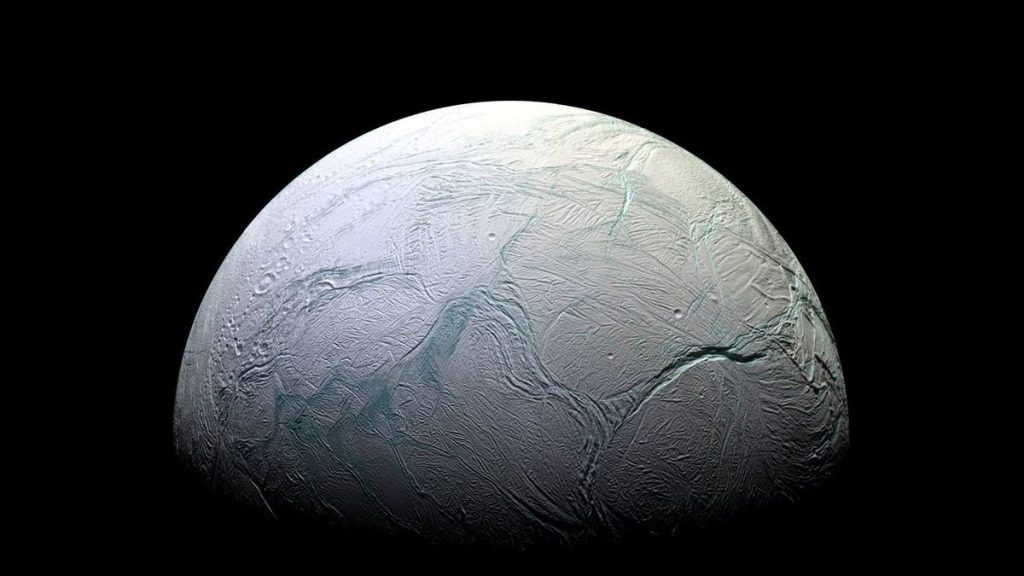
Enceladus may be the better bet, and it has no dedicated mission. Cassini already flew through its plumes and found salts, organics, hydrogen and phosphates using instruments designed years before anyone knew the plumes existed. A spacecraft built specifically to sample that spray, with modern mass spectrometry and a slow enough approach speed not to shatter the molecules on impact, is the most direct search for alien life that current technology could actually mount. Concepts exist, including an orbiter-lander study that planetary scientists have ranked highly in their long-range priorities. Funding does not.
Europe has its own stake in the Jupiter system. JUICE launched in April 2023 and will settle into orbit around Ganymede in the mid-2030s, the first spacecraft ever to orbit a moon other than our own. Ganymede also appears to hold a buried ocean, sandwiched between ice layers rather than resting on rock, which may make it less promising chemically — though comparing three icy moons in one system is exactly how you learn which conditions matter.
Titan gets a rotorcraft
Dragonfly is the strangest mission in the queue: a nuclear-powered eight-rotor vehicle that will fly between sites on Titan, sampling surface material in a place where the atmosphere is thick, the gravity is low and flying is easier than driving. Launch is scheduled no earlier than July 2028, arrival in the mid-2030s.
Its target is prebiotic chemistry rather than biology. Titan runs organic chemistry continuously in an environment with no liquid water on the surface, which makes it a natural experiment in how far complexity gets under conditions unlike Earth’s. Whatever it finds will inform what counts as a plausible starting point.
The instruments that would settle it are still on paper
Reading an Earth-sized planet around a Sun-like star means separating a source roughly ten billion times fainter than the object next to it. Transit spectroscopy cannot do it for such worlds; direct imaging with extreme starlight suppression can, in principle.
The Nancy Grace Roman Space Telescope carries a coronagraph as a technology demonstration, which is the polite way of saying its job is to prove the hardware works before anyone bets a flagship on it. That flagship is the Habitable Worlds Observatory, a proposed large ultraviolet-to-infrared telescope designed from the start to image temperate rocky planets around nearby stars and take their spectra. Technology development is under way; launch is a 2040s proposition at best.
On the ground, the Extremely Large Telescope in Chile, with a 39-metre primary, should reach first light late this decade and attack the same problem with adaptive optics from beneath the atmosphere. Its collecting area is large enough that high-resolution spectroscopy of nearby rocky planets becomes conceivable, and the Proxima Centauri system is close enough to be an obvious early target.
Running alongside all of it is the technosignature route, which needs no biosignature at all. A radio or optical detection could arrive tomorrow from an existing survey, or never. It is genuinely a separate bet, using separate instruments, on a separate question.
None of this guarantees anything. A biosignature detection would launch the same brutal verification process that consumed the phosphine and DMS claims, and it would deserve to. The most likely path to a first result in the search for alien life runs through years of argument after the instrument does its part — which is why following the missions matters more than following the headlines. SETIworld tracks them as they launch, arrive and report back.