Posted by
 The search for extraterrestrial life is the rare scientific project that everyone assumes they understand and almost nobody does. It is not a matter of pointing a dish at the sky and waiting for a voice. It is spectroscopy, statistics, drill cores, rover wheels, interference logs, and long arguments about whether a wiggle in a graph is real. The people who do this for a living are not looking for spaceships. They are looking for chemistry that has no business being in an atmosphere, or a radio tone too narrow for nature to produce.
So far, nothing has been confirmed. Hold on to that word, because everything else in this field is built around it.
One Example, Then Thousands
Until 1995, the only planetary system anyone could actually study was the one we live in. Then Michel Mayor and Didier Queloz announced a planet orbiting 51 Pegasi, and it made no sense at all: a gas giant whipping around its star every four days. Nobody had predicted that. Theorists had assumed other systems would look like ours, with the big planets kept safely far out. The very first one found broke the pattern.
Kepler changed the scale of the problem. Launched in 2009, it stared at a single patch of sky toward Cygnus and Lyra for four years, watching roughly 150,000 stars at once and waiting for dips of a few hundredths of a percent as a planet crossed in front of its star. That is a brutally small signal to chase. It worked anyway. Confirmed worlds went from a curiosity to a catalog of thousands, and the assumption flipped: planets are not rare accidents, they are the normal furniture of the galaxy.
A few names carry the story. Kepler-186f, announced in 2014, was the first roughly Earth-sized planet found in the habitable zone of another star, a dim red dwarf. Kepler-452b followed in 2015, orbiting a star more like the Sun. TRAPPIST-1, announced in 2017, holds seven Earth-sized planets packed into a space smaller than Mercury’s orbit, about forty light-years away. And Proxima b, found in 2016 through the tiny wobble it induces, orbits the closest star to the Sun there is.
Then comes the part the headlines skip. A habitable zone is a temperature bracket, nothing more. Liquid water could survive on the surface, assuming the planet has an atmosphere, assuming it is the right kind, and assuming the star has not spent billions of years stripping it away. Red dwarfs flare violently when young. Whether that ruins a world’s chances is unresolved.
Listening, and Why Listening Is So Hard
Frank Drake pointed the Green Bank telescope at Tau Ceti and Epsilon Eridani in 1960 and listened. That was Project Ozma, and it heard nothing. The following year he sketched an equation on a blackboard for a small meeting of colleagues, running from the rate of star formation down to how long a technological civilization lasts. It gets quoted as a prediction. It never was one. It was an agenda, and most of its terms are still unmeasured today.
In August 1977 the Big Ear telescope at Ohio State recorded a narrowband burst near the hydrogen line that lasted 72 seconds, the time the sky took to drift through the beam. Jerry Ehman circled the printout and wrote “Wow!” in the margin. Astronomers have gone back to that patch of Sagittarius many times since. It has never repeated. Whatever it was, a single unrepeated event is a story, not a result.
Project Phoenix ran from 1995 to 2004, working through roughly 800 nearby stars using Parkes, Arecibo and Green Bank. It found nothing, which is what nearly every survey has reported. Breakthrough Listen picked up the thread in 2015 with a hundred million dollars behind it.
Its most famous candidate is instructive. BLC1 surfaced in archived Parkes data taken while the telescope pointed toward Proxima Centauri: a narrowband signal near 982 MHz that drifted in frequency the way something on a moving object should. For a while it was the most interesting thing anyone had. Then the analysis tightened and it fell apart, matching a family of local interference: human hardware leaking into a very sensitive receiver. The team published that conclusion. Publishing the debunk is the job as much as the search is.
Arecibo collapsed in December 2020, taking with it the most sensitive single dish the field had. The work now runs through Green Bank, the Allen Telescope Array at Hat Creek, and systems riding along on the VLA that scan for narrowband signals while the array is busy with other astronomy. The Square Kilometre Array will change what is possible again.
Not Everyone Is Calling
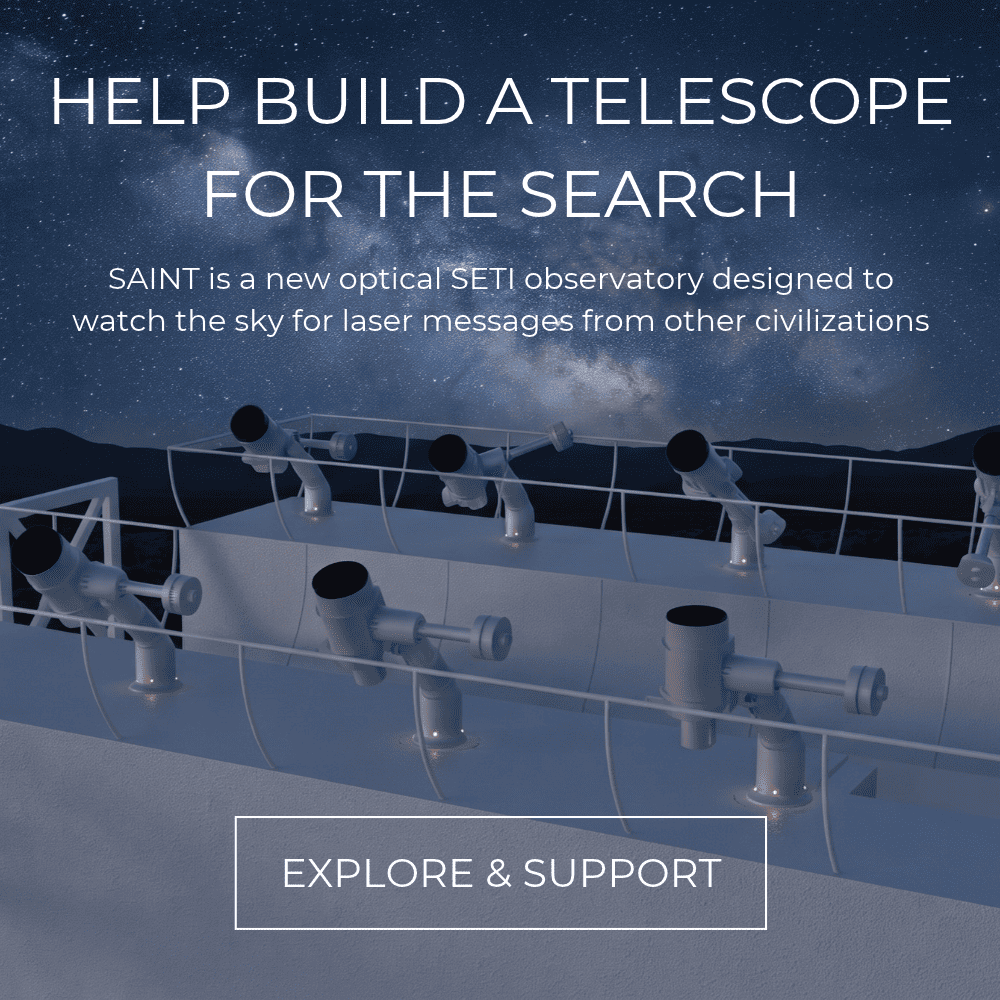
Radio carries an old assumption baked into it: that somebody out there is deliberately transmitting toward us. Technosignature research drops that assumption and asks what technology might do at planetary scale that would be visible from here, whether or not anyone intended it to be. Optical SETI looks for laser pulses lasting nanoseconds, bright enough in that instant to outshine a star. Other proposals go after industrial byproducts such as chlorofluorocarbons, which have no plausible geological source, or the waste heat a civilization would radiate if it were capturing serious amounts of its star’s output. None of it has turned anything up. All of it widens the number of ways an answer could arrive.
Reading the Air of Another World
The other half of the search for extraterrestrial life ignores technology completely and goes after microbes. Most of Earth’s history was microbial. If life is common, this is probably what it looks like.
The main tool is transmission spectroscopy. When a planet passes in front of its star, a sliver of starlight filters through the rim of its atmosphere, and molecules there take bites out of specific wavelengths. What reaches a telescope is a spectrum with gaps in it, and the pattern of gaps names the chemistry. JWST does this well enough to have detected methane and carbon dioxide around K2-18b, a planet larger than Earth orbiting a red dwarf.
K2-18b also produced the loudest atmospheric argument of recent years. A possible signature of dimethyl sulfide appeared in the data, a compound produced on Earth largely by marine plankton, and the coverage ran well ahead of the evidence. Independent reanalyses have found the feature weak, sensitive to how the models are set up, and not clearly distinguishable from other molecules. That dispute is still live, and it is a fair picture of how this science moves.
There is a deeper problem underneath. No single molecule proves biology. Oxygen can accumulate abiotically when ultraviolet light splits water and the hydrogen escapes. Methane comes out of rocks. What would be harder to explain is a combination that should not coexist, gases that react with each other yet both stay abundant, implying something keeps topping them up. Even then the honest answer would be that we had found chemistry we could not explain.
The Ones We Can Reach
Mars is close enough to touch, which changes the standard of evidence entirely. Curiosity has been in Gale Crater since 2012 and has measured methane in the air that rises and falls with the seasons. The ExoMars Trace Gas Orbiter, watching from above with instruments built for exactly this, has not seen it. Two sets of hardware, one planet, no agreement.
Perseverance has been working Jezero Crater since 2021, sealing samples meant to come back to Earth on a mission whose budget and schedule keep shifting. The caution goes back to 1996, when NASA held a press conference about the Martian meteorite ALH 84001 and structures inside it that looked like fossilized microbes. Most researchers eventually concluded the features could form without biology. The field has been careful ever since.
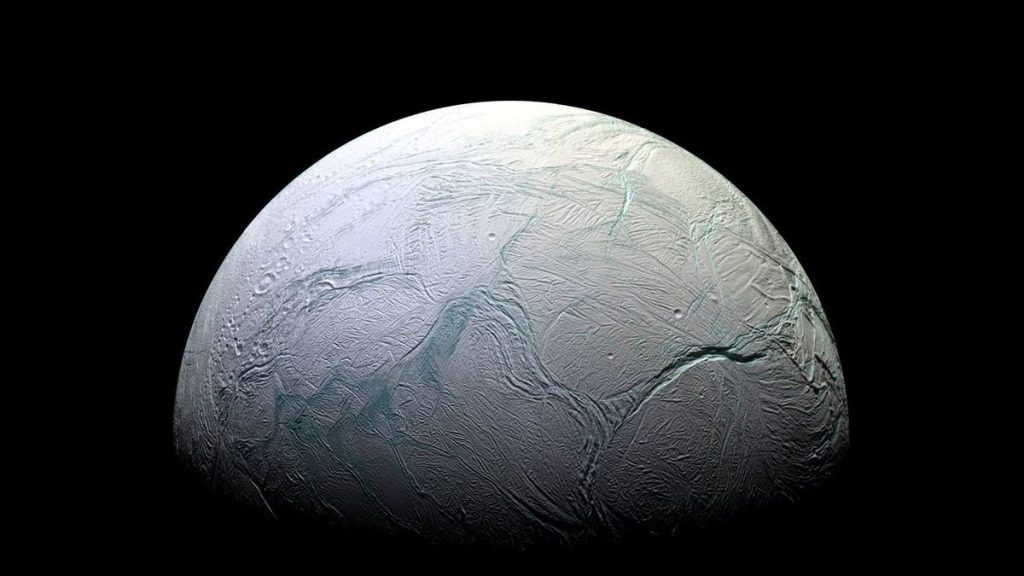
Beyond Mars the interesting real estate is icy. Cassini flew straight through the plumes erupting from Enceladus and sampled them. Europa hides an ocean under its shell, and a dedicated mission is on its way there. Venus got its own controversy in 2020 when a team reported phosphine in the cloud deck, a gas with no obvious non-biological source at that altitude; the detection was challenged almost immediately over the data processing. And OSIRIS-REx delivered a sample of the asteroid Bennu to the Utah desert in September 2023, whose organic chemistry says the raw ingredients are common. Ingredients are not organisms.
What Would Actually Count
Modern observatories produce data at volumes no human can inspect. Machine learning now does the first pass, and a neural network re-analysis of archived Breakthrough Listen observations did pull out signals earlier pipelines had missed. None of them repeated. The software decides nothing. It shortens the queue.
The bar for a real detection is deliberately punishing. Independent instruments. Independent teams. A result that repeats. Interference, contamination, calibration error and every plausible natural explanation ruled out first, in public, by people who would rather prove you wrong. One dot on one graph will never be enough, and it should not be.
None of which means the search for extraterrestrial life is stalled. TESS keeps feeding nearby targets to JWST, the Extremely Large Telescope is going up in Chile, and the range of things we know how to look for is wider than it was a decade ago. The search has quietly turned into a coordinated program instead of a handful of hopeful experiments.
If you want to follow that program as it unfolds, argue about the K2-18b spectra, or just see what the telescopes turned up this month, SETIworld is where that conversation happens. Come read along, and bring your skepticism.