Posted by
 If you ask an astrobiologist “do you think there’s life out there,” most will give you a version of the same answer: probably yes, but we don’t know. The “probably yes” comes from the statistics — the enormous number of potentially habitable environments in the observable universe, and the speed with which life appeared on Earth after conditions became suitable. The “we don’t know” comes from having exactly one data point for the origin of life.
One example tells you that life is possible. It tells you almost nothing about how common it is.
The Scope of the Field
Astrobiology encompasses the origin, evolution, and distribution of life in the universe. In practice, this means research across multiple disciplines simultaneously: organic chemistry, microbiology, planetary science, atmospheric science, geology, stellar astrophysics, and instrument development. A NASA astrobiology team might include a geochemist studying hydrothermal systems, a molecular biologist studying RNA replication, a planetary scientist studying Mars geology, and an instrument engineer designing a spectrograph for life detection. The questions are genuinely interdisciplinary and can’t be answered from within any single field.
NASA formally organized its astrobiology research program in 1998, creating the NASA Astrobiology Institute (now the NASA Astrobiology Program). ESA, JAXA, and other space agencies have parallel programs. There are dedicated peer-reviewed journals, annual conferences, and graduate programs at major research universities specifically in astrobiology. It’s a full scientific field, not a fringe pursuit.
Priority Targets in Our Solar System
Mars is the most studied. Its surface is now inhospitable — thin atmosphere, high UV radiation, perchlorates in the soil that would damage organic molecules. But 3.5–4 billion years ago, Mars had liquid water. River valleys, lake basins, delta deposits. If life started when water was available, chemical traces might persist in subsurface rock that hasn’t been exposed to surface radiation for billions of years. The Perseverance rover is collecting samples from Jezero Crater — a former river delta — for eventual Earth return.
Europa is the second priority. Jupiter’s moon has a global ocean of liquid water beneath an ice shell roughly 10–30 km thick. The ocean is probably 100 km deep — more liquid water than all of Earth’s oceans combined. It’s kept liquid by tidal heating from Jupiter’s gravitational pull. Hydrothermal activity at the ocean floor is plausible, and where you have liquid water, chemical energy from rock-water reactions, and organic molecules, the conditions for life exist. NASA’s Europa Clipper, launched October 2024, will make 49 close flybys of Europa to characterize the ocean, ice shell, and surface chemistry. A lander capable of drilling into the ice would be the next step — currently under study, not yet approved.
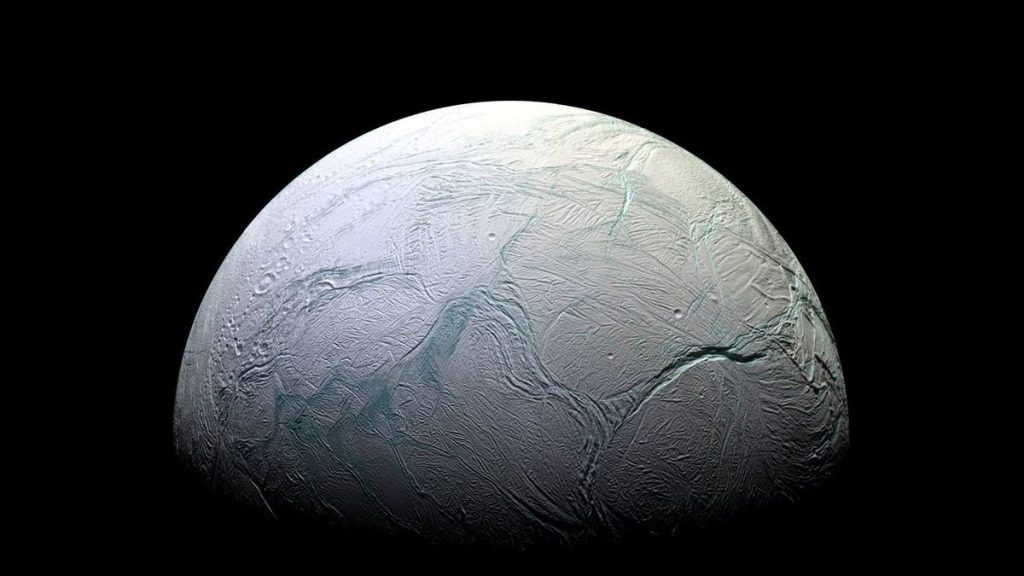
Enceladus, Saturn’s small moon, is the dark horse. Cassini discovered water vapor and ice plumes erupting from the south pole in 2005. Subsequent flybys detected complex organic molecules, silica nanoparticles (indicating hydrothermal activity), and molecular hydrogen — all consistent with active chemistry at a subsurface ocean floor. Cassini flew through the plumes and sampled them directly. A dedicated Enceladus mission with more capable instruments could, in principle, detect biosignatures in the plume material without landing or drilling.
Beyond the Solar System
For targets outside the solar system, astrobiology informs what telescopes should be looking for. The primary remote biosignatures are atmospheric: oxygen coexisting with methane (the biogenic pair), nitrous oxide, methylchloride. These are detectable in principle via transmission spectroscopy during planetary transits — the primary mode of atmospheric characterization for nearby exoplanets.
The James Webb Space Telescope is now characterizing atmospheres of rocky planets in habitable zones — TRAPPIST-1 planets primarily, but also targets like TOI-700d and LHS 1140b. Webb can detect large molecules — CO₂, water vapor, methane — but not, at its current precision, the specific combination that would constitute a robust biosignature. The signal-to-noise requirements for biosignature detection in a rocky habitable-zone planet are beyond what Webb can achieve in a reasonable observing time. The next generation of instruments — both ground-based (ELT) and space-based (Habitable Worlds Observatory) — are being designed specifically for this.
The Problem of Life’s Definition
Astrobiology struggles with a definitional problem: we don’t have a widely agreed-upon scientific definition of life. NASA’s working definition — “a self-sustaining chemical system capable of Darwinian evolution” — is useful but approximate. It excludes some things that seem life-like (viruses — they replicate but aren’t self-sustaining without host cells) and might include things that aren’t alive (certain autocatalytic chemical networks).
This matters for detection. If you’re looking for life in a Martian rock sample or an exoplanet atmosphere, what exactly are you looking for? Molecular complexity? Chirality (the preference for left-handed amino acids and right-handed sugars that characterizes all life on Earth)? Isotopic fractionation patterns? Information-encoding polymers? The answer shapes instrument design and sample analysis protocols. Chris McKay at NASA Ames has argued that the most robust approach is looking for patterns that are difficult to explain by abiotic chemistry, rather than looking for specific molecules associated with Earth life. This is important because life on Mars or elsewhere might use different chemistry than life on Earth.
The Shadow Biosphere Hypothesis
One provocative concept in astrobiology is the “shadow biosphere” — the possibility that life arose independently more than once on Earth, and that a second lineage might still exist, using different biochemistry, undetected because our detection methods are tuned to the specific chemistry of known life. Paul Davies and Carol Cleland have written about this.
If true, it would suggest that the origin of life is relatively easy given appropriate conditions, and it’s happened repeatedly even on a single planet. It would be one of the most significant discoveries in biology’s history. Current searches for unusual biosignatures — microbes in extreme environments using right-handed amino acids, or using different genetic alphabets — haven’t found evidence of such a shadow biosphere. But the search hasn’t been exhaustive.
The Missions That Will Test This in Our Lifetime
The strength of modern astrobiology is that its central question is now attached to a concrete schedule of spacecraft. Europa Clipper, launched in October 2024, reaches Jupiter around 2030 to assess whether Europa’s buried ocean is habitable. The European Space Agency’s JUICE mission, launched in 2023, is on its way to study Ganymede and the other icy moons over the same period. Together they turn the “ocean worlds” idea from speculation into measurement.
Further out, NASA’s Dragonfly mission — a nuclear-powered rotorcraft — is confirmed for a July 2028 launch and will reach Saturn’s moon Titan in late 2034, flying between sites to sample the chemistry of a frigid world unlike any other. Mars Sample Return, though under budget pressure, aims eventually to bring Perseverance’s sealed Jezero samples to Earth laboratories. And the proposed Habitable Worlds Observatory would, in the 2040s, hunt for biosignatures on planets around other stars. These aren’t hopes; they are funded or in-flight commitments. The search for life beyond Earth has become a sequence of scheduled appointments, each one designed to answer a piece of the question with hardware that already exists or is being built.
Contamination: The Risk of Finding Ourselves
One of astrobiology’s strangest practical problems is making sure that when we go looking for alien life, we don’t accidentally find Earth life that we brought with us. Spacecraft are built on a planet covered in microbes. Bacteria are extraordinarily hardy — some survive vacuum, radiation, and extreme cold. If a rover carried terrestrial microbes to Mars and they showed up in a sample, the result could be a catastrophic false positive: “life on Mars” that was actually a hitchhiker from Florida.
This is why planetary protection exists. Spacecraft headed for potentially habitable targets are assembled in cleanrooms, baked, and chemically sterilized to reduce their microbial load to strict limits set by international agreement under the Outer Space Treaty. Missions are categorized by how biologically sensitive their destination is; a flyby of a dead world faces loose rules, while a lander aimed at a Mars region with possible liquid water faces the strictest. NASA deliberately steered the Cassini probe into Saturn at the end of its mission specifically to avoid any chance of it later crashing into Enceladus or Titan and contaminating their potential biospheres.
The concern runs both directions. “Forward contamination” is carrying Earth life outward. “Back contamination” is the reverse — the small but non-zero risk of returning extraterrestrial material to Earth. Mars Sample Return planning includes elaborate containment protocols for exactly this reason, treating returned samples as potentially hazardous until proven otherwise. None of this implies anyone expects to find dangerous Martian organisms. It reflects a scientific discipline that understands a single contaminated sample could compromise the most important measurement it will ever make — and is willing to spend years and budget to protect against it.
A Discipline Built for Patience
Astrobiology is, in a sense, a science designed to wait well. It may be decades before a Mars sample is analyzed in a terrestrial lab, before a probe samples Europa’s ocean, or before a telescope reads a convincing biosignature in an exoplanet’s air. In the meantime, the field advances by sharpening the question — building better instruments, ruling out false signals, and mapping the conditions under which life is possible. That steady, unglamorous work is what will make any eventual answer trustworthy rather than merely exciting.
SETIworld tracks astrobiology missions, biosignature research, and discoveries from Mars to distant exoplanets — join the portal to follow the search.
References
- NASA Astrobiology Strategy 2015 — astrobiology.nasa.gov astrobiology.nasa.gov
- Cockell et al., Astrobiology: Understanding the Origin, Evolution, and Distribution of Life in the Universe, Astrobiology 2016
- McKay, What Is Life — and How Do We Search for It in Other Worlds?, PLoS Biology 2004
- Lammer et al., Outgassing History and Escape of the Martian Atmosphere, Space Science Reviews 2013
- Hand et al., Astrobiology and the Potential for Life on Europa, Astrobiology 2009
- Nimmo & Pappalardo, Ocean worlds in the outer solar system, Journal of Geophysical Research 2016