Posted by
 In January 1610 Galileo pointed a telescope that magnified about twenty times at Jupiter and noticed three, then four, little stars lined up beside it that changed position from night to night. They were moons. Within a few months he had also seen the phases of Venus and something odd about Saturn that he described as ears. Seeing the Solar System has been a story of better eyes ever since, and the latest eyes are cameras riding on spacecraft billions of kilometres from home.
What is remarkable is how much of that journey is still available to anyone with a pair of binoculars.
What you can see from a back garden
Start with the Moon, which rewards almost any optical aid. Then Jupiter. Even steadily held 10×50 binoculars will show the four Galilean moons as pinpricks, and a small telescope reveals the cloud belts and, on a good night, the Great Red Spot. Watching Io slip behind the planet over an hour or two is the closest thing to seeing orbital mechanics in real time.
Saturn’s rings show up in a modest telescope at around 25 times magnification, and the view tends to get an audible reaction from people who have only seen photographs. Venus shows phases, just as Galileo saw. Mars is disappointing most of the time and spectacular near opposition, roughly every 26 months, when a good telescope can pick out a polar cap and dark surface markings. Mercury is the tricky one, never straying far from the Sun, so you catch it low in twilight.
Uranus is just visible to the naked eye under dark skies if you know exactly where to look. Neptune needs optical help and looks like a faint bluish star. One rule matters more than any other: never look at the Sun through any optics without a proper certified solar filter. Permanent eye damage takes seconds.
Why the atmosphere gets in the way
Earth’s air is the main enemy of planetary observers. Turbulence blurs fine detail, and water vapour and other gases absorb whole bands of infrared light. Modern observatories fight back with adaptive optics, deformable mirrors that adjust hundreds of times a second to cancel the shimmer, and some of the sharpest ground-based views of Jupiter and Neptune now come from large telescopes in Hawaii and Chile using that technology.
The cleaner solution is to leave the atmosphere altogether. Hubble has photographed the outer planets every year since 2014 under a programme that tracks how their storms and cloud bands change. The James Webb Space Telescope, working in infrared, has produced startling views of the faint rings of Uranus and Neptune, rings that Voyager 2 saw only in passing in the 1980s. Telescopes are also how new members of the Solar System keep turning up. The Vera C. Rubin Observatory in Chile, which released its first images in 2025, is expected to find millions of asteroids over its ten-year survey.
Going there instead
For most of history, seeing the Solar System meant looking at it from here. A telescope looks. A spacecraft can touch, sniff and sometimes bring a piece home. The difference in what we know about each world is often the difference between whether a probe has been there or not.
Mercury was a blurry crescent until NASA’s MESSENGER orbited it from 2011 to 2015 and found water ice in permanently shadowed craters near the poles, which on the planet closest to the Sun still sounds slightly absurd. The European-Japanese BepiColombo mission has been working its way toward its own orbit around Mercury with a series of flybys.
Venus hides under a permanent overcast, so ordinary light is useless. Radar cuts through cloud, and NASA’s Magellan orbiter used it between 1990 and 1994 to map almost the entire surface, revealing volcanoes, lava plains and strange pancake-shaped domes. The only photographs from the ground are from Soviet Venera landers, which lasted a couple of hours at most in heat and pressure that would crush a submarine.
Mars has had the most visitors by far. The HiRISE camera on the Mars Reconnaissance Orbiter can resolve objects about a metre across, enough to photograph landers and their parachutes from orbit. On the surface, Curiosity has been climbing Mount Sharp in Gale Crater since 2012, and Perseverance has been collecting rock cores in Jezero Crater, a former lake, since 2021.
The giants and their moons
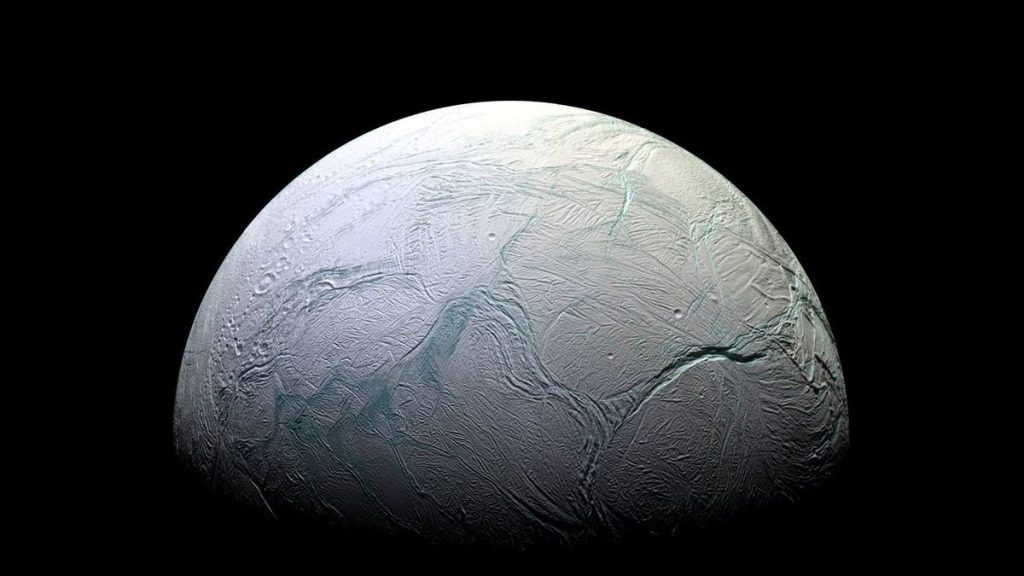
The outer planets reveal their true complexity only up close. Juno has orbited Jupiter since 2016, diving low over the poles and finding clusters of cyclones arranged in geometric patterns. Cassini spent thirteen years at Saturn, from 2004 until it was deliberately plunged into the planet in 2017. It dropped the Huygens probe onto Titan in January 2005, the most distant landing ever made, and found geysers of water ice spraying from Enceladus, evidence of an ocean beneath its crust.
Those ocean moons are where much of the next decade’s exploration is headed. ESA’s JUICE launched in 2023 to study Ganymede, Callisto and Europa. NASA’s Europa Clipper followed in October 2024 and is due at Jupiter in 2030 to make dozens of close passes over Europa. A rotorcraft called Dragonfly is being built to fly between landing sites on Titan.
Uranus and Neptune remain the neglected pair. Each has been visited exactly once, by Voyager 2 in 1986 and 1989. In 2022 a major US planetary science review named a Uranus orbiter and probe as its top priority for a new flagship mission, but nothing has been scheduled to launch yet. For now Webb and the big ground-based telescopes are our best view.
Small bodies, big returns
Some of the most important recent results came from objects most people never see. Japan’s Hayabusa2 brought samples from asteroid Ryugu to Earth in December 2020. NASA’s OSIRIS-REx delivered material from Bennu in September 2023, rich in carbon and water-bearing minerals. In 2022 the DART spacecraft deliberately crashed into the small moonlet Dimorphos and shortened its orbit around a larger asteroid by about 32 minutes, the first test of whether humanity could nudge a threatening rock.
Beyond Neptune, New Horizons turned Pluto from a smudge into a world of nitrogen glaciers in 2015 and then passed the small object Arrokoth on New Year’s Day 2019. Comet 67P, which ESA’s Rosetta orbited from 2014 to 2016, turned out to be a duck-shaped body venting gas from its surface as it warmed.
The star in the middle
The Sun is the hardest object to study up close and the most important for everything else. Parker Solar Probe, launched in 2018, has repeatedly flown through the Sun’s outer atmosphere, and on 24 December 2024 it passed about 6.1 million kilometres from the surface, closer than any human-made object before. On the ground, the Daniel K. Inouye Solar Telescope on Maui, with a four-metre mirror, resolves features on the solar surface only a few tens of kilometres across.
A view that keeps sharpening
Galileo saw ears on Saturn because his telescope could not resolve the rings. We now have spacecraft data on rings, plumes, polar ice on Mercury and dust from Bennu sitting in curated lab cabinets in Houston. Seeing the Solar System is not a finished project, and the outer planets in particular still hold far more questions than answers. Even so, the next clear night still has a lot to offer anyone who steps outside and looks up.
For mission news, observing tips and the wider question of whether any of these worlds might host life, keep exploring with SETIworld.