Posted by
 In December 1990 the Galileo spacecraft swung past Earth on its way to Jupiter, and Carl Sagan’s team used the flyby as an experiment: could an alien probe, knowing nothing, tell that this planet was inhabited? The answer, published in Nature in 1993, was yes, and one of the strongest clues was a large amount of oxygen sitting alongside methane, two gases that should destroy each other unless something keeps replenishing them. That idea still shapes the hunt for life on exoplanets. It also comes with a catch, because biology is only one of the possible sources of oxygen on a planet.
Earth made its oxygen the slow way
Today oxygen is about 21 percent of the air, almost all of it produced by photosynthesis in plants, algae and cyanobacteria. It was not always so. For roughly the first half of Earth’s history there was almost no free oxygen at all. Cyanobacteria were probably releasing it for a long time before it built up, because iron in the oceans and volcanic gases soaked it up as fast as it was made. The Great Oxidation Event, around 2.4 billion years ago, marks when oxygen finally started accumulating in the atmosphere, and levels close to modern ones came much later still.
That history is the first warning for anyone looking at exoplanets. Earth was inhabited for well over a billion years while its air would have shown no obvious oxygen signal. A distant observer scanning our planet at the wrong moment would have written it off.
Light can split water without any help from life
The most worrying non-biological sources of oxygen involve starlight and water. Ultraviolet light breaks water molecules high in an atmosphere into hydrogen and oxygen. Hydrogen is light enough to escape into space. The oxygen stays.
On most planets that process is slow and the oxygen reacts with surface rocks. But in some cases it could run away. Red dwarf stars, the most common stars in the galaxy, spend a long early phase, possibly hundreds of millions of years, much brighter than they will be later. A planet that ends up in the habitable zone of such a star may have spent its youth far too hot, in a steamy greenhouse state, losing hydrogen by the ocean-load. A 2015 modelling study suggested that such planets could be left with hundreds of bars of abiotic oxygen, an atmosphere that would look spectacularly alive from a distance and contain nothing living at all.
Carbon dioxide can do something similar. On a dry, cold planet with little nitrogen or other background gas, ultraviolet light can break CO2 apart faster than the pieces recombine, letting oxygen and carbon monoxide build up. Mars has a trace of oxygen in its thin air, around a tenth of a percent, produced largely this way.
Oxygen in places nobody would call alive
Our own Solar System is full of reminders that oxygen is not a signature in itself.
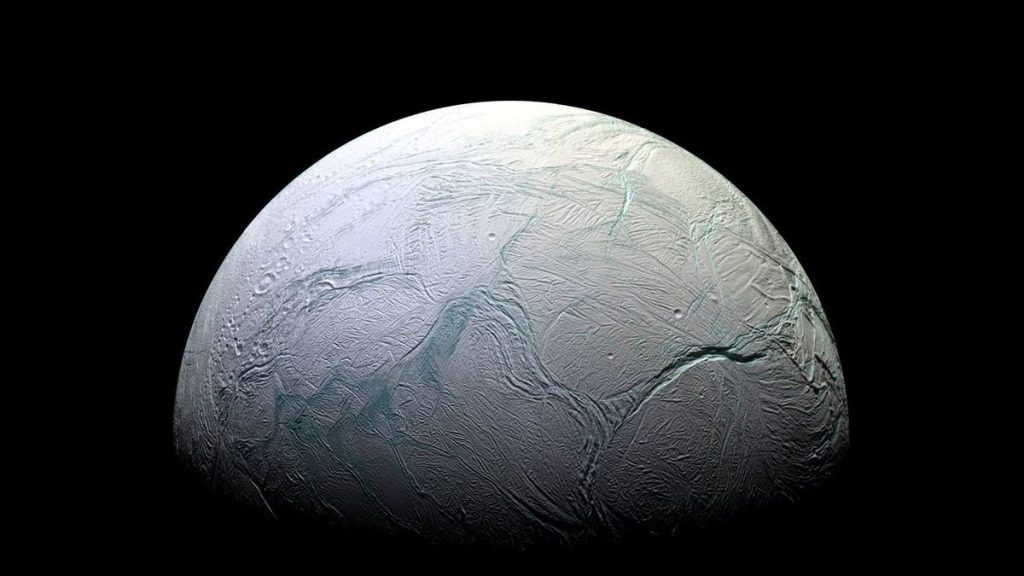
Jupiter’s moon Europa has a tenuous oxygen atmosphere made when charged particles from Jupiter’s magnetic field smash into its icy surface and break water molecules apart. NASA’s Juno spacecraft measured that production rate in 2022, and the result, published in 2024, was around 12 kilograms per second, much less than some earlier estimates. Ganymede and Saturn’s moon Rhea have thin oxygen layers made the same way. Rosetta found molecular oxygen streaming from comet 67P in 2015, apparently locked in the ice since before the planets formed, which surprised almost everyone.
Even on Earth the picture is not quite finished. In 2024 a team reported oxygen being produced on the dark Pacific seafloor, apparently by metal-rich nodules acting like natural batteries that split seawater. Other scientists have challenged the measurements, and the finding remains under dispute. Whatever the outcome, it is a useful reminder that chemistry has more routes to oxygen than textbooks tend to list.
None of these settings would produce an atmosphere like Earth’s. The point is narrower. Oxygen alone, stripped of context, is ambiguous.
Ozone, the easier cousin
Ozone, the three-atom form of oxygen, forms when ultraviolet light acts on ordinary oxygen, and it has a strong absorption feature in the mid-infrared, around 9.6 micrometres. For some telescopes it may be easier to spot than oxygen itself, so it is often treated as a stand-in. The same caveats apply. Ozone tells you oxygen is there. It does not tell you where it came from.
The context checklist
So how would researchers judge a real detection? Not by the oxygen alone. They would want to know the star: its age, its history of flares and ultraviolet output, whether its planets were likely roasted early on. They would want the planet’s mass, temperature and whether there is evidence of water. They would look for carbon monoxide, which tends to build up alongside oxygen made by CO2 photolysis but not alongside biological oxygen, and for very large oxygen pressures, which would point toward runaway water loss.
Most of all they would look for disequilibrium, the combination Sagan’s team used. Oxygen and methane together, at the same time, in amounts that only make sense if something is constantly producing both. Nitrous oxide is another possible companion. One gas is a hint. A combination that chemistry cannot sustain is something much stronger.
And they would need to repeat the observation, ideally with different instruments, because spectral signals from small planets are faint enough that noise, starspots and instrument quirks can mimic a molecule.
Why this is so hard to measure
A rocky planet’s atmosphere might block a few parts per million of its star’s light during a transit. The James Webb Space Telescope has been trying to detect atmospheres around rocky planets orbiting red dwarfs, and so far the results suggest some of them, including the inner TRAPPIST-1 worlds, may have little or no atmosphere at all. Detecting oxygen specifically is beyond what Webb can realistically do for an Earth-like planet.
The best near-term shot may come from the ground. The Extremely Large Telescope, under construction in Chile, could in principle pick out the narrow oxygen absorption band near 760 nanometres in the light of a nearby rocky planet by using very high-resolution spectroscopy, though it would take many nights of observing. Further ahead, NASA’s proposed Habitable Worlds Observatory is designed to image Earth-like planets around Sun-like stars directly and search their light for oxygen, ozone, water and methane together.
The other mistake: missing life that does not breathe
False positives get most of the attention, but false negatives are just as real. Plenty of Earth’s organisms never use oxygen at all. A world full of microbes that run on hydrogen, sulphur or methane could leave an atmosphere with no strong oxygen signal, exactly like early Earth. That is why researchers are compiling long lists of other potential biosignatures, while knowing every one of them comes with its own non-biological explanations.
None of this makes oxygen less interesting. It is still one of the clearest signals a photosynthesising biosphere could produce, and identifying the sources of oxygen on a planet is the only way to know what that signal means. It simply means the first detection, whenever it comes, will be the beginning of an argument rather than the end of one.
If you want to follow that argument as it unfolds, from Webb results to the next generation of telescopes, SETIworld covers the science of biosignatures and the search for life in plenty of depth. Come and read more.