Posted by
 A biosignature is evidence of life. A technosignature is evidence of technology — and the difference matters, because technology can produce signals far more conspicuous, and far stranger, than biology ever could. The search for technosignatures is really a search across several distinct categories, each betting on a different way an advanced civilization might give itself away.
Radio Signals: The Original Target
Radio has been the workhorse of the search since 1960, for solid reasons. Radio waves travel across the galaxy with little absorption, they’re cheap to generate, and a narrow-band signal — energy concentrated in a tiny slice of frequency — is something nature essentially never produces. Stars and gas clouds emit radio across broad bands; a sharp spike at one frequency screams “artificial.”
This is why radio telescopes scanning for narrow-band signals remain central to the effort. The famous “Wow! signal” of 1977 was exciting precisely because it was strong and narrow — though it was never repeated, and never explained. Most of what radio SETI does is rule out the natural and the human-made, patiently, channel by channel.
Optical and Laser Pulses
A newer branch looks for light instead of radio. A civilization might signal — or simply operate — using powerful, brief laser pulses. A laser flash could, for an instant, outshine its host star at a specific wavelength, producing a signature no natural stellar process mimics.
Optical SETI surveys scan stars for exactly these nanosecond flashes. The appeal is bandwidth: light can carry far more information than radio, so if anyone wanted to send a rich message efficiently, lasers would be a reasonable choice. The challenge is that you have to be looking at the right star at the right instant.
Megastructures and Waste Heat
Here the search gets genuinely speculative — and fascinating. In 1960, physicist Freeman Dyson pointed out that a civilization hungry for energy might build vast structures around its star to capture its output — what’s now called a Dyson sphere or swarm. Such a structure would absorb visible starlight and re-radiate it as waste heat in the infrared.
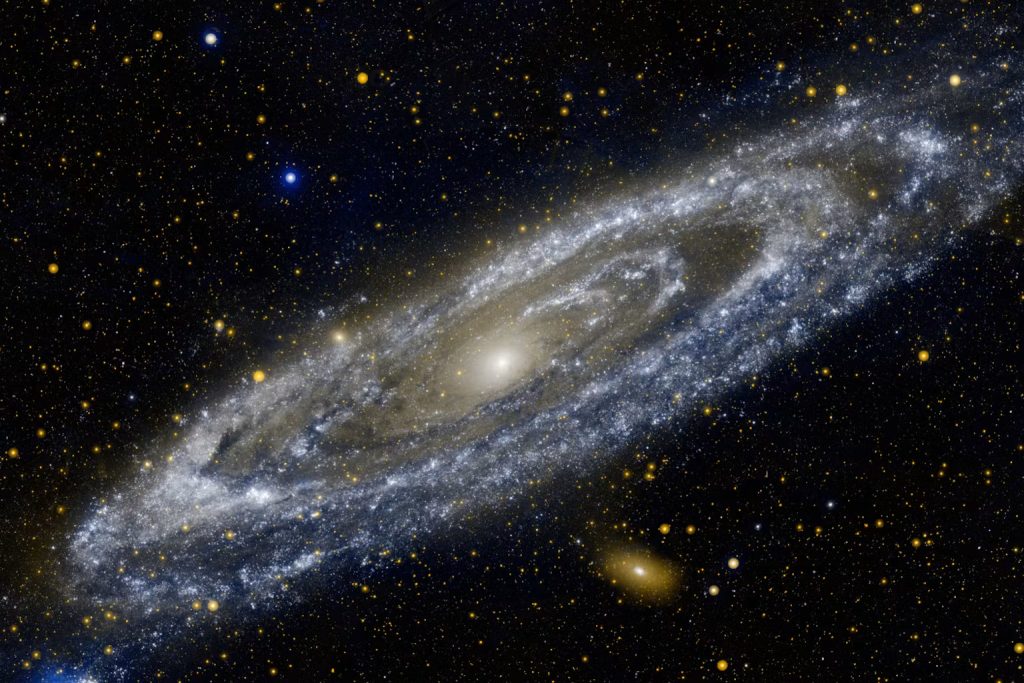
So one can hunt for technology by looking for stars that emit too much infrared for their visible brightness — an unexplained excess of heat. Infrared surveys have searched catalogs of galaxies and stars for this signature. Nothing conclusive has turned up; a few anomalies have natural explanations like dust. But the logic is sound: any sufficiently energy-hungry civilization must dump waste heat somewhere, and thermodynamics makes that heat hard to hide.
Atmospheric Pollution
If a civilization industrializes the way we have, its atmosphere may carry chemical fingerprints of that industry. Certain compounds — chlorofluorocarbons, nitrogen dioxide, other synthetics — have no significant natural source. Detecting them in an exoplanet’s atmosphere via spectroscopy would be a technosignature distinct from any biosignature.
This category is attractive because it piggybacks on tools we’re already building to study exoplanet atmospheres for life. The same telescope reading a planet’s air for oxygen could, in principle, catch the glint of industrial pollutants — a civilization revealed not by its broadcasts but by its smog.
Artifacts and Probes
The most direct technosignature would be a physical object — a probe, a derelict craft, anything manufactured — within our own solar system. We’ve sent probes outward ourselves; a long-lived civilization might have done the same, far more extensively. Some researchers have argued for searching nearby space and stable gravitational points for artificial objects.
This idea sits at the edge of respectability, and it attracts more than its share of overheated speculation. But the underlying point is defensible: if interstellar probes are possible, the galaxy has had billions of years to fill with them, and looking costs relatively little.
Why Cast Such a Wide Net
The reason the catalog keeps growing is humility about our own ignorance. We have exactly one example of a technological civilization — ourselves — and we’ve been technological for barely a century. We genuinely don’t know what an advanced civilization a million years older would do, build, or emit. It might broadcast. It might go silent and efficient. It might leave waste heat, or pollution, or nothing we’d recognize.
So the search hedges across categories, each one a different guess about how technology announces itself. None has succeeded yet. But each new category — optical, infrared, atmospheric — is a new way of looking, and the history of astronomy suggests that most discoveries arrive when someone finally looks in a way no one tried before.
Searching for What You Can’t Imagine
The deepest problem in technosignature science isn’t technical — it’s imaginative. We have exactly one example of a technological species, ourselves, and we’ve been technological for roughly a century. Trying to predict what a civilization a million or a billion years older would build is like asking a medieval scribe to anticipate the internet. The honest position is that we probably can’t conceive of the most advanced technosignatures, because they’d rest on physics or engineering we haven’t discovered.
This is why the field deliberately avoids betting everything on one idea. Radio made sense as a starting point because it’s cheap, fast, and distinguishable from nature — but a civilization that outgrew radio would leave it behind, just as we’re abandoning powerful broadcast transmitters for fiber and tight satellite links. The categories researchers search — radio, lasers, waste heat, pollution, artifacts — are really five different guesses about how technology announces itself, each one anthropocentric in its own way. The unsettling possibility is that the right answer isn’t on the list, and that an advanced civilization is sitting in plain sight, emitting something we don’t yet know to look for. The search hedges across categories precisely because it’s trying to compensate for the limits of its own imagination.
Technology or Biology: Which Do We Find First?
There’s a strategic question underneath all this: is humanity more likely to first detect alien life, or alien technology? The two searches have opposite profiles. Biosignatures are common in the sense that simple life, if it exists at all, is probably widespread — but they’re faint, ambiguous, and easily faked by geology. Technosignatures are rare, since they require not just life but technological life, yet a strong one could be unmistakable: nature simply doesn’t produce a narrow-band radio beacon or a refrigerant gas.
So the searches trade frequency against clarity. There may be a million inhabited worlds for every one with technology, which argues for finding biology first. But a single deliberate beacon could outshine a thousand subtle atmospheric hints, which argues that if technology is out there, it might be the easier catch. Most researchers pursue both, because the honest answer is that nobody knows which column the universe has stocked more heavily — abundant quiet life, or rare loud civilizations.
From the Fringe to the Funded
For decades, technosignature research carried a stigma. Mainstream science treated it warily, funding was scarce, and “looking for aliens” was a reputational risk for a serious astronomer. That has shifted markedly in recent years. In 2018, NASA convened a technosignatures workshop to chart legitimate research directions, signaling renewed institutional interest after a long drought. Privately funded efforts like Breakthrough Listen brought serious money and serious instruments. Universities began establishing dedicated technosignature research positions.
The rehabilitation came partly from reframing: technosignatures are simply an extreme case of biosignatures, scientifically continuous with the broader, well-respected search for life. The same telescopes built to read exoplanet atmospheres for oxygen could read them for industrial pollutants. That continuity helped move the field from the margins toward the mainstream — not because anyone found a signal, but because the search itself was recognized as a rigorous, falsifiable scientific program rather than wishful speculation.
Why Looking Costs So Little to Justify
A reasonable skeptic might ask why we bother searching for signatures we admit we can’t fully imagine, from civilizations that may not exist. The answer is asymmetry of payoff. Most technosignature work piggybacks on instruments and surveys built for other astronomy — the same radio telescopes, the same exoplanet atmosphere studies, the same infrared sky catalogs. The marginal cost of also checking that data for artificial signals is small. And the potential payoff is among the largest in all of science: confirmation that humanity is not alone. A cheap search with a civilization-altering upside is rational to run even if the odds of success are low and the targets are uncertain. That cost-benefit logic, more than any confidence that aliens are out there, is what keeps the wide net cast.
SETIworld follows every category of technosignature research — from radio to megastructures. Join the portal to track how the search for alien technology expands.
References
- Wright et al., The Ĝ Infrared Search for Extraterrestrial Civilizations, ApJ 2014
- Dyson, Search for Artificial Stellar Sources of Infrared Radiation, Science 1960
- Tarter, The Search for Extraterrestrial Intelligence, Annual Review of Astronomy and Astrophysics 2001
- Wright, Dorminey & others, NASA Technosignatures Workshop Report, 2018
- Lin et al., Detecting Industrial Pollution in Exoplanet Atmospheres, ApJ Letters 2014 doi.org/10.1088/2041-8205/792/1/L7
- Socas-Navarro et al., Concepts for future missions to search for technosignatures, Acta Astronautica 2021