Posted by
 Ask a planetary scientist whether we’re alone in the universe and you’ll rarely get a straight yes or no. What you’ll get instead is astrobiology — the messy, thrilling, deeply cross-disciplinary effort to figure out how life begins, where it could survive, and how we might actually recognise it from light-years away. It borrows from astronomy, chemistry, geology and biology, and it has quietly become one of the central projects of modern space science. The search for life beyond Earth is no longer a fringe question. With thousands of exoplanets now on the books, it’s a research programme with real targets.
Here’s the thing that makes it hard, though. We have exactly one example of life to work from. Just Earth. Everything we think we know about biology — what it needs, what it leaves behind, how stubborn it can be — comes from a single planet. So astrobiologists do something clever and a little humbling: they study the edges of life here to imagine it elsewhere.
Life at the extremes tells us where to look
Microbes thrive in places that should, by any reasonable expectation, kill them. Boiling acidic springs. The crushing dark of hydrothermal vents on the seafloor, far from any sunlight. Antarctic ice. Rock kilometres underground. These organisms — extremophiles — keep resetting our sense of where the line is. And every time the line moves, so does the map of worlds worth checking.
That matters because when scientists talk about a planet being “habitable,” they mostly mean one thing: could liquid water sit stably on its surface? Orbit your star at the right distance — not so close that oceans boil off, not so far that everything freezes — and you’re in what’s called the habitable zone. It’s a rough guide, not a guarantee. But it’s a place to start pointing telescopes.
The worlds we’ve found
Exoplanets are the whole game here, and we’ve gone from knowing of essentially none around Sun-like stars in the early 1990s to a catalogue in the thousands. Two techniques did most of the heavy lifting. The transit method watches for the tiny, repeated dip in a star’s brightness when a planet crosses in front of it. The radial-velocity method looks for the star’s subtle wobble as an orbiting planet tugs it back and forth. NASA’s Kepler mission, staring at one patch of sky, proved that small rocky planets are genuinely common. TESS took over the wider survey, scanning brighter, closer stars.
Some of the finds have become almost household names among people who follow this stuff. The TRAPPIST-1 system, with seven Earth-sized planets packed around a small cool star, several of them in or near the habitable zone. Proxima Centauri b, orbiting the nearest star to the Sun. TOI-700 d, a roughly Earth-sized world in its star’s temperate zone. K2-18b, a larger planet where astronomers have been picking apart the atmosphere for hints of interesting chemistry. None of these is a confirmed second Earth. They’re candidates — invitations to look closer.
Reading the light for signs of life
So how do you check a planet you’ll never visit, one that shows up as a fraction of a pixel? You read its atmosphere. When a planet transits, a sliver of starlight filters through the gas around it on the way to us, and different molecules absorb different colours, leaving fingerprints in the spectrum. This is where biosignatures come in — gases that might, might, point to biology. Oxygen is the famous one, because on Earth it’s continuously replenished by living things. Methane is another, especially alongside oxygen, since the two together are hard to explain without something actively producing them.
The catch is that chemistry can fake it. Oxygen can build up through purely physical processes; methane leaks from volcanoes and geology, no life required. The phosphine episode is a good cautionary tale — a claimed detection of that gas in the clouds of Venus set off a storm of excitement and argument, and years later the science community still hasn’t fully settled whether it’s really there or what it means. That’s not a failure. That’s how careful this has to be. A single spectral line is never going to be a smoking gun.
The James Webb Space Telescope has changed what’s possible here. It can dissect exoplanet atmospheres with a precision earlier instruments couldn’t touch, teasing apart water vapour, carbon dioxide and more on distant worlds. It wasn’t built solely as a life-detector, but it’s become one of the sharpest tools we have for the job. And bigger eyes are coming — the Extremely Large Telescope rising in the Chilean desert, and the Square Kilometre Array on the radio side.
Listening for the engineers
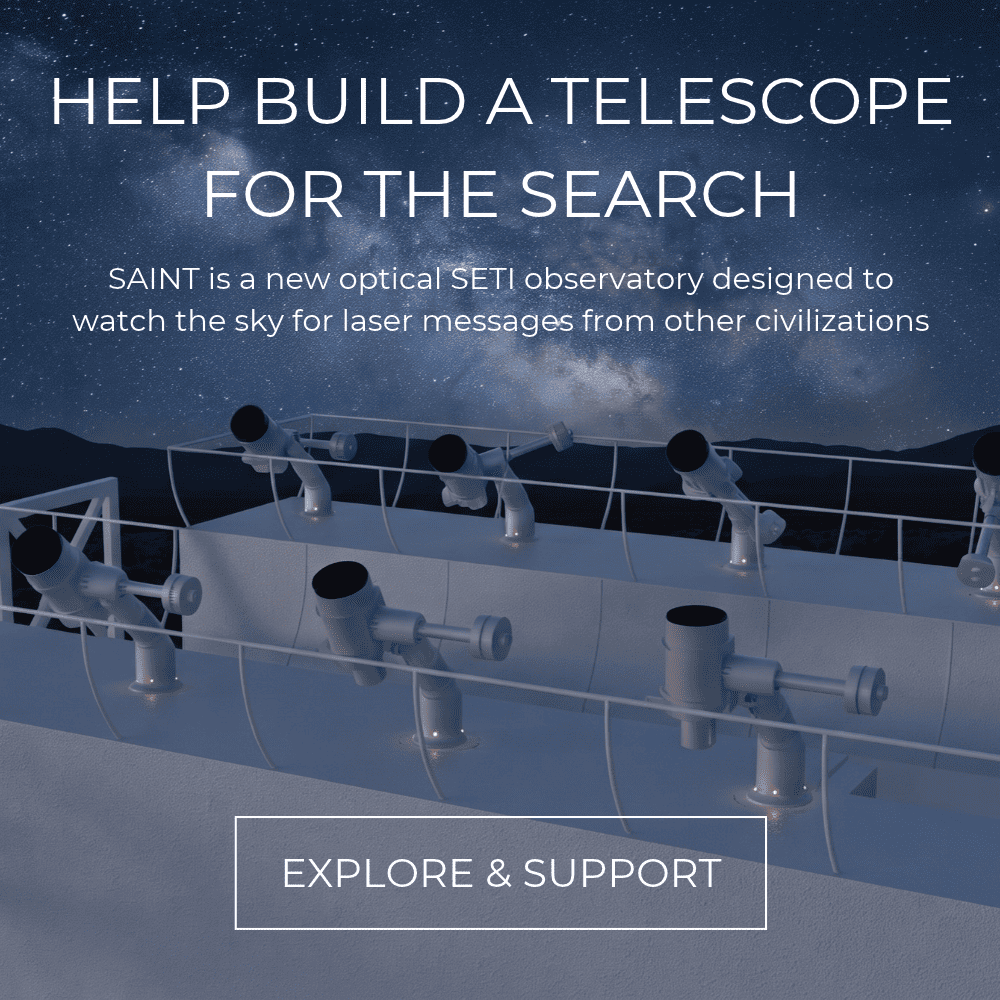
Biosignatures are about life in general — pond scum counts. But there’s a second, bolder search running in parallel, and it’s the one that gives SETI its name: technosignatures. Instead of hunting for the byproducts of biology, you hunt for the byproducts of technology. Narrow-band radio signals that nature doesn’t produce. Pulses of laser light. Even, in principle, industrial pollutants in an atmosphere, or waste heat from something vast.
Radio telescopes have been sweeping the sky for decades, filtering out our own noisy civilisation to catch anything that looks engineered. Nothing confirmed has ever turned up. That silence is itself a data point — it’s the heart of the Fermi paradox, the nagging question of why, in a galaxy this old and this large, we haven’t heard a peep. The Drake equation was an attempt to at least organise our ignorance, breaking the odds of contact into pieces we could argue about one at a time. Most of those pieces we still can’t fill in with confidence.
Why it’s genuinely hard, and why we keep going
Everything about this work fights the observer. The planets are faint, drowned in the glare of stars thousands of times brighter. The distances are absurd. And nature is a talented forger, producing signals that mimic biology closely enough to fool a hasty read. So confirmation, if it ever comes, won’t be one dramatic image. It’ll be the slow accumulation of the same result, from different instruments, until the boring explanations run out.
Machine learning has quietly become part of the toolkit — sifting oceans of telescope data for the faint periodic dip of a transit, flagging candidates a human might miss in the noise. It’s not magic, and it doesn’t replace the astronomer’s judgement, but it lets us look at far more sky than we otherwise could.
Would finding even a single microbe on another world matter? It would upend biology, philosophy, our whole sense of our place in things. But it’s worth saying the other outcome carries weight too. If we keep looking and keep finding nothing, that emptiness teaches us something real about how rare and fragile our own start may have been. The honest answer to “are we alone” is that we still don’t know — and for now, the looking is the point.
If any of this pulls at you, the SETIworld portal is a good place to follow the discoveries as they come in and dig deeper into the science.