Posted by
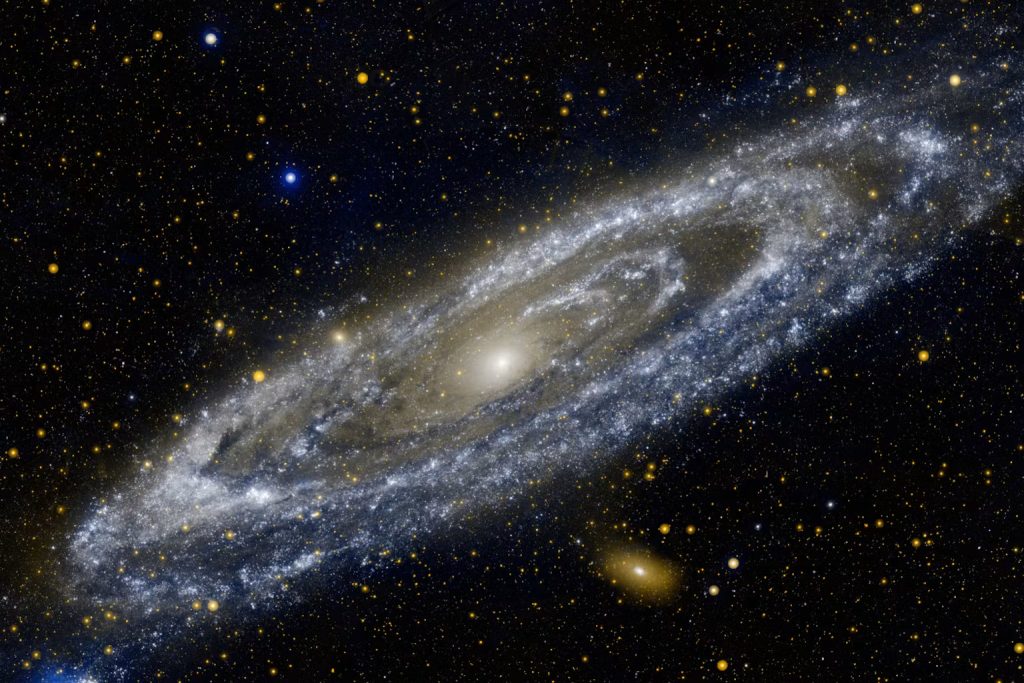
 A new study published in “The Astrophysical Journal” investigates how supermassive black holes may influence the habitability of planets across entire galaxies. The authors focus not on radiation from active galactic nuclei, which has been studied before, but on powerful AGN winds, especially ultrafast outflows that can travel at about 10% of the speed of light. These winds may strongly affect Earth-like planetary atmospheres.
The researchers modelled black holes ranging from 10^6 to 10^10 solar masses, covering the natural mass range observed in galaxies. They examined how AGN winds could heat atmospheres, accelerate atmospheric molecules, drive atmospheric escape and destroy protective ozone layers. Their results show a clear trend: the more massive the central black hole – the stronger the atmospheric damage. The effect also decreases with distance from the galactic centre.
Energy-driven winds were found to be more destructive than momentum-driven winds. In galaxies with black holes above about 10^8 solar masses, energy-driven outflows could cause severe atmospheric loss and almost complete ozone depletion over large galactic distances. For planets closer to the galactic centre, atmospheric particles such as nitrogen or hydrogen may reach escape velocity, meaning that a planet could lose much of its atmosphere. Without sufficient atmosphere, surface liquid water and protection from harmful radiation would become difficult or impossible to maintain.
A particularly important finding concerns ozone: the study suggests that AGN winds can trigger nitrogen oxide chemistry that destroys ozone, exposing planetary surfaces to much higher ultraviolet radiation. Even if life were not completely eliminated, surface ecosystems could be severely damaged.
The work shows that the growth and activity of supermassive black holes may be an important factor in determining which regions of galaxies can remain habitable.
For more details, read the full article here.