Posted by
 Open a feed of astronomy news this week and you get the same impression you got last week, and the week before that: a firehose. A galaxy that shouldn’t exist. A planet that might have life. A black hole that formed far too early. Read forty in a row and the effect is numbing rather than informative, because nothing in the stream tells you which story will still matter in a year and which was a press release with good artwork attached.
There is a way to read all this that makes it manageable, and it has surprisingly little to do with knowing astrophysics. It has to do with knowing the plumbing. When results get announced and why they bunch up in certain months. What stage of vetting a claim has reached by the time you see it. Whether the sentence describes something measured or something modelled. And where the actual numbers sit, in public, for free.
None of it is secret — just rarely explained to the people doing the reading.
Astronomy Runs on a Calendar That Nobody Prints
Early January is loud. The American Astronomical Society holds its winter meeting then — several thousand astronomers in one convention centre, press conferences all week, results held back for the occasion. Teams sit on findings for months to time them to that room. If you’ve ever wondered why the first fortnight of a year delivers a suspicious density of cosmic headlines, that’s why. The European Astronomical Society meeting in summer runs a smaller version.
Then the proposal cycles. Hubble and JWST each issue an annual Call for Proposals; astronomers write, panels review, successful programmes get their hours months later. JWST has been oversubscribed severalfold since its first cycle. Both telescopes now use dual-anonymous review, with proposers and reviewers hidden from each other — a change Hubble adopted in 2018 after evidence that proposals were being judged partly on whose name was attached.
Observations arrive. The data then sits under an exclusive-access period of roughly a year while the team that won the time analyses it, and only afterwards comes a paper, and later still a press release. When that exclusive period expires the data goes public and a second wave of papers appears, written by people who never applied for the time at all. Same photons, fresh headlines, years apart. That’s not duplication; it’s the design.
Big catalogue releases are the other clock. Gaia, ESA’s star-mapping satellite, published its data in scheduled instalments — the second in April 2018, the third in June 2022 with positions and motions for roughly 1.8 billion sources. On release day arXiv takes dozens of papers at once, all written in advance under embargo. The dates are announced years ahead. You can put them in a calendar.
Where a Headline Actually Comes From
The chain is short and almost always the same. A team analyses data, writes a paper, submits it to a journal. A referee asks for changes. Eventually it’s accepted, and a press officer at the university or space agency writes a release, sends it to reporters under embargo, and at an agreed hour everyone publishes.
Which is why five outlets carry the identical story at the identical minute on a Tuesday morning. That’s not journalists copying each other. That’s an embargo lifting.
The February 2017 announcement of seven Earth-sized planets around TRAPPIST-1 is the textbook case: a NASA press conference, a paper in Nature, coordinated global coverage in one afternoon, for a system 40 light-years away already under study for years. The science held up. The synchronised thunderclap was manufactured, and that’s fine as long as you know it’s happening. Press offices compete for attention, and the vocabulary drifts accordingly — “Earth-like” gets attached to worlds whose mass nobody has measured.
A Preprint Is Not a Paper
Almost every astronomy result you read about passes through arXiv, the preprint server that has been running since the early 1990s. Its astro-ph section takes well over a hundred new submissions on a typical weekday. Most astronomers post their manuscript the day they submit it to a journal, which means a large share of what’s on arXiv at any moment has been reviewed by nobody except its authors.
That’s not a scandal. It’s how the field moves fast, and working astronomers read arXiv for exactly that reason. But a preprint and a refereed paper are different objects, and good coverage tells you which it’s describing.
Peer review is no truth machine either. Two or three unpaid referees, reading in the gaps of their own work, catch sloppiness far more reliably than subtle error. In March 2014 the BICEP2 collaboration announced at a press conference that it had found the imprint of gravitational waves from cosmic inflation in the microwave background. Within a year, joint analysis with Planck showed the signal was consistent with dust in our own galaxy.
The Breakthrough Listen candidate known as BLC1 ran a similar arc on the SETI side: a narrowband radio signal in Parkes Observatory data pointed at Proxima Centauri, leaked to the press in December 2020 while the checks were still running, and shown in the published work to be human-generated interference. The team never claimed otherwise. The news cycle simply arrived first.
Measurement, Model, or Somebody’s Reasonable Guess
This is the single most useful filter, and it costs about ten seconds.
A measurement is a quantity somebody extracted from data, with error bars. A model is a story that explains the measurement, and multiple stories usually fit. Coverage tends to blur the two, because the model is what makes the sentence exciting.
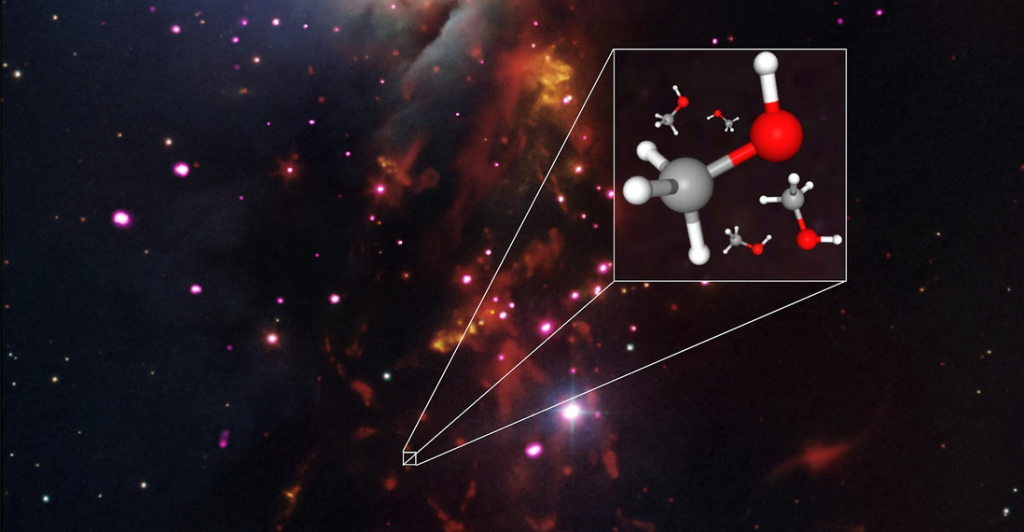
Take K2-18b. JWST spectra gave solid detections of methane and carbon dioxide in its atmosphere — a measurement, and an impressive one. The same work reported a tentative hint of dimethyl sulfide, a molecule made on Earth mostly by marine life. That hint has been contested ever since, with independent reanalyses of the same data finding the feature not statistically robust. And the “ocean world under a hydrogen sky” phrasing attached to the planet is an interpretation built on its density, not something anyone has seen.
Venus went the same way: the 2020 phosphine detection, then disputes as other groups reprocessed the telescope data and got different answers about whether the line was there at all.
Mars offers a cleaner puzzle, because there it’s measurement against measurement. Curiosity’s laser spectrometer has repeatedly detected methane inside Gale crater, varying with the seasons. ESA’s Trace Gas Orbiter, more sensitive and looking at the whole planet, has not. Both instruments work. Nobody has fully reconciled them, and that unresolved state is more interesting than either result alone.
And then there’s ALH 84001, the Martian meteorite announced in 1996 as possibly holding fossil microbes, complete with a White House statement. Decades of argument later, the structures are generally explained without biology — yet it still anchors every serious discussion of what a life detection must look like.
The Feeds Working Astronomers Actually Watch
Nearly everything in astronomy news this week traces back to a primary layer that is public, free, and dull in the best possible way.
The Astronomer’s Telegram carries short, unrefereed notices about objects doing something now. The Transient Name Server registers supernovae and other new transients. GCN circulars distribute gamma-ray burst alerts. The Minor Planet Center handles asteroids and comets. LIGO, Virgo and KAGRA push automated public alerts for gravitational-wave candidates, minutes after detection, including the ones later withdrawn.
For catalogued facts rather than events: the NASA Exoplanet Archive keeps the running census of confirmed planets with the parameters and source paper for each; MAST and the ESA archives hold telescope data; SIMBAD and VizieR at Strasbourg tie objects to the literature.
None of it requires credentials. When a headline calls a planet “potentially habitable”, you can look up what was actually measured — usually a radius, an orbital period and a host star — and see how much of the rest was inference. The volume is about to get worse, incidentally: the Vera C. Rubin Observatory is expected to issue millions of alerts a night, more than any human pipeline can triage.
Slow Reading Beats Fast Reading
The habit worth building is to stop treating each item as an event and start reading it as a point in a sequence. Exoplanets are the easiest place to practise: 51 Pegasi b in 1995, a hot Jupiter no formation theory had predicted, found by Michel Mayor and Didier Queloz. Kepler staring at one patch of sky for four years. TESS scanning the whole sky in strips. Thousands of confirmed planets now, and the question has shifted from whether they exist to what their atmospheres are made of.
As isolated headlines, no single step there looks decisive. As a line thirty years long, it’s one of the fastest transformations any science has managed.
The other habit is patience with silence. Arecibo’s 305-metre dish collapsed in 2020 and is gone; the Square Kilometre Array and the Extremely Large Telescope are still being built. The OSIRIS-REx capsule landed in the Utah desert in September 2023 with material from asteroid Bennu, and papers on what’s inside have been arriving steadily ever since, mostly without press conferences. A quiet stretch in astronomy news this week usually means instruments are being built or data is being analysed, not that nothing is happening.
If you’d rather follow all of it with context than chase it one headline at a time, that’s more or less what SETIworld exists for — the exoplanet results, the astrobiology arguments, the technosignature searches, and the occasional pleasure of watching a spectacular claim quietly fall apart. Come read with us, and bring your scepticism.