Posted by
 Nobody was there to watch, which is the first thing to admit about how Earth was created. Everything we know comes from reading clues left in rocks, meteorites, Moon samples and the disks of dust around other young stars. Put together, those clues tell a story that runs roughly 4.5 billion years, and the early chapters are far more violent than the blue, quiet planet you see from the International Space Station would suggest.
Here is that story in rough chronological order, with the places where scientists still disagree left in.
The first few million years
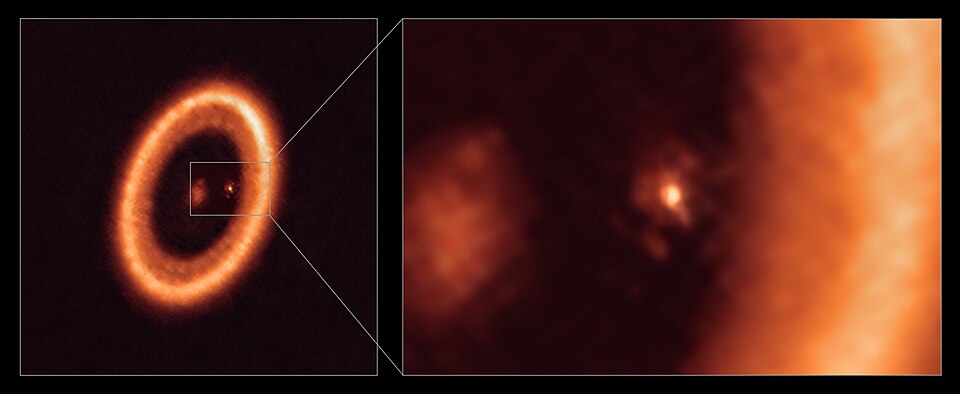
The Sun formed when part of a cold cloud of gas and dust collapsed. The leftover material spun into a flat disk, and within it tiny grains began to stick together. How dust becomes boulder-sized bodies is genuinely tricky physics, because small fragments tend to bounce off each other or shatter rather than merge. One popular idea, called the streaming instability, has turbulence in the gas herding pebbles into dense clumps that then collapse under their own gravity into planetesimals tens of kilometres across.
From there gravity took over. Larger bodies pulled in smaller ones faster, a runaway process that produced dozens of planetary embryos, each perhaps the size of the Moon or Mars. The inner Solar System at this point was not four tidy planets. It was a crowded, chaotic shooting gallery.
Tens of millions of years of collisions
Earth was built by those embryos smashing into each other. Estimates for how long the main phase of growth lasted vary, but most models put it in the range of a few tens of millions of years, perhaps up to around 100 million. Every major collision released enormous energy, and together with heat from radioactive elements such as aluminium-26 and the squeezing of the growing planet under its own weight, it kept the young Earth partly or largely molten.
Molten is the important word. In a planet that soft, heavy iron and nickel sink toward the centre while lighter silicate rock floats up, the process geologists call differentiation. There is a clever clock for this. The element hafnium decays into tungsten with a half-life of about 9 million years, and hafnium prefers rock while tungsten prefers metal. By comparing tungsten isotopes in Earth’s mantle with those in meteorites, researchers concluded that the core separated within roughly the first 30 million years or so, though the exact figure depends on how the metal and rock mixed.
The day the Moon was born
Then came the collision everyone remembers. The leading explanation for the Moon has a body roughly the size of Mars, nicknamed Theia, striking the young Earth a glancing blow. Debris from both bodies was flung into orbit, formed a ring and gathered into the Moon. The Apollo astronauts brought back 382 kilograms of lunar rock between 1969 and 1972, and those samples show that the Moon is depleted in volatile elements and has a small iron core, both of which fit a hot, violent origin.
The awkward detail is that lunar and terrestrial rocks are almost identical in their oxygen isotopes. If the Moon were mostly made of Theia, you would expect a difference. Some researchers argue Theia and Earth simply formed from similar material; others prefer a higher-energy impact that mixed everything thoroughly. The giant impact itself is broadly accepted. The details are not.
Whatever happened, the surface after the impact was probably a global ocean of magma.
Hell’s eon, maybe not so hellish
Geologists call Earth’s first half-billion years the Hadean, after Hades, because they pictured a world of lava and constant bombardment. The rock record from this time is almost gone, recycled by later geology. The oldest intact rocks, such as the Acasta Gneiss in northern Canada, are a little over 4 billion years old.
The best evidence comes from something smaller. In the Jack Hills of Western Australia, geologists found zircon crystals that survived erosion and were redeposited in younger sandstone. Some of them are about 4.4 billion years old. Zircons are almost indestructible and lock in a chemical record of where they formed, and the oxygen isotopes in some of these grains suggest they crystallised from magma that had interacted with liquid water at the surface. If that reading is right, Earth had cooled enough to hold water and possibly early continental crust within roughly 150 million years of its formation. That is a surprisingly quick turnaround from a magma ocean, and it is still argued over.
There is also the question of the so-called Late Heavy Bombardment, a proposed spike in impacts around 3.9 billion years ago, inferred mainly from the ages of Apollo samples. Some researchers now suspect it was an artefact of sampling a few big lunar basins, and that impacts declined more smoothly. The verdict is open.
Air, oceans and a slow chemical revolution
Earth’s early atmosphere was nothing like the one we breathe. It was built from gases released by volcanoes and impacts: water vapour, carbon dioxide, nitrogen and others, with essentially no free oxygen. As the surface cooled, water vapour condensed into rain and oceans formed. Where that water originally came from is a separate puzzle, with contributions likely from the rock Earth formed from and from asteroids that arrived later.
Life seems to have shown up early. Stromatolite-like structures in rocks about 3.5 billion years old in Western Australia are widely, though not universally, accepted as traces of microbial communities. Older claims exist and are more controversial.
Oxygen took far longer. Photosynthetic microbes, cyanobacteria, began releasing it, but for hundreds of millions of years iron dissolved in seawater mopped it up, leaving behind the striped banded iron formations now mined in places like Western Australia. Around 2.4 billion years ago oxygen finally began to accumulate in the air, an event called the Great Oxidation Event. Even then, levels stayed low for a very long time. Air you could comfortably breathe is a fairly recent feature.
Meanwhile, two processes deep inside kept the planet changing. The first is the magnetic field, generated by churning liquid iron in the outer core. Magnetised minerals suggest Earth had a field at least 3.5 billion years ago, possibly earlier, and that field helps shield the atmosphere from being stripped by the solar wind.
The second is plate tectonics, which recycles crust, builds mountains and drives the long-term carbon cycle that keeps climate within a liveable range. When it started is one of the bigger open questions in geology. Estimates span from more than 4 billion years ago to under 3 billion, partly because the earliest crust behaved differently from modern plates.
Three planets, three endings
Venus and Mars are useful controls in this experiment. They formed from broadly similar material in the same inner disk. Venus ended up with a carbon dioxide atmosphere about 90 times thicker than ours and a surface hot enough to melt lead. Mars lost most of its atmosphere and its surface water, partly after its global magnetic field faded, a process NASA’s MAVEN orbiter has been measuring since 2014.
Earth kept its oceans, its field and its tectonics running at the same time. Whether that combination is rare or common is exactly what researchers hope to learn by studying rocky exoplanets around other stars. Knowing how Earth was created gives them the only detailed case study they have.
Still under construction
The process did not really stop. Continents drift, the core is still slowly freezing from the inside out, and life keeps rewriting the chemistry of the air and oceans. Asking how Earth was created turns out to be asking a question with a moving answer.
If you want to follow the geology, the Moon samples and the hunt for other rocky worlds as new results come in, there is plenty more of it on SETIworld. Have a look around.