Posted by
 The most powerful consumer telescope is usually described with a number. Twenty inches. Twenty-five. A mirror roughly the size of a manhole cover, sitting in a plywood box in somebody’s garage. That answer is not wrong so much as incomplete, because the chain that runs from starlight to mirror to eyeball to hard drive has five or six links in it, and the mirror is almost never the one that snaps first.
Some scale to start with. William Herschel found Uranus in 1781 using a reflector with a mirror about six inches across. A stock 8-inch Dobsonian, sold today for less than a decent laptop, outguns it comfortably. That is the floor of the hobby, not the ceiling.
Sixteen Inches and the Ladder Problem
The serious end of visual astronomy begins somewhere around 16 inches of aperture. Obsession Telescopes in Wisconsin has been building truss-tube Dobsonians in 15, 18, 20, 22 and 25-inch sizes since the 1980s, and Sky-Watcher sells 18 and 20-inch Stargates through ordinary retail dealers. There is nothing exotic about buying one. You wait a few months and a freight company delivers several very heavy crates.
Then you have to use it, which is a different problem entirely. A 20-inch scope breaks down into a mirror box, a rocker, a set of truss poles, an upper cage, a light shroud and a mirror cell, and reassembling that in the dark is a fifteen-minute ritual you will perform on your knees. The glass has to reach ambient temperature before it performs, and a thick 20-inch blank pulled from a warm house into cold air can take well over an hour to settle even with cooling fans running. Until it does, you are looking through the heat coming off your own optics. And at f/4, pointed near the zenith, the eyepiece of a 20-inch sits about two metres above the ground, so you observe from the top of a stepladder, in the dark, with your dominant eye pressed to a piece of glass.
People sell these telescopes constantly. Almost never because the views disappointed them.
What kills a big Dobsonian is Tuesday. The forecast is marginal, setup is forty minutes, teardown is another twenty, and a smaller instrument in the hallway would already be cooling on the patio. Aperture is a real physical advantage and there is no substitute for it. It is also a tax on every clear night you will ever have.
Folding the Light
Schmidt-Cassegrain telescopes exist because long focal lengths are awkward. A thin aspheric corrector plate at the front, a spherical primary at the back, a convex secondary bouncing the beam forward again: the design packs nearly four metres of focal length into a tube you can carry under one arm. Celestron’s 14-inch runs at f/11, close to 3,900 mm, in an optical tube shorter than most people are tall.
The EdgeHD line adds corrective optics near the focuser to flatten the field and clean up coma out at the edges, which matters enormously once a rectangular sensor replaces the eyepiece. A classic SCT gives lovely stars in the middle of the field and smeared ones in the corners of a full-frame chip. That was tolerable for fifty years of visual observing and became intolerable the moment amateurs started photographing everything.
Compact does not mean easy. Long focal length magnifies every tracking error and every wobble of the air, mirror flop and focus shift are ordinary annoyances on big SCTs, and the corrector plate dews over on damp nights unless you strap a heater to it.
Where the Atmosphere Draws the Line
Here is the part the marketing copy skips. Diffraction sets a telescope’s theoretical resolving power, and by the Dawes criterion a 500 mm aperture should split double stars about a quarter of an arcsecond apart. Real air does not cooperate. Typical suburban seeing runs two or three arcseconds, a genuinely good night gives you one, and the professional mountaintops, Mauna Kea and Paranal among them, hold median seeing under an arcsecond. That is why anyone bothered hauling concrete up there. It is also why the most powerful consumer telescope on your driveway hits its ceiling long before your bank account hits its own.
So on most nights, a 20-inch and a 6-inch resolve fine planetary detail about equally well. The big mirror still wins on faint objects, because collecting area is collecting area and the atmosphere does not throw photons away. It just refuses to let you use the resolution you paid for.
Planetary imagers get around this by cheating time. A high-frame-rate camera records thousands of short exposures, software throws away the frames where the air was turbulent, and the surviving few percent are aligned and stacked. The technique is called lucky imaging, and it is why backyard Jupiter portraits now show detail that would have embarrassed a professional observatory in the 1970s.
It also produces discoveries. On 19 July 2009, Anthony Wesley was imaging Jupiter from Murrumbateman in New South Wales with a 14.5-inch Newtonian and noticed a dark bruise near the south pole that had not been there. Something had hit the planet. Nobody had seen it coming, professional facilities followed up within a day, and the initial report came from a man in a field with a homemade telescope.
The Camera Became the Telescope
In 1995 Michel Mayor and Didier Queloz announced 51 Pegasi b, the first planet found around a normal star. They used the 1.93-metre telescope at the Observatoire de Haute-Provence, an instrument that had been sitting there since the 1950s. The mirror was old news. The new thing was ELODIE, the spectrograph bolted to the back of it.
That lesson has propagated all the way down to the consumer market. Back-illuminated CMOS sensors of the last decade read out with roughly one or two electrons of noise and convert most of the photons that land on them, which changes the arithmetic completely. A 106 mm apochromatic refractor with three elements of low-dispersion glass, riding a mount that tracks to about an arcsecond, will pull structure out of a faint galaxy that no eyepiece on a 20-inch will ever show you. Colour, too, which the human eye simply cannot manage at those light levels.
Ask experienced astrophotographers what to buy first and most of them say the mount, then argue about which one. The optical tube is close to interchangeable. The thing carrying it is not.
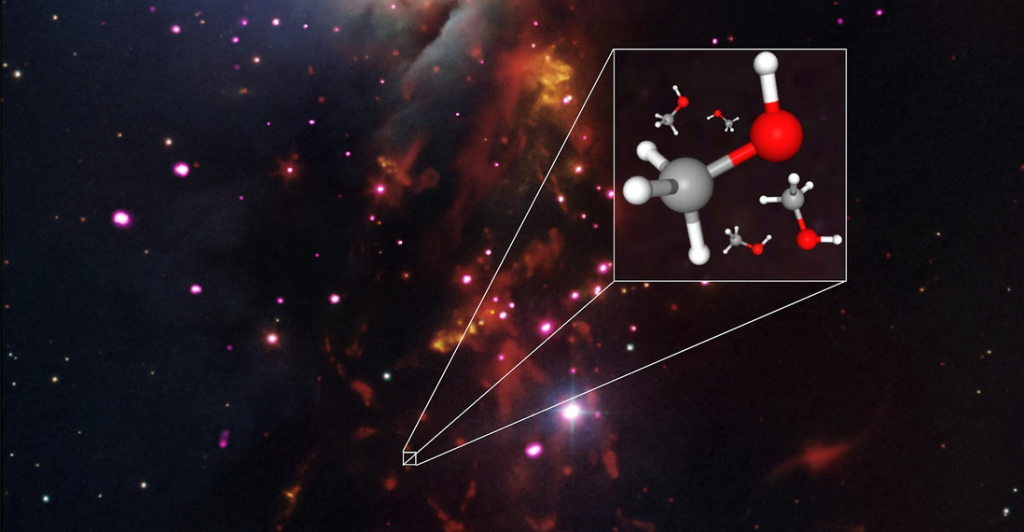
Even at the far professional end the pattern holds. The argument over whether JWST has seen dimethyl sulfide in the atmosphere of K2-18b is not an argument about a 6.5-metre mirror. It is an argument about detector systematics, about how you model a spectrum, about what counts as a detection when the signal sits close to the noise. Nobody is proposing a bigger mirror to settle it.
Small Robots Doing Real Science
Which brings us to the odd little instruments that have rewritten the question. Unistellar’s eVscope carries a mirror of about 4.5 inches, no eyepiece worth the name, a sensor at the focus and a phone app doing the pointing and stacking. Vaonis builds the Stellina and Vespera along similar lines. By the traditional metric they are unremarkable. By any other metric they are the most interesting thing to happen to amateur astronomy in thirty years.
The reason is the network behind them. Franck Marchis, a senior astronomer at the SETI Institute, is also Unistellar’s chief scientific officer, and the two organisations run coordinated observing campaigns for people who own these telescopes. Asteroid occultations are the classic case: a star winks out for a second or two as a rock passes in front of it, and timings gathered from many sites strung across the shadow path give you the object’s size and shape. One observer contributes a chord. Fifty observers contribute a silhouette.
The same network chases transits of candidate planets from TESS, confirming or killing them, and turns out for planetary defence work. When DART struck Dimorphos on 26 September 2022, amateur telescopes around the world watched the system brighten as the ejecta plume spread. NASA’s Lucy mission ran ground-based occultation campaigns on its Trojan targets years before the spacecraft got anywhere near them.
None of that requires a big mirror. It requires being in the right place, at the right minute, with a clock you trust.
Buying the Ceiling
The honest answer to what the most powerful consumer telescope is: it depends which of the four bottlenecks you are currently sitting against. If it is photons and you are already under dark sky, buy aperture. If it is resolution, more aperture will not help and better seeing will. If it is the picture, spend the money on the mount and the sensor. If it is light pollution, an hour’s drive is worth more than any upgrade on the market.
Serious observers eventually work out that the telescope they use most is the one that wins, which is an argument for modest instruments that a separate conversation covers better than this one does. But the ceiling is worth knowing about. It is higher than most people assume and lower than the catalogues imply, and it is set by air, not by budget.
If you are somewhere on that ladder, or thinking about stepping onto it, SETIworld is a good place to compare notes. Observers here swap equipment experience, seeing reports and processing arguments, and follow the campaigns where small telescopes contribute real data to the search for life elsewhere. Bring your own results, however modest. Somebody will want to see them.