Posted by
 Point a large telescope at a star fifty light-years away and you get a blazing white dot. Somewhere inside that dot, buried under the glare, there may be a planet. Digging it out is the whole job of a planet imager: an instrument built not to gather light but to throw most of it away, very precisely, so the tiny fraction that matters survives.
Almost everything we know about other worlds came from not seeing them. 51 Pegasi b, the first planet around a Sun-like star, was announced by Michel Mayor and Didier Queloz in 1995 from a wobble in a spectrum. Kepler stared at one patch of sky near Cygnus for four years, watching more than 150,000 stars for dips of a few hundredths of a percent. Between transits and radial velocity, roughly six thousand planets are now confirmed. Actual photographs number in the dozens, starting with 2M1207 b, caught by the VLT in 2004.
That ratio tells you how hard this is.
Two numbers that rule everything
The first is contrast. In visible light Jupiter reflects roughly a billionth of the Sun’s output, and Earth is about ten times fainter still. No detector cares about a signal that faint when the neighbouring pixels are saturated.
The second is angular separation. Move the Sun and Earth out to about thirty light-years and the gap between them shrinks to roughly a tenth of an arcsecond, the angle a two-centimetre coin subtends from forty kilometres away. A big telescope can resolve that. Resolution is not the problem. The problem is that you are still deep inside the halo of scattered starlight the telescope itself smears across the image.
Which is why every planet photographed so far is young, massive and far from home, still glowing from the heat of its own formation. Those worlds are not typical. They are simply the ones current hardware can reach.
Lyot’s trick, ninety years on
The central idea predates exoplanets by six decades. In the early 1930s the French astronomer Bernard Lyot tired of waiting for total solar eclipses and built an instrument that manufactured one inside a telescope: an occulting disc at the focus to cover the Sun, then a second stop further down the optical train to catch the light diffraction had smeared around the edges of the optics. That second aperture still carries his name.
Modern descendants are stranger. Some use masks that shift the phase of the starlight so it interferes with itself and cancels; a vector vortex coronagraph twists the wavefront into a spiral that drains on-axis light out of the beam entirely. Every design trades something away. Suppress more starlight and you usually blind yourself to planets close in, which is why the inner working angle is the one number nobody here gets to ignore.
The coronagraph is not the final limit anyway. Speckles are. A mirror polished to a few nanometres is still not perfect, and those imperfections scatter starlight into a field of bright grains that look exactly like planets and drift over an hour of observing. Much of the discipline exists to tell a speckle from a world.
Fixing the sky a thousand times a second
Ground-based instruments have an extra enemy: a hundred kilometres of turbulent air. Warm and cold pockets of atmosphere bend starlight differently from one millisecond to the next, and the sharp point of light your optics deserve arrives as a boiling blob. Adaptive optics undoes that. A wavefront sensor measures how the light front is deformed, a computer solves for the correction, and a deformable mirror carrying more than a thousand actuators reshapes itself to cancel the distortion, then does it again, over a thousand times a second.
Ordinary adaptive optics has been standard on large telescopes since the 1990s. Planet imaging needed something harsher, and the field calls it extreme AO: faster loops, denser actuator grids, correction stable enough to hold a dark region clean for an hour rather than sharp for an instant. The target star is bright enough to serve as its own reference, so no laser guide star is needed. That also quietly limits the whole enterprise to a few hundred nearby young systems.
The class of 2014
Two instruments arrived within months of each other and set the template for what a planet imager is.
The Gemini Planet Imager saw first light on Gemini South in Chile in November 2013, packing extreme AO, an apodized coronagraph and an integral-field spectrograph into one box, so every detection arrived with a spectrum attached. Its survey worked through hundreds of young nearby stars. The best result was 51 Eridani b, announced in 2015: a young Jupiter analogue with methane in its spectrum, an object theorists had sketched for years without anyone photographing one.
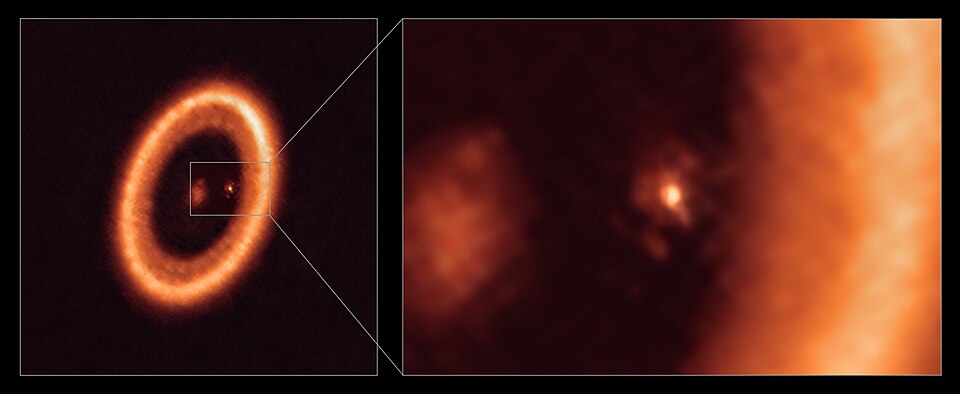
SPHERE opened its eye on the VLT at Paranal in May 2014 and has been the more prolific of the two. It caught HIP 65426 b in 2017. In 2018 it delivered PDS 70 b, a planet still sitting inside the gap it had carved in its star’s dust disc, about as close as anyone has come to watching planet formation happen. In 2020 it returned the first image of two giant planets around a young Sun-like star, TYC 8998-760-1.
The surveys also produced a result that never makes a poster: mostly, they found nothing. Hundreds of young stars, a handful of planets. Giant worlds on wide orbits are rare, and that null result forced theorists to rethink how often planets end up far from where they were born.
Four planets and a twenty-year time-lapse
If this field has a poster system, it is HR 8799, a young star about 130 light-years away in Pegasus, barely thirty million years old. In November 2008 Christian Marois and colleagues published images of three giant planets around it, taken with Keck and Gemini North. A fourth, closer in, followed in 2010. Four worlds of several Jupiter masses, strung from roughly fifteen to sixty-odd astronomical units.
They move slowly, so watching them is a career-length assignment; the outermost planet needs centuries for one orbit. Astronomers have nevertheless stitched the observing epochs into a short film in which four points of light visibly wheel around a masked-out star. Real photons, spanning most of two decades, not a simulation.
JWST has since revisited the system behind its coronagraphs and reported carbon dioxide in those atmospheres, which argues for formation by slow core accretion rather than a rapid collapse in the disc. That inference leans on atmospheric models, and the models are still being argued about.
Masks a million miles from here
JWST carries coronagraphic masks in both NIRCam and MIRI, and it works where this problem is kindest. In the thermal infrared a warm young planet is thousands of times fainter than its star rather than a billion times fainter. It also sits at L2 with no atmosphere to fight and a thermally quiet bench, so its speckle pattern barely wanders.
Its first direct image of an exoplanet, in 2022, was HIP 65426 b, the same world SPHERE had found five years earlier, now measured at wavelengths no ground telescope reaches through the air. In 2025 the MIRI coronagraph reported a roughly Saturn-mass companion in the disc around the young star TWA 7, the lightest planet imaged directly so far.
A 6.5-metre mirror still sets a hard floor on resolution, and JWST cannot see close in. For rocky planets in habitable zones it is the wrong instrument, and everyone involved knew that before launch.
What thirty-nine metres buys
Resolution scales with aperture, so seeing closer to a star means building something enormous. On Cerro Armazones in the Atacama, ESO is assembling the Extremely Large Telescope, a 39-metre primary of nearly 800 hexagonal segments, with first light planned late this decade. METIS, one of its first-generation instruments, combines mid-infrared imaging and spectroscopy with coronagraphs, and its stated ambitions include thermal-infrared detection of rocky planets around the nearest stars. Proxima b, found in 2016 around the closest star to the Sun, is the obvious target.
Whether it reaches the required contrast, nobody can honestly promise. Extreme AO on a 39-metre mirror is not a scaled-up copy of extreme AO on an 8-metre one, and predicting the residual speckle floor is what a decade of instrument papers has been trying to do.
In orbit, NASA’s Roman Space Telescope carries a coronagraph flown explicitly as a technology demonstration, meant to prove the active wavefront control that any future attempt at photographing an Earth twin would need. That observatory, sketched for now under the name Habitable Worlds Observatory, is decades of engineering away.
An image is worth more than a detection, which is the whole reason people keep grinding at this. A transit gives you a radius and a shadow. A planet imager gives you the planet’s own photons, and photons can be split into a spectrum whether or not the orbit happens to line up edge-on with Earth. Only a small fraction of systems transit; in principle, all of them can be photographed. Right now that phrase carries an enormous load. We can photograph young giants on wide orbits and very little else, and the gap between that and a temperate rocky world runs to several orders of magnitude. It has been closing steadily since 2004, one instrument at a time.
SETIworld follows this work as it happens, including the null results and the arguments over what a spectrum really shows. If you would rather track what the next generation of planet imagers actually delivers than what the press releases promise, read along with us.