Posted by
 The Moon as a Record of Cosmic History
The Moon has long been considered one of the most stable and scientifically valuable objects in our Solar System. Unlike Earth, it has no atmosphere, no active weather systems, and very little geological activity. This makes it an ideal place to preserve evidence of ancient events—including the theoretical possibility of alien technology or extraterrestrial artifacts.
In modern SETI research, the Moon is increasingly viewed as a potential archive of technosignatures. If advanced civilizations ever visited or observed our Solar System, traces of their activity could, in theory, still exist on the lunar surface.
This idea forms part of a broader field sometimes referred to as “space archaeology.”
Why the Moon Is a Unique Target
The Moon offers several advantages for searching for signs of alien technology.
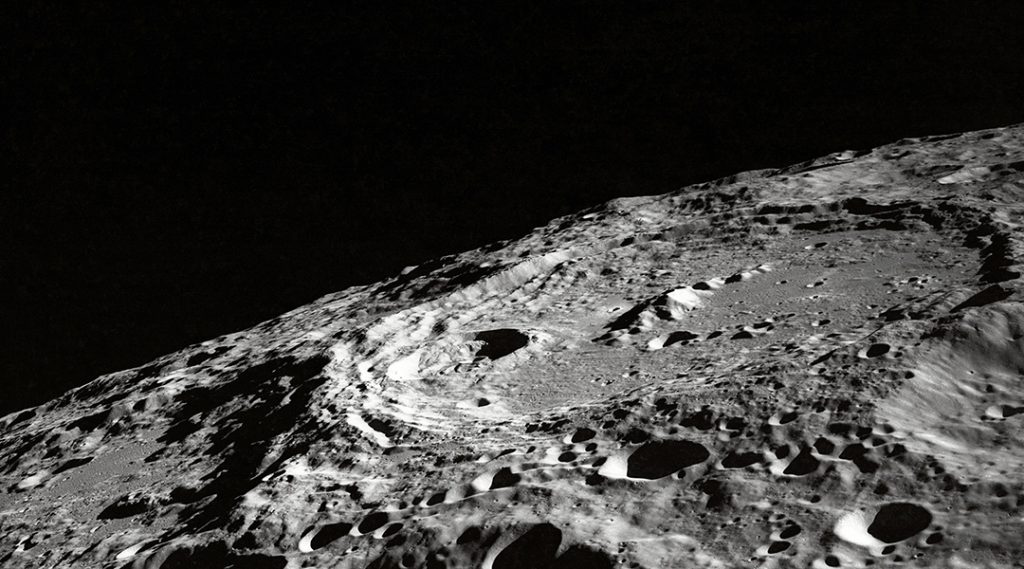
First, its lack of atmosphere means that surface evidence is not eroded by wind or water. Any physical artifact or structural anomaly could remain preserved for millions or even billions of years.
Second, the Moon’s surface is geologically inactive compared to Earth. There are no plate tectonics or large-scale resurfacing events that would erase potential evidence.
Third, its proximity to Earth makes it accessible for high-resolution imaging, robotic exploration, and future human missions.
These characteristics make the Moon one of the best candidates for investigating long-term extraterrestrial traces.
What Scientists Are Looking For
When searching the Moon for clues about alien technology, scientists focus on several categories of anomalies.
These include unusual surface structures, geometric formations that do not match natural geological processes, and materials with non-natural composition.
Researchers also examine permanently shadowed craters, which could preserve delicate structures protected from solar radiation.
In addition, unexplained reflectivity patterns or thermal anomalies may indicate non-natural origins.
While no confirmed artificial structures have been found, ongoing lunar missions continue to collect high-resolution data.
Orbital Imaging and Lunar Surveys
Modern lunar exploration relies heavily on orbital satellites equipped with advanced imaging systems.
These instruments can map the Moon’s surface in extraordinary detail, detecting features as small as a few meters across. By analyzing this data, scientists can identify unusual formations that warrant further investigation.
Spectral analysis is also used to determine the chemical composition of lunar soil and rocks. This helps identify materials that differ from expected natural lunar geology.
Combined, these techniques provide a comprehensive view of the Moon’s surface environment.
The Possibility of Ancient Artifacts
One of the more speculative ideas in lunar SETI research is the possibility of ancient alien artifacts.
If extraterrestrial civilizations visited the Solar System in the distant past, they may have left behind probes, monitoring devices, or other technological remnants.
Due to the Moon’s stability, such objects could remain preserved for extremely long periods without significant degradation.
However, there is currently no scientific evidence supporting the existence of such artifacts.
Radio and Technosignature Monitoring
In addition to physical searches, scientists also monitor the Moon for radio and electromagnetic anomalies.
If artificial structures or devices were present, they might produce detectable signals under certain conditions.
SETI researchers also consider the possibility that the Moon itself could reflect or amplify signals in unusual ways, potentially revealing hidden sources of technological activity.
These methods complement visual and spectral observations.
Lunar Missions and Future Exploration
Future lunar missions may significantly improve our ability to search for technosignatures.
Planned human bases and robotic exploration systems will allow for direct surface investigation. These missions could analyze subsurface layers, collect samples, and conduct in-situ experiments.
Advanced rovers may also be able to investigate areas that are difficult to observe from orbit, such as deep craters and polar regions.
As exploration expands, the Moon will become an increasingly important site for SETI-related research.
Challenges in Detecting Alien Technology
Despite advanced technology, detecting alien artifacts on the Moon remains highly challenging.
The lunar surface is covered with impact craters, dust, and natural geological formations that can easily mimic artificial structures in imaging data.
Additionally, the vast size of the Moon means that only a small portion has been studied in extreme detail.
False positives and interpretation errors are significant risks in this type of research.
Why the Lunar Search Matters
Even if no alien technology is found, studying the Moon provides valuable scientific insights.
It helps refine detection methods, improves imaging technology, and enhances our understanding of planetary surfaces.
Most importantly, it expands the scope of SETI beyond distant stars and brings it closer to home.
The Moon serves as a natural laboratory for testing ideas about extraterrestrial intelligence and space archaeology.
Conclusion
Searching the Moon for clues about alien technology is a fascinating intersection of astronomy, planetary science, and speculative SETI research. While no evidence of extraterrestrial artifacts has been discovered, the Moon remains one of the most promising locations for investigating long-term technosignatures.
As technology improves and lunar exploration expands, humanity may one day gain a clearer understanding of whether our closest celestial neighbor holds hidden clues about intelligent life beyond Earth.
Register on the portal to explore SETI research, lunar exploration, technosignatures, and the search for extraterrestrial intelligence across the Solar System.