Posted by
 In the winter of 1610 Galileo turned a tube with a lens about the size of a bottle cap toward Jupiter and watched four specks shuffle their positions from one night to the next. His best instruments reached perhaps thirty times magnification, with optics a modern factory would reject outright. They were enough to break the geocentric universe. That gap between the equipment and the result is why it is worth thinking hard about what a small powerful telescope actually is, because nearly everything printed on the box of a beginner scope is the wrong number.
The wrong number is magnification. A “675x” flash on the packaging tells you only that somebody bundled a very short eyepiece with a very cheap tube.
Aperture Buys Light, Magnification Only Crops
Aperture is the clear diameter of the front lens or the primary mirror, and it is the one specification that changes what exists in the image at all. Light collection scales with area, so a 100 mm objective gathers roughly two hundred times more light than a fully dark-adapted human pupil at about 7 mm. Resolution scales with diameter too. The old Dawes limit puts a 100 mm telescope at around 1.2 arcseconds of separation on a tight double star, and no eyepiece ever made will improve on that.
Magnification is free by comparison. Swap the eyepiece, get more of it. What you do not get is more detail: past roughly twice the aperture in millimetres, which is 200x on that 100 mm scope, you are simply enlarging blur. On most nights the atmosphere gives up long before the optics do, and anything past 150x to 250x turns Jupiter into a boiling smear. Astronomers call it seeing. You will curse it by name.
This is the whole trick behind a small powerful telescope: a well-made 90 mm instrument routinely beats a 114 mm department-store reflector advertising triple the power.
Lenses, Mirrors, and John Dobson’s Plywood Box
Refractors put a lens at the front. Sealed tube, nothing to align, high-contrast images, and they work the moment you carry them outside. The catch is colour. A cheap two-element achromat throws a violet halo around Venus and along the lunar limb, and the apochromatic glass that fixes it gets expensive very fast, which is why portable refractors cluster between 60 and 100 mm and stop there.
Newton built the first working reflector in 1668 to dodge exactly that problem. Mirrors bend all wavelengths identically, and a mirror needs one good optical surface where a lens needs four, so a Newtonian delivers far more aperture per unit of money. The price is collimation. The mirrors drift out of alignment and you learn to nudge them back, a job that takes five minutes once you have done it twice.
Then there is the Dobsonian, which is not an optical design at all. It is a mount. John Dobson, a former Vedanta monk who hauled homemade telescopes onto San Francisco street corners from the late 1960s onward, dropped a Newtonian tube into a plywood box turning on cheap bearings. It costs almost nothing and it does not shake. A 130 mm tabletop Dobsonian today sells for less than a mediocre 80 mm refractor and shows considerably more sky.
Maksutov-Cassegrains and Schmidt-Cassegrains fold a long focal length into a stubby tube. Superb on planets, easy to travel with, and they want half an hour standing outside before the image settles down.
The Tripod Is Half the Telescope
Nobody prints this on the box. At 150x, a thin aluminium tripod converts a fingertip on the focuser into four seconds of visible earthquake, and four seconds is longer than anyone’s patience. The mount is where cheap telescopes are genuinely cheap, and a bad one ruins good optics faster than bad glass does.
Altazimuth mounts move up-down and left-right, which is how your body already thinks. Equatorials tilt one axis to match your latitude and then follow a star with a single slow motion, which matters enormously for photography and rather less for looking. GoTo mounts will find objects for you after you align on two or three known stars. They will also drain batteries in the cold and quietly prevent you from ever learning the constellations. Decide which of those you mind more.
What You Actually See
Saturn first, because Saturn converts people. The rings separate cleanly in a 60 mm refractor at 50x, small and sharp and unmistakably a ring rather than a bulge, while the Cassini Division splitting them wants something nearer 100 mm and a genuinely steady night. Titan sits off to the side looking like a faint star that refuses to move.
Jupiter gives up two dark equatorial belts immediately and more if the air holds still. The four Galilean moons visibly rearrange themselves across a single evening, and when one crosses the face of the planet you notice its shadow before you notice the moon. The Great Red Spot is neither especially great nor especially red now, having shrunk for over a century into a pale salmon oval, and plenty of first-time observers stare straight past it.
The Moon is the target everyone underrates. Never look at it full, when the light is flat and blinding. Work the terminator instead, the line where the sun is rising or setting on the surface, and crater walls throw shadows kilometres long across the floor. Copernicus is 93 km wide, and a 90 mm scope shows its terraced rim and central peaks.
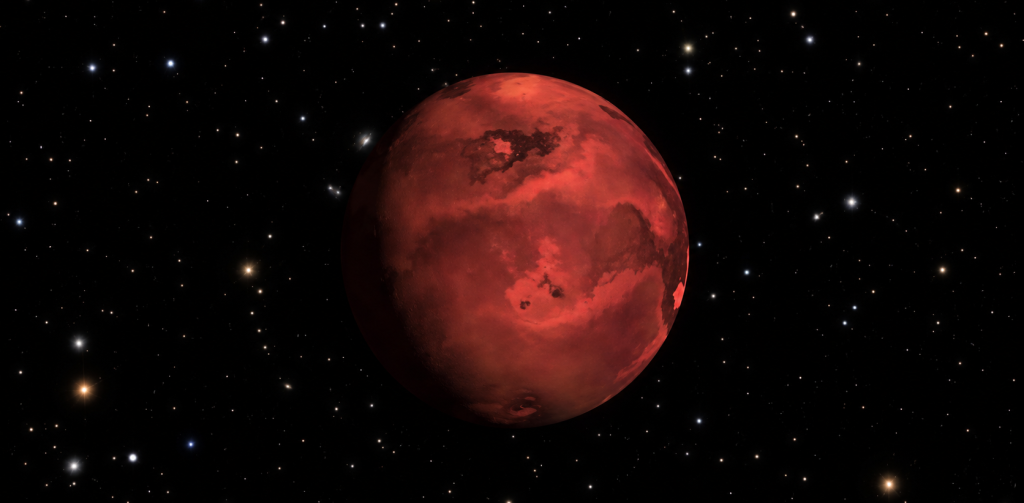
Mars disappoints for two years out of every two and a bit, then swings near opposition and grudgingly hands over a polar cap and the dark wedge of Syrtis Major.
And the Orion Nebula, thirteen hundred-odd light years off, hanging in the sword below the belt. Through a small telescope it is a grey-green fan of gas wrapped around four hot young stars, the Trapezium. Grey-green, not the pink of every photograph you have ever seen of it, because at that light level the colour-sensitive cones in your retina simply do not fire. Andromeda is harsher still: an oval smudge, no spiral arms, no dust lanes. Learning to enjoy that honestly is most of the skill.
Light Pollution Beats Aperture Every Time
An atlas of artificial night sky brightness published in Science Advances in 2016 found that more than 80 percent of the world’s population lives under light-polluted skies, and that over a third of humanity cannot see the Milky Way from home at all. Sky glow does not dim your target. It lifts the background, and contrast is what faint things live or die on.
Planets and the Moon punch straight through it. Galaxies do not. An 80 mm refractor driven out to properly dark countryside will beat a 200 mm tube marooned on a city balcony on every nebula in the sky, which makes portability a performance specification rather than a convenience. The best small powerful telescope is the one light enough that you genuinely put it in the car.
Amateurs Still Do Real Science
Modest apertures have a strange history of mattering. The first transit of an exoplanet ever observed, HD 209458 b in 1999, was caught by David Charbonneau, Timothy Brown and colleagues using STARE, a 10-centimetre instrument. Ten centimetres. The seven planets of TRAPPIST-1, announced in 2017, came out of a 60 cm robotic telescope at La Silla whose acronym stands in part for Small Telescope.
Three things amateurs still contribute. Variable star photometry, coordinated through the AAVSO since 1911, has built a database of tens of millions of observations that professionals mine when they need a star’s behaviour on record before committing expensive time to it. Occultation timing is the second: groups such as IOTA scatter observers along a shadow path to record the exact second a star blinks out behind an asteroid, and the chords assemble into a shape. In 2017 mobile teams dragged portable telescopes to Argentina and southern Africa to catch a faint star winking behind a distant Kuiper Belt object, and the awkward results warned the New Horizons team that Arrokoth was nothing like a simple sphere well before the spacecraft arrived on New Year’s Day 2019.
Third is transit follow-up. TESS throws out more candidates than professional observatories can possibly check, and NASA’s Exoplanet Watch programme pushes some of them into backyards. Nobody discovers a planet this way. What amateurs do is pin down when a known transit actually happens, so that time on something like JWST is not burned staring at an empty window.
What a small powerful telescope will not do is pick up a signal from anyone else. Breakthrough Listen works through the 100-metre Green Bank dish and Parkes in Australia, and Arecibo, which carried decades of that search, collapsed in December 2020. Radio SETI is not a garden hobby.
So the priorities go: aperture over magnification, a mount that does not wobble, and dark sky over both. Everything past that is preference. A 100 mm refractor and a 150 mm Dobsonian are different tools rather than better and worse ones, and the honest answer to which you should buy is whichever one you will carry outside on a cold Tuesday.
If you get that far, and Saturn holds still for a second and the rings snap into focus, you have arrived roughly where the rest of us started. SETIworld watches the same sky from the other end, through exoplanet catalogues, Mars sample science and the long unfinished argument about whether anybody out there is transmitting. Read along with us, and bring whatever you saw last night.