Posted by
 Understanding SETI and the Search for Extraterrestrial Intelligence
SETI stands for the Search for Extraterrestrial Intelligence, and the name is almost the whole idea. It is the scientific attempt to find out whether anyone else is out there by looking for signals or technological traces that nature alone cannot produce. There are no spaceships involved, no abductions, none of the things that science fiction taught us to expect. What there is instead is astronomy, physics, a great deal of signal processing, and a lot of patience. Researchers point telescopes at the sky, record enormous streams of data, and comb through them for something that does not look like a star, a pulsar, or a passing satellite.
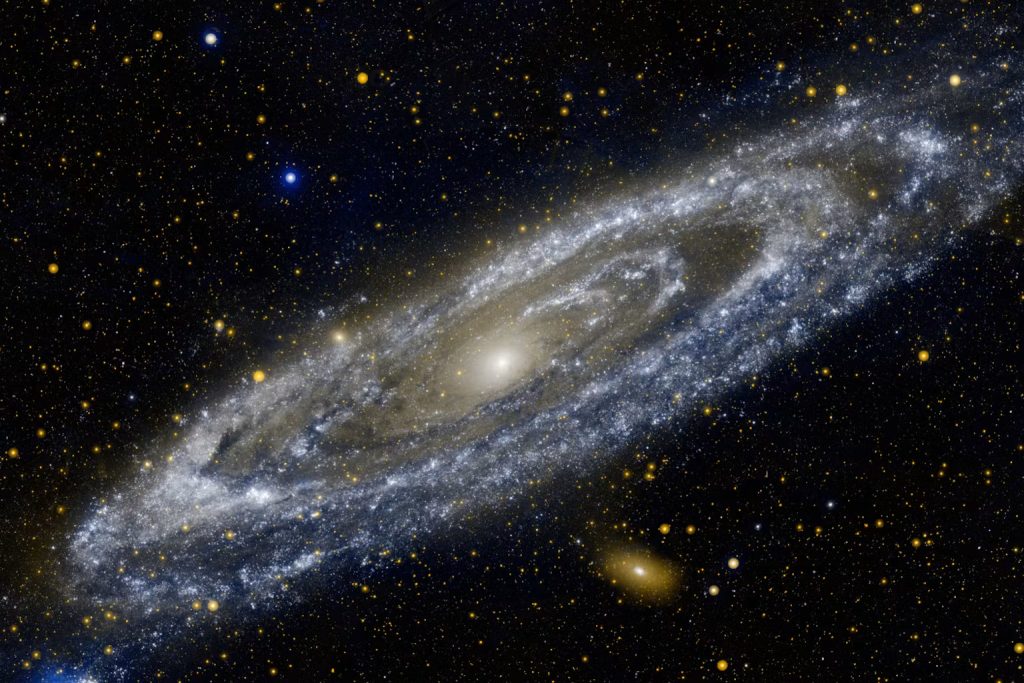
The question underneath all of this is old and very simple. Are we alone? People have asked it around campfires for thousands of years. What changed in the last century is that we finally built instruments capable of turning the question into an experiment. We now know the Milky Way holds hundreds of billions of stars, and that most of them carry planets. Some of those planets sit in the temperate zone where liquid water can survive. SETI exists because, for the first time in history, the universe looks crowded enough that the search is worth doing seriously.
A Short History of the Search
The modern story begins in 1960. A young astronomer named Frank Drake pointed a radio telescope in Green Bank, West Virginia, at two nearby Sun-like stars and listened. He called it Project Ozma, after the queen of Oz, and although he heard nothing conclusive, he proved the search could be done with real equipment. A year later he wrote down the famous Drake Equation, a back-of-the-envelope way of estimating how many communicating civilizations might exist in our galaxy. It did not give an answer. It gave researchers a list of the things they needed to learn.
Then came the Wow! signal of 1977, a strong, narrow burst picked up by Ohio State University’s Big Ear telescope. An astronomer circled the printout and scribbled “Wow!” in the margin. The signal never repeated, and to this day nobody is certain what it was. That single unexplained minute captures the whole field rather well: a tantalizing maybe, never confirmed, impossible to dismiss. Later efforts such as NASA’s brief survey and the privately funded Project Phoenix carried the work forward, and today Breakthrough Listen runs one of the most ambitious campaigns ever attempted.
How Does SETI Actually Work?
Most of the search has focused on radio waves, and for a practical reason. Radio travels across vast stretches of space cheaply, passes through dust clouds that would block visible light, and is something any technological species would likely stumble onto early. Telescopes like Green Bank in the United States and the enormous FAST dish in China can collect faint whispers of radio energy from thousands of light-years away. Receivers split that energy into millions of narrow frequency channels, because a natural source spreads its power across a wide band while a transmitter tends to concentrate it into a sharp tone.
Radio is not the only avenue. Optical SETI looks for brief, powerful laser pulses that could outshine a star for a billionth of a second. Other researchers hunt for technosignatures of a different kind altogether: waste heat from vast machinery, strange industrial gases in a planet’s atmosphere, or structures that block starlight in unnatural ways. The common thread is intentionality. Scientists are looking for the fingerprint of engineering, the one thing physics does not create on its own.
What Makes a Signal Interesting?
Here is the hard part. The sky is loud, and almost all of the noise comes from us. Phones, aircraft radar, GPS satellites, microwave ovens, even a poorly shielded laptop in the control room can masquerade as a message from the stars. Pulsars and quasars add their own natural roar. So when a candidate appears, the first assumption is always that it is interference, and the burden of proof sits squarely on the signal.
A genuinely interesting detection has to clear several hurdles. It should be narrow in frequency, the way human transmitters are and nature is not. It should come from a fixed point on the sky and drift in step with the Earth’s rotation, rather than following an airplane or a satellite. Ideally it repeats, so a second telescope can confirm it. Only after a candidate survives all of that does it earn a closer look. The overwhelming majority do not survive, and that is exactly how the process is supposed to work.
Why the Search Matters Even Without an Answer
It would be easy to call sixty years of silence a failure. It is not. SETI has pushed radio astronomy, signal processing, and data science forward in ways that ripple far beyond the search itself. The techniques built to sift cosmic noise now help analyze everything from medical scans to financial data. The volunteer project SETI@home, which let millions of people donate idle time on their home computers, became a model for distributed computing that researchers in dozens of unrelated fields later borrowed.
There is a quieter benefit too. Every time a telescope scans a patch of sky for artificial signals, it also records natural ones, and that data feeds ordinary astronomy. Pulsars get catalogued, distant galaxies get measured, and our map of the neighborhood gets a little sharper. A search that finds no aliens still finds the universe.
The Challenges That Remain
Space is the obstacle and the prize at the same time. It is staggeringly large, and radio signals fade with distance, so a transmission from a faraway world might reach us as something barely louder than the hum of the receiver. We also have no idea what to expect. A civilization might broadcast for a few decades and then go quiet, or use a technology we have not invented and cannot recognize. We are, in a real sense, trying to overhear a conversation without knowing the language, the channel, or whether anyone is speaking at all.
Modern telescopes generate so much data that no team of humans could ever read it directly. This is where machine learning has quietly transformed the field. Algorithms now scan petabytes of recordings, flagging the handful of anomalies worth a scientist’s attention and discarding the mountains of ordinary noise. The search has become as much a computing problem as an astronomical one.
The Drake Equation, Without the Math
People often hear about the Drake Equation and assume it spits out a number. It does not. Frank Drake wrote it in 1961 not to calculate how many alien civilizations exist, but to organize the question into pieces small enough to study one at a time. How many stars form each year? How many have planets? How many of those planets could support life, and of those, how many actually do? Then the harder, almost philosophical terms: how often does life become intelligent, build technology, and survive long enough to be detected?
The early terms have shifted from guesswork to measurement. We now know planets are common and that temperate, rocky worlds are not rare. The later terms remain wide open, because we have exactly one example of a technological species, and a sample size of one tells you very little. That is precisely why SETI keeps looking. Every part of the search chips away at a number nobody can yet write down with confidence.
Would We Even Recognize a Message?
Suppose a signal arrived tomorrow. Recognizing it as artificial is one thing; understanding it is another entirely. A message from a civilization thousands of light-years away would carry no shared language, no agreed alphabet, nothing we could simply translate. Researchers have thought hard about this, and most expect a first contact to look less like a conversation and more like a mathematical beacon, something built from prime numbers or physical constants that any technological species would recognize. The content might stay a mystery for years. The mere fact of the signal would already be the most important discovery in human history.
The Future of SETI
The next decade looks promising. New radio arrays with far greater sensitivity are coming online, and instruments built to study exoplanet atmospheres, such as the James Webb Space Telescope, may one day spot a chemical imbalance that hints at industry or life. As astronomers pin down which nearby planets are genuinely temperate, the search can aim at specific, promising targets instead of sweeping the whole sky blindly. Each improvement narrows the haystack.
No confirmed signal has arrived yet, and it is entirely possible none ever will in our lifetimes. But the value of the search was never only in the finding. It sits in the asking, in the instruments we build to ask better, and in what those instruments teach us about the cosmos along the way. Curiosity has always been the thing that pushed people over the next hill, and few hills are taller than this one.
Register on our portal to explore more SETI discoveries, space science articles, and the latest research on the search for extraterrestrial intelligence.