Posted by
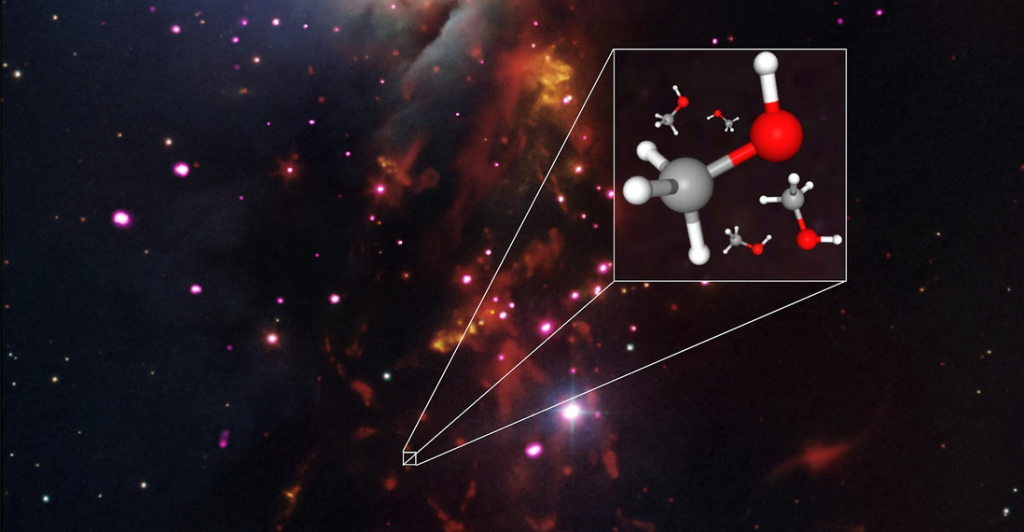
 Astronomers have identified an exceptionally molecule-rich cloud near the center of the Milky Way that could become an important laboratory for studying how complex and potentially prebiotic chemistry develops in space. The molecular cloud, known as G+0.633-0.0604, lies at the southern edge of the Sagittarius B2 complex near the Galactic Center.
Researchers have already detected more than 120 molecular species there, including compounds containing all six major biogenic elements – carbon, hydrogen, oxygen, nitrogen, phosphorus, and sulfur.Observations were obtained with the Yebes 40-meter, IRAM 30-meter, and APEX radio telescopes across nearly 100 GHz of bandwidth.
The findings establish G+0.633 as the first confirmed astrochemical “twin” of G+0.693-0.027, one of the richest molecular environments known in interstellar space. The two clouds show striking similarities in their molecular inventories and chemical abundances, suggesting that the unusual chemistry of G+0.693 is not a unique phenomenon. Instead, researchers propose that both clouds may owe their molecular richness to similar shock-driven chemical processes.
Among the molecules detected in G+0.633 are several compounds relevant to prebiotic chemistry. These include ethanolamine, associated with the hydrophilic heads of phospholipids in modern cell membranes, and glycolamidected all three cyanomethanimine isomers discussed in the study, molecules considered important intermediates in proposed chemice, a structural isomer of glycine. Researchers also detal pathways toward adenine, a nucleobase found in RNA and DNA.
G+0.633 also offers an observational advantage: its molecular spectral lines are about twice as narrow as those in G+0.693, reducing line blending and making faint molecular signatures easier to identify. Researchers say the pair could become a benchmark for testing astrochemical models and investigating how molecular complexity arises in interstellar space.
For more details, read the full article.