Posted by
 In August 1877, with Mars unusually close to Earth, Asaph Hall spent night after night at the 26-inch refractor of the US Naval Observatory in Washington, hunting for something most astronomers assumed wasn’t there. He was about to give up. His wife, Angeline Stickney Hall, told him to keep looking, and within a week he had found both of the moons of Mars: a faint speck he named Deimos and a closer one he called Phobos, after the twin attendants of the war god in Greek myth. Dread and Fear. Not exactly cozy names for two lumps of rock that, on closer inspection, turned out to be among the strangest satellites in the solar system.
Strange, because they look nothing like our Moon. Phobos is roughly 27 by 22 by 18 kilometers, Deimos about 15 by 12 by 11. You could drive across Deimos in a quarter of an hour, if there were a road. Neither has enough gravity to pull itself into a ball, so both are lumpy, cratered and very dark, reflecting only a few percent of the sunlight that hits them. Almost a century and a half after Hall’s discovery, the most basic question about them is still open: where did they come from?
Two potatoes and a coincidence
Before getting to that, a small historical oddity. In 1726, Jonathan Swift wrote in Gulliver’s Travels that the astronomers of Laputa had discovered two moons circling Mars, one of them very close to the planet. Swift was probably riffing on an older guess by Johannes Kepler, who reasoned (wrongly, but entertainingly) that if Earth had one moon and Jupiter four, Mars ought to have two. Pure numerology. It happened to land on the right answer.
The moons themselves are anything but tidy. Phobos orbits only about 6,000 kilometers above the Martian surface, roughly 9,400 kilometers from the planet’s center, and completes a lap in 7 hours and 39 minutes. That is faster than Mars rotates, which produces some peculiar effects in the Martian sky. Deimos sits much farther out, around 23,500 kilometers from the center, and takes a little over 30 hours per orbit. Both move in nearly circular paths that hug the plane of the Martian equator.
Hold on to that last detail. It matters more than it seems.
Captured asteroids, or debris from a giant impact?
For most of the twentieth century, the favored explanation was capture. The moons are small, dark and irregular, and their reflected light resembles the spectra of primitive carbon-rich asteroids, the so-called D-type and C-type objects common in the outer asteroid belt. Mars sits right next door to that belt. A passing asteroid gets snagged, settles into orbit, done.
That sounds tidier than it is. A captured body usually ends up on an eccentric, tilted orbit, the way many of the small outer moons of Jupiter and Saturn do. Getting an asteroid onto a near-circular orbit aligned with the Martian equator requires bleeding off a lot of energy, perhaps through drag in an extended early atmosphere or a cloud of gas and dust. Doing it twice, for two separate objects, stretches the story further.
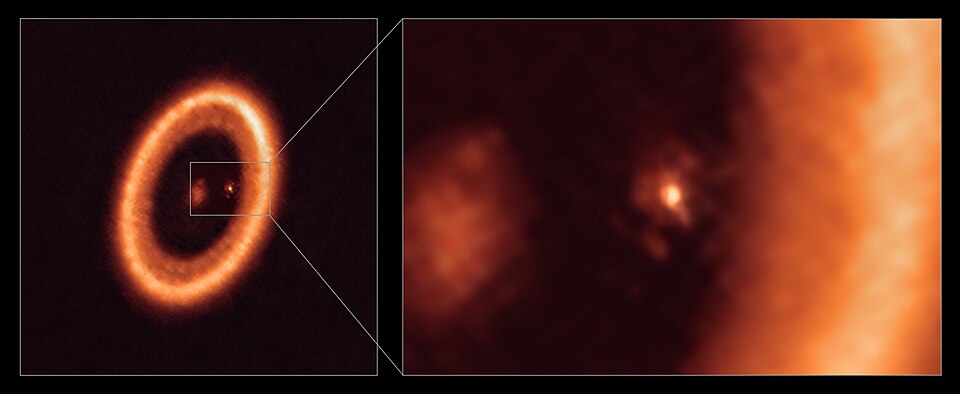
So a second idea has been gaining ground. Early Mars took heavy blows, and the planet’s northern lowlands may themselves be the scar of something enormous. A large impact could have hurled a disk of debris into orbit, and simulations published in the 2010s by groups in France, Belgium and Japan showed that such a disk could build a big inner moon close to Mars that later spiraled in and broke apart, leaving smaller moonlets like Phobos and Deimos farther out. Equatorial, circular orbits fall out of that model naturally.
There are other variants. One proposal from 2021 suggested Phobos and Deimos are fragments of a single larger moon that split apart billions of years ago. Another suggests Mars has gone through several cycles of building rings and moons from the same recycled material. Nobody knows which, if any, is right, and the dark colouring that originally pointed to captured asteroids can also be produced by space weathering of ordinary Martian rock. The spectra, in other words, are ambiguous.
Phobos, the moon that is running out of time
Phobos has a problem. It orbits inside the point where a moon would keep pace with the planet’s rotation, so the tidal bulge it raises on Mars lags behind and drags on it. The result is that Phobos is losing altitude, by somewhere around 1.8 meters per century. That sounds trivial. Over geological time it is fatal.
Within roughly 30 to 50 million years, Phobos will either crash into Mars or, more likely, be torn apart by tidal forces once it crosses the Roche limit, scattering its material into a ring that may circle the planet for millions of years before raining down. Saturn wears its rings now. Mars may get a turn. Deimos, being outside the synchronous point, is drifting very slowly outward instead, a little like our own Moon.
The surface of Phobos may already show the strain. It is scored by long parallel grooves, some of them hundreds of meters wide, and for decades scientists argued about what made them. Ejecta from the giant Stickney crater, which is about 9 kilometers wide and named after Angeline Stickney Hall, was one candidate. Rolling boulders were another. A newer idea holds that at least some grooves are stretch marks from tidal stress, the first visible signs of a moon slowly being pulled apart. The debate is not settled, and it probably won’t be until something lands there.
Deimos, the quiet one
Deimos gets less attention, partly because it is smaller and partly because it looks calmer. Its craters are muffled by a thick blanket of loose dust and rubble, so the surface appears smooth in all but the closest images taken by Viking in the 1970s and by NASA’s Mars Reconnaissance Orbiter decades later. In 2023, the United Arab Emirates’ Hope orbiter swung close to Deimos and returned some of the best views of its far side ever captured, along with spectral data that the team argued look more like Martian material than a typical asteroid.
If that holds, it nudges the needle toward an impact origin. If.
Why a sample would settle the argument
Remote sensing has taken us about as far as it can. Every spacecraft that has studied the moons of Mars from orbit, including Europe’s Mars Express, which has made dozens of close passes of Phobos, has come back with better pictures and the same unresolved question. The problem is that a dark, dusty surface can hide what lies underneath, and spectra from a distance can be read more than one way.
What scientists actually want is material in a lab. If Phobos is a captured asteroid, its rock should resemble certain carbonaceous meteorites, with the chemistry and isotopes of the outer asteroid belt. If it formed from impact debris, it should look much more like Mars itself, perhaps even carrying fragments of the ancient Martian crust thrown up by later impacts on the planet below. Isotope ratios of oxygen and other elements would be close to a fingerprint.
The Soviet Union tried twice. Phobos 2 reached Mars orbit in 1989 and lost contact shortly before its planned approach to the moon, and Russia’s Phobos-Grunt sample-return mission never left Earth orbit after its 2011 launch. The next attempt is Japan’s Martian Moons eXploration mission, MMX, which is designed to orbit Mars, land on Phobos, scoop up surface material, fly past Deimos and return the sample to Earth. Its schedule has shifted before, so treat any arrival date with some caution. If it works, it would be the first sample ever returned from the Mars system.
Small moons, big footnotes
There is also a practical reason people keep talking about Phobos. Its gravity is so weak that a spacecraft could land and lift off with very little fuel, and some mission planners have floated it as a staging post or a shielded observation base for crews orbiting Mars before anyone attempts the surface. Whether that ever happens is a separate story, and a speculative one.
The scientific case is stronger and more immediate. The moons of Mars sit at the junction of several big questions: how rocky planets got battered in their youth, how satellite systems form, and how much material Mars has swapped with its surroundings over four billion years. Two dark potatoes, discovered on the strength of a stubborn telescope session and a spouse’s encouragement, may hold a record of all that.
If you want to follow what MMX finds, or compare notes on Martian rings that don’t exist yet, there is plenty more about Mars and the wider solar system on SETIworld. Come and read, argue, and keep looking, the way the Halls did.