Are we alone - and can science actually find out?
For as long as humans have looked at the night sky, one question has followed us:
“Are we alone in the universe?”
Is life something that naturally appears when the right conditions come together, or was Earth a rare accident? And if another civilization exists somewhere among the stars, could we ever notice each other across distances measured in light years?
For most of history, these questions had no scientific answer. People could imagine other worlds, write stories about alien civilizations, or argue about whether life beyond Earth was possible. But there was no way to test these ideas. No known planets outside the Solar System. No instruments capable of studying distant worlds. No experiment that could separate a universe full of civilizations from one where humanity was alone. That began to change when astronomy developed the ability to study the universe not just as a collection of stars, but as a collection of physical places. Today, we still do not know whether other technological civilizations exist, but we can finally investigate the possibility.
From Stars to Planetary Systems
The first step toward answering the question began with a change in how we understood stars.
For centuries, stars were simply distant points of light. Modern astronomy showed that they are other suns, governed by the same physical laws as our own. Scientists learned how stars form, how they change over time, and how they eventually disappear. Then came another major discovery: planets are not rare exceptions. In 1992, astronomers found planets orbiting a pulsar[1] – a type of star unlike anything in our Solar System. Three years later, in 1995, Michel Mayor and Didier Queloz discovered 51 Pegasi b, the first planet detected around a Sun-like star[2]. The planet itself was not an Earth-like world. It was a giant planet orbiting extremely close to its star, completing one orbit in just over four days.
But the discovery changed astronomy forever. Planets around other stars were no longer an assumption. They were real objects that could be found and studied! Since then, thousands of exoplanets have been confirmed. Some are enormous gas giants larger than Jupiter; others are rocky worlds closer in size to Earth. Some orbit within the habitable zones of their stars – regions where temperatures could allow liquid water to exist if other conditions are suitable.
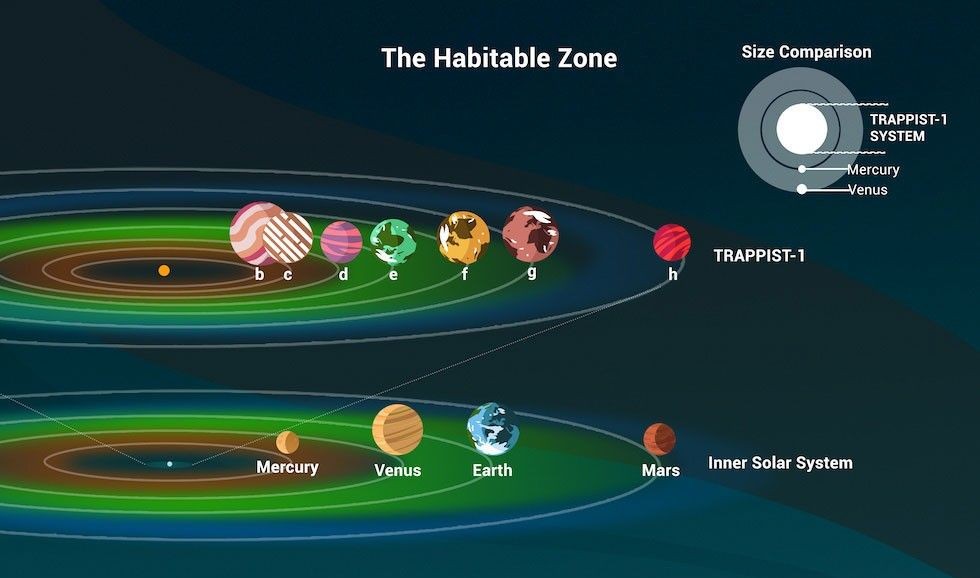
However, a planet in the habitable zone is not automatically a planet with life. Its atmosphere matters. So does the activity of its star, its geological history, and many other factors that scientists are still trying to understand. Still, one fact is now clear: the Universe contains an enormous variety of planetary systems. The search for life is no longer about imaginary worlds around unknown stars. We now have actual planets to investigate!
Looking for Technology, Not Aliens
When people hear about the search for extraterrestrial intelligence, they often imagine astronomers trying to find alien civilizations directly. But that is not what SETI does.
The name SETI stands for ‘Search for Extraterrestrial Intelligence’, but telescopes cannot see intelligence itself. They cannot detect thoughts, languages, or intentions. They can only measure physical signals. So, researchers ask a different question: “Could another civilization create something that we could detect from Earth?”
This is the idea behind technosignatures – possible signs of technology beyond our planet. Scientists have considered many possibilities[3]:
- powerful radio transmissions;
- short laser pulses;
- unusual chemicals in a planet’s atmosphere;
- large amounts of heat produced by advanced energy systems;
- other physical effects that natural processes might not easily explain.
A famous example shows why this distinction matters. In 1977, the Ohio State University radio telescope detected a strong, narrow-band radio signal that lasted just over a minute. Astronomer Jerry Ehman, who noticed the unusual pattern in the data the following morning, wrote “Wow!” on the printout. The signal appeared to behave like a source fixed on the sky as the telescope moved across it, which made it particularly interesting for SETI. It was never detected again, however, and its origin remains unresolved.
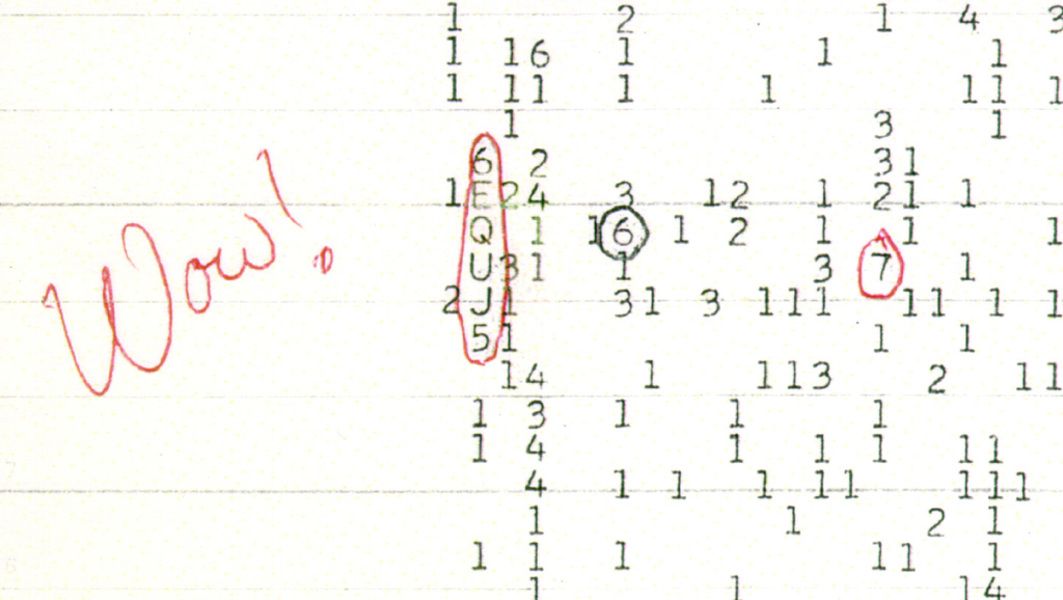
The ‘Wow! Signal’ is therefore not evidence that extraterrestrial technology has been found. It is something more useful for understanding SETI: an example of the kind of unexpected physical signal that can trigger a search for a technological explanation – and of why a single unusual observation is never enough to claim a discovery[4] .
The advantage of this approach is that researchers do not need to know what alien life looks like, as a civilization could be completely different from humanity. It could have a different biology, culture, or way of communicating. But technology follows physics, and if a civilization builds something powerful enough, it may leave traces that travel through space.
Could we actually detect it?
The possibility of detection depends on physics. A signal produced by another civilization would have to travel through interstellar space and still be strong enough for an instrument on Earth to distinguish it from natural background radiation and human-made interference. Distance matters, because a signal generally becomes weaker as it spreads away from its source. The power of the transmitter matters too: a powerful signal can remain detectable much farther away than a weak one.
The type of signal matters just as much:
- narrow radio transmission concentrated around one frequency may stand out differently from a broad transmission spread across a large part of the spectrum;
- a laser pulse can be extremely bright but very short;
- an atmospheric chemical signature may remain for years but require a completely different type of telescope to detect.
Time creates another difficulty. A civilization might transmit continuously, but it could also produce a signal only for a few seconds, minutes, or hours. If Earth is not observing at exactly the right moment, the signal may pass unnoticed. The same problem applies to direction: a transmitter could send most of its energy in a narrow beam, and Earth would detect it only if that beam crossed our line of sight. Even the frequency of a signal can create a blind spot – a receiver can examine only a particular part of the electromagnetic spectrum at a given time; if a signal appears somewhere else, the telescope may simply not register it.
These limitations mean that detecting another civilization is not a matter of making a telescope powerful enough and waiting. Scientists must make a series of physical assumptions about what kind of signal could exist and what an instrument should be able to measure. The search therefore begins with a prediction: if technology of a certain kind exists, what would it look like from Earth?
The search continues
The question is therefore much more physical than it first appears. What we mean is:
- Could a radio transmitter be detected from another star system?
- Could a short laser pulse be distinguished from natural light?
- Could a technological process alter a planet’s atmosphere enough for a future telescope to notice?
Each of these questions can be translated into measurements, models and observations.
We still do not know whether another technological civilization exists somewhere in the universe. But the problem is no longer purely philosophical: we know what kinds of physical effects our instruments can measure, and we can calculate how far those effects might travel and under what conditions they could be detected. Humanity has learned how to turn the question “Are we alone?” into a set of experiments. The next problem is understanding how many of those experiments we have been carried out.
References
[1] Wolszczan, A., & Frail, D. A. (1992). A planetary system around the millisecond pulsar PSR1257 + 12. Nature, 355, 145–147. https://doi.org/10.1038/355145a0
[2] Mayor, M., & Queloz, D. (1995). A Jupiter-mass companion to a solar-type star. Nature, 378, 355–359. https://doi.org/10.1038/378355a0
[3] SETI Institute. A Primer on SETI at the SETI Institute. https://www.seti.org/research/seti-101/a-primer-on-seti-at-the-seti-institute/
[4] SETI Institute. The Wow! Signal. SETI 101. SETI Institute – The Wow! Signal. https://en.wikipedia.org/wiki/Wow!_signal
https://www.seti.org/news/the-wow-signal-a-lingering-mystery-or-a-natural-phenomenon/