If Another Earth Were Nearby, Could We Detect It?
Imagine that somewhere in our galaxy there is a second Earth. It has oceans, an atmosphere and a civilization roughly as advanced as ours. Its inhabitants use radio, satellites, lasers, cities and spacecraft; they do not send us a message, they do not deliberately announce their existence. Could we still discover them?
The question sounds similar to the one SETI has been asking for decades, but gives scientists something rare in SETI – a real example to work with.
Earth as a benchmark
What do we know? We know:
- exactly what technology on Earth produces;
- that communication systems emit radio waves;
- that planetary radar can produce much stronger, highly directed signals;
- that satellites and spacecraft have artificial signatures;
- that cities emit light and heat;
- that industrial activity changes the composition of our atmosphere.
None of these signals was created for SETI – they are simply consequences of being a technological civilization. That makes Earth a useful test case! If we can calculate how far away another civilization could detect these signatures, we can get a better idea of what “detectable technology” actually means.
A 2025 study led by Sofia Sheikh did exactly this. Instead of assuming a hypothetical civilization with enormous transmitters or advanced megastructures, the researchers asked how far present-day Earth technology could be detected using present-day observing technology. They considered radio transmissions, atmospheric changes, optical and infrared signatures, and artificial objects in space or on planetary surfaces. [1]
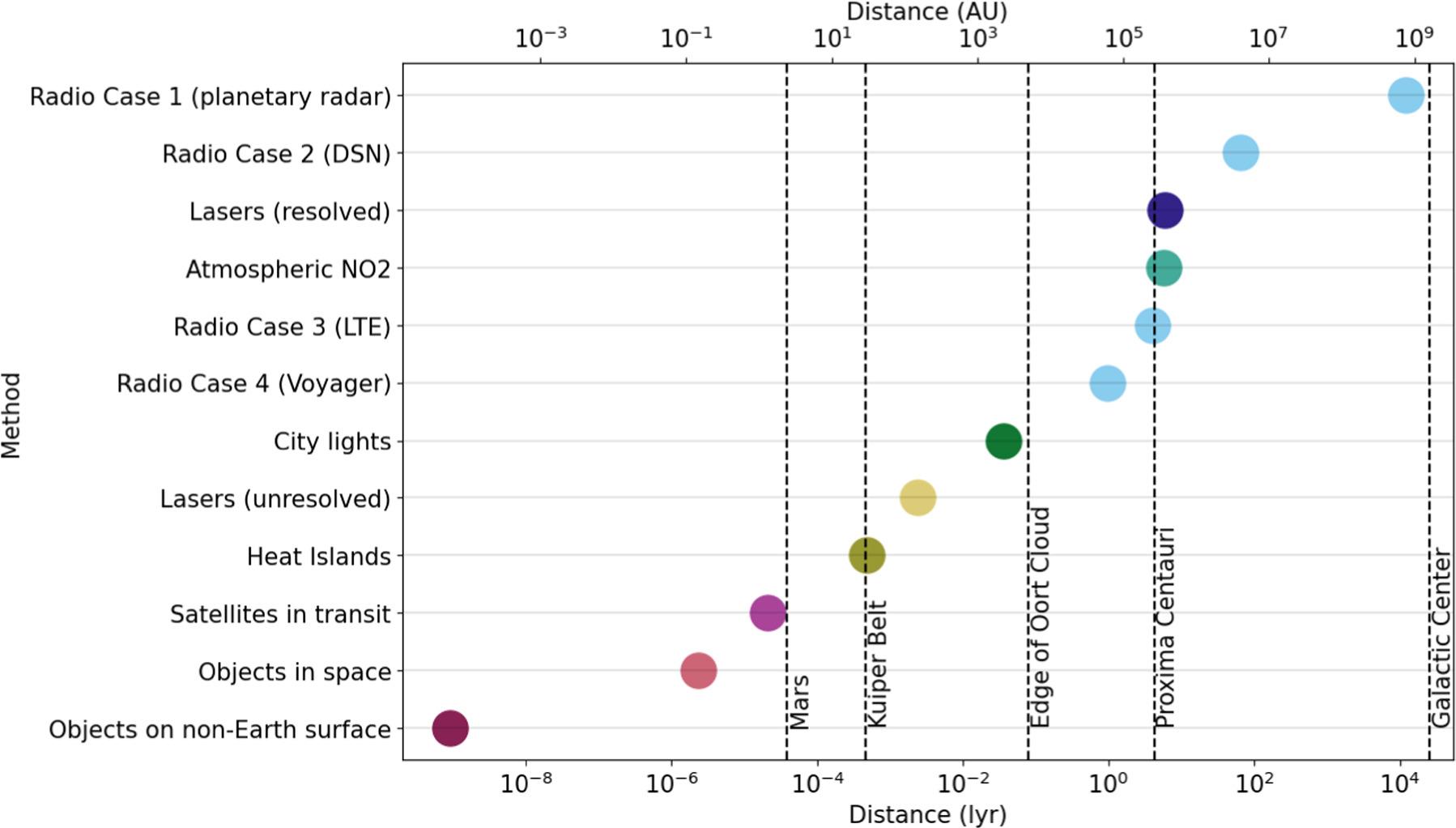
The result was not one simple detection distance. Different parts of Earth would become visible at very different ranges.
Some parts of Earth are much louder than others
Radio is still the strongest way for a civilization like ours to make itself detectable across interstellar distances. But even within radio astronomy, the difference can be enormous. A weak, broadly distributed signal is difficult to distinguish from the background. A powerful signal aimed deliberately into space is much easier to detect.
The clearest example is planetary radar. Earth has used powerful radio transmitters to study planets and asteroids. The 2025 study found that signals of this kind could, in principle, be detectable from up to about 12,000 light-years with present-day receiving technology under the study’s assumptions. That makes planetary radar by far the most detectable of the Earth-based technosignatures considered.
Ordinary communication is a different story. Signals associated with systems such as LTE are much weaker. The same study estimated a maximum detection distance of about 4 light years for its LTE case – roughly the distance to our nearest stellar neighbours.
So even the phrase “Earth is producing radio signals” hides an important question. Which signals? How powerful are they? Are they directed? How often are they produced? And is the observer in the right direction to see them? The answer can change the detection distance by orders of magnitude. What about light, pollution and cities?
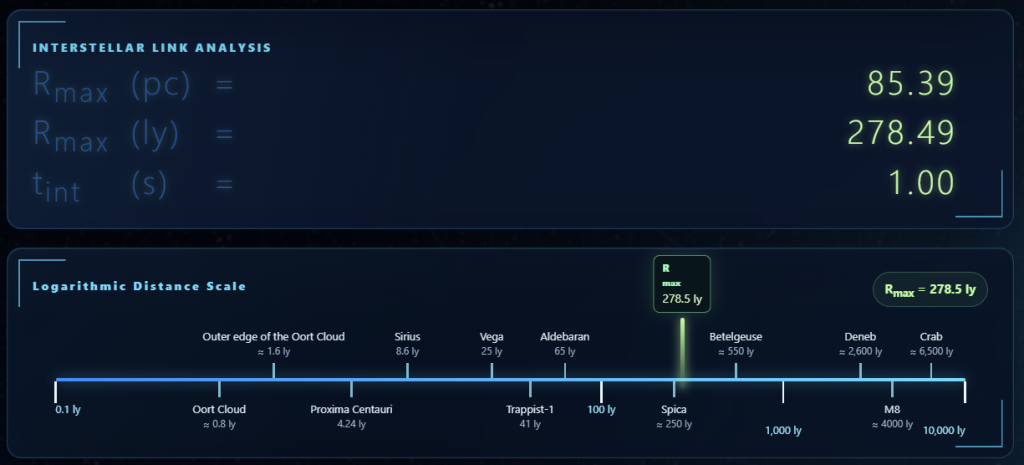
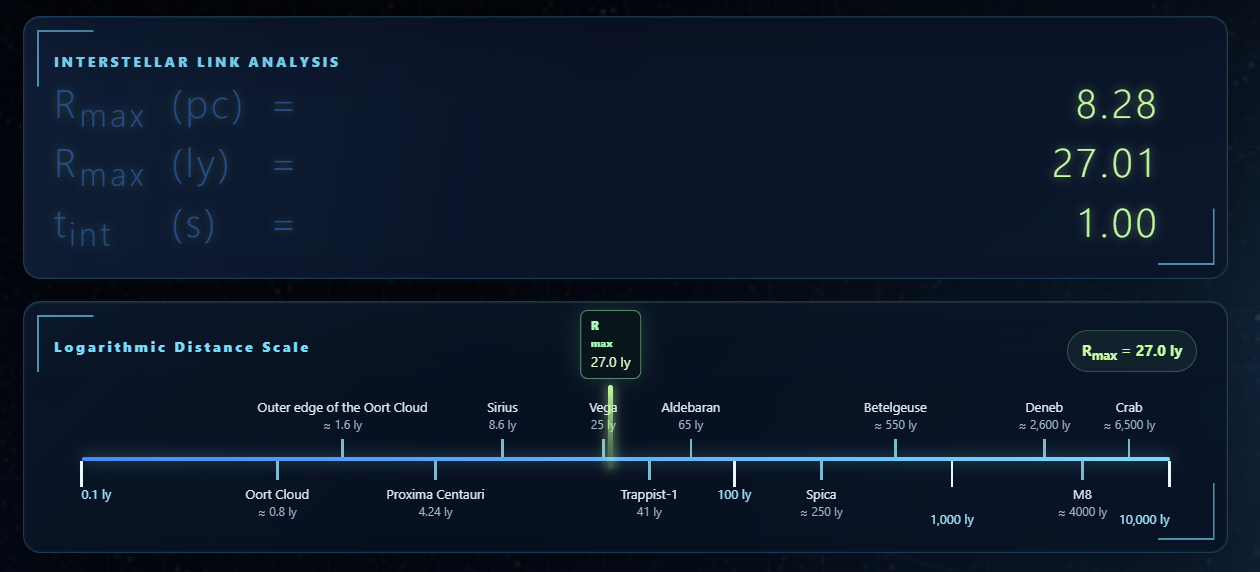
These differences can also be explored with the SETIworld Interstellar Communication Range Calculator, which allows users to change parameters such as transmitter power, antenna characteristics and receiver sensitivity and see how they affect the estimated detection range. It is a simple way to see why a signal can exist and still remain beyond our ability to detect it.
Radio is not the only possible way to notice Earth. A technological civilization could also look for changes in a planet’s atmosphere. Some industrial processes release gases that can potentially leave detectable spectral signatures. One example is nitrogen dioxide (NO₂), which is associated with combustion and other human activity.
Other possibilities are more familiar.
An advanced telescope could look for artificial light on the planet’s night side. In principle, large cities could produce a spectral signature different from natural sources. Researchers have also considered the excess infrared emission associated with urban heat islands. But these signatures are much harder to detect than the strongest radio transmissions.
The 2025 study estimated that present-day city lights would be detectable only at a tiny fraction of a light-year under its assumptions, while atmospheric NO₂ could potentially be detectable from several light-years away. The difference illustrates an important point: being a real technosignature does not mean being an easy technosignature to detect.
The same applies to artificial objects. Satellites, spacecraft and equipment left on planetary surfaces are unmistakable signs of technology if someone can resolve them, but from interstellar distances, their physical size becomes a severe limitation. A civilization could know that such objects exist and still be unable to see them.
Detection depends on the observer
There is another problem that is easy to overlook: Earth does not look the same from every direction.
Our strongest radio transmissions are not emitted equally in all directions – some are deliberately pointed toward particular targets.
A civilization located somewhere else in the Galaxy might never lie in the path of a powerful transmission. And the same applies to time: technology changes; radio systems, that were common decades ago, may disappear; new communication systems may use different frequencies or lower-power signals; a civilization could become more or less visible as its technology evolves… Even the Earth itself changes – a distant observer detecting our atmosphere today would not see exactly the same chemical composition that existed a century ago. An observer far enough away would also see our past, because light takes time to cross interstellar distances. That means SETI is not only a search across space – it is also, inevitably, a search across time.
Could another Earth hide from us?
This thought experiment leads to an uncomfortable conclusion: a technological civilization does not need to be invisible to be difficult to detect.
Earth is full of technology: we produce radio emissions, artificial light, atmospheric changes, satellites, spacecraft and heat. And yet, if another Earth existed nearby, we could easily miss most of these signatures. Only a small number of Earth’s technological effects are detectable across truly large interstellar distances. Others require the observer to be relatively close, to use sufficiently sensitive instruments, or to look at exactly the right wavelength, time or direction.
This is important for SETI because it gives us a realistic benchmark. Instead of imagining an alien civilization that builds a transmitter a million times more powerful than anything humanity has ever constructed, we can begin with a simpler question:
Could we detect a civilization like ourselves?
The answer is sobering: probably not, at least not reliably with today’s technology.
Some of Earth’s most powerful technosignatures could, under very specific conditions, be detected across thousands of light-years. But many of the signals produced by a civilization like ours are detectable only over much shorter distances. For example, the 2025 study estimated a maximum detection range of about 65 light-years for signals from the Deep Space Network, while ordinary 4G LTE signals could be detectable from only about 4 light-years away.[1]
This helps explain why the absence of a confirmed signal is not surprising at our current level of technology. We simply have not been able to see enough of the Galaxy, in enough ways, to expect a detection.
But there is good news: in recent years, humanity has made major advances in both technology and the way we search. New instruments, more sensitive receivers and new methods of analysing large amounts of astronomical data are allowing us to look for signals that previous generations simply could not detect. The next article will explore why this may be the best time in history to search for another civilization.
References
[1] Sheikh, S. Z., Huston, M. J., Fan, P., Wright, J. T., Beatty, T., Martini, C., Kopparapu, R., & Frank, A. (2025). Earth Detecting Earth: At What Distance Could Earth’s Constellation of Technosignatures Be Detected with Present-day Technology? The Astronomical Journal, 169(2), 118. DOI: 10.3847/1538-3881/ada3c7.