What Does Finding Nothing Actually Tell Us?
SETI has been searching for signs of extraterrestrial technology for decades, but most searches end in the same way: no convincing signal is found. At first, this can sound like a failure. If the goal is to find another civilization, what have we learned when there is nothing to report?
The answer depends on what the experiment was designed to test. A SETI search does not simply ask whether aliens exist. It tests a specific possibility: a particular kind of signal, from a particular part of the sky, at particular frequencies, with a particular strength and during a particular period of time. If the signal is not found, the result applies to that specific set of conditions.
A null result is still a result
Suppose astronomers observe a group of nearby stars with enough sensitivity to detect a powerful, continuous radio transmitter within a defined frequency range. Nothing is detected, but that does not mean the stars contain no life. It does not mean they contain no intelligence; it does not even mean they contain no technology! It means that the type of transmitter the experiment could detect was not found during those observations.
This distinction is important because a scientific search does not have to prove that a phenomenon exists in order to produce useful information. Researchers can also learn by testing a prediction and finding that the expected signal is absent.
The result becomes especially useful when the limits of the experiment are clear. We can describe what kind of transmitter would have been visible, how strong it could have been, which frequencies were covered and which targets were observed. We can then say which possibilities have been tested and which have not.
Why “Nothing Found” Does Not Mean “Nobody Exists”
Imagine looking for a lighthouse from a distant coastline. If you do not see its light, several explanations are possible:
- the lighthouse may not exist;
- it may not be switched on;
- it may be pointing in another direction;
- or its light may simply be too weak to reach you.
SETI faces similar problems; a civilization may transmit only occasionally, or it may use a signal weaker than our instruments can detect, or it may communicate at a frequency we did not observe. It may use a technology that produces a type of signal we have not considered, or it may direct its transmission somewhere other than Earth. A non-detection therefore cannot answer the much larger question “Is anybody out there?”. It answers a narrower question: did we find the type of signal that this particular experiment was capable of detecting?
This is also why the absence of a signal should not be treated as evidence that all possible technosignatures are absent. A radio search cannot rule out an optical signal simply because it did not find one. A short observation cannot rule out a signal that appears only rarely. And a search pointed at one group of stars cannot tell us what is happening around stars that were never observed.
Not all non-detections are equally useful
Two searches can both report “no signal detected” and still tell us very different things. A telescope that can detect only extremely powerful transmissions rules out fewer possibilities than one capable of detecting much weaker signals. A five-minute observation gives us less information about a signal that appears once a year than repeated observations over a much longer period.
The same principle applies to frequency coverage, number of targets, bandwidth, repetition and directionality. A search that examines a narrow range of frequencies tests fewer possibilities than one that covers a much wider range; a search that observes a star once tests fewer time-dependent possibilities than one that returns to the same target repeatedly. Before interpreting a non-detection, we therefore need to ask a simple question: what was the experiment actually capable of seeing?
Upper limits
A well-designed non-detection can sometimes be turned into a quantitative limit. Suppose researchers know that a very powerful transmitter would almost certainly have been detected around the stars in their sample. They observe those stars and find no such transmission. They cannot conclude that the stars contain no technological civilizations, but they can place a limit on how common that particular type of transmitter could be within the searched sample. [1]
This is known as an upper limit. It does not tell us how many civilizations exist in the Galaxy; it tells us how common a particular detectable type of technology could be, given the assumptions and sensitivity of the search.
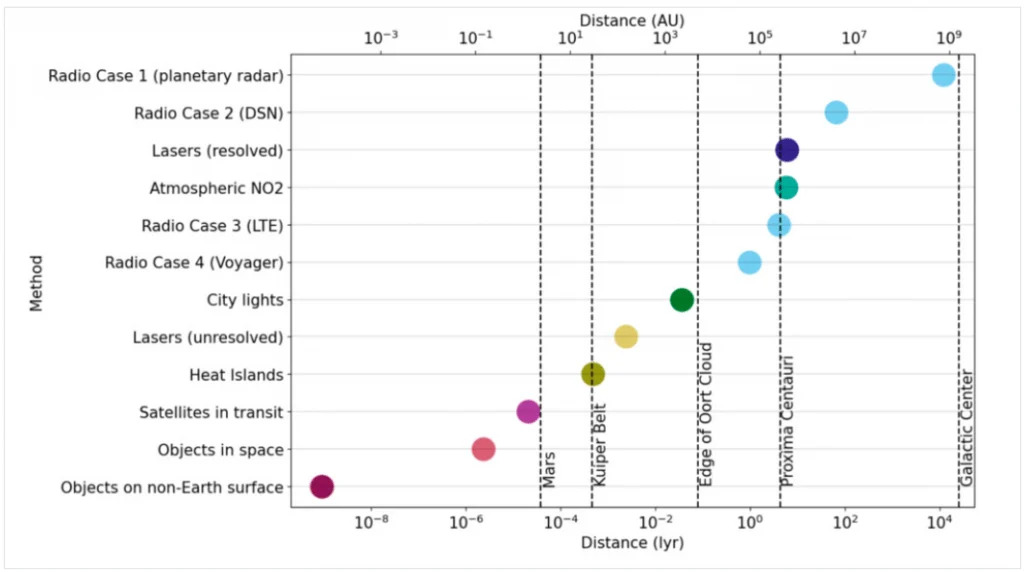
As instruments become more sensitive and surveys examine more targets, these limits can become stronger. A new experiment can therefore add scientific information even when it produces no candidate signal.
Every search tests a particular possibility
This is where the technical nature of SETI becomes important. Researchers cannot search for “technology” in the abstract; they have to translate that idea into something a telescope can measure. A radio search may ask whether a transmitter above a certain power level exists in a certain frequency range, an optical search may look for short laser flashes, another study may examine whether a planet’s atmosphere contains chemicals that could be difficult to explain through known natural processes. Each of these is a different hypothesis.
The same is true within one type of search. A continuous signal and a short pulse require different observing strategies. A weak transmitter and a powerful one can be detectable at different distances. A signal sent in all directions presents a different problem from a narrow beam pointed toward a specific target. So, when a search finds nothing, the scientific question is not simply whether the result was positive or negative – we need to know which possibility was tested.
The search as a giant table
This gives us a useful way to picture the entire SETI problem.
Imagine a huge table. As discussed in the previous article, one 2018 study estimated that only about 6 × 10⁻¹⁶ % of a defined eight-dimensional radio SETI search space had been explored[2]. That number gives a sense of how much of the table remains open. Each cell represents one possible combination of conditions: a particular region of the sky, a distance, a frequency range, a signal strength, a duration, a bandwidth, a repetition rate and a direction of transmission. Other cells can represent different types of technology or different ways that technology might reveal itself. The table is enormous because every one of these variables can change what we are able to detect. A single survey can examine only a fraction of the cells: if its instruments are sensitive enough and the observations cover the necessary conditions, those cells can be marked as tested. The rest remain open.
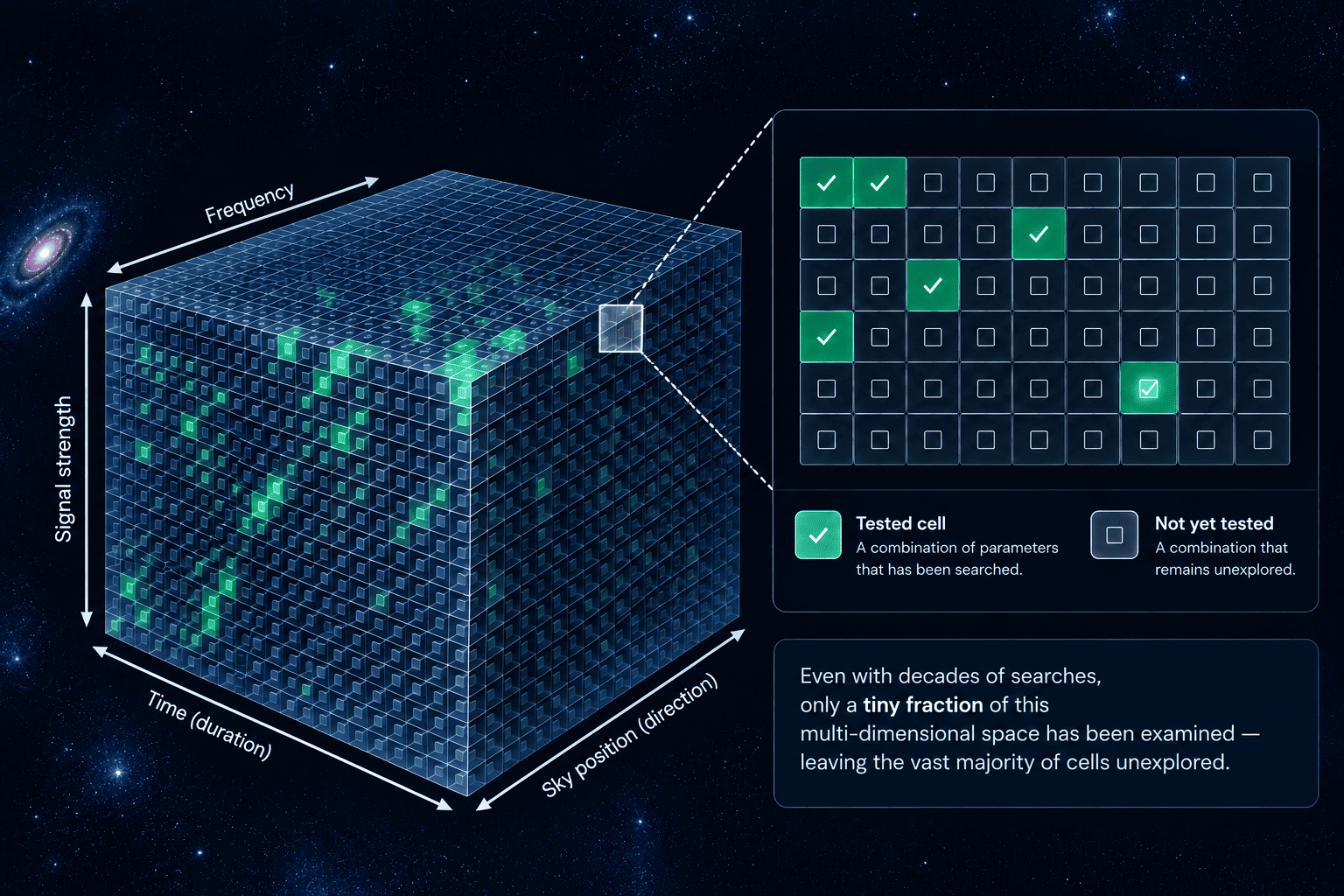
Then another survey can examine a different group of cells. This is what decades of SETI research gradually produce: not one giant yes-or-no experiment, but a growing record of which possibilities have been tested.
New non-detections close new cells
Suppose an older telescope could detect only very powerful radio transmitters. The cells representing weaker signals remained open. A newer instrument can reach lower signal strengths and searches the same type of targets. If it finds nothing, some of those previously open cells can now be closed.
The same thing happens when researchers extend the search in time: if a survey observes a star for several minutes, many possibilities involving rare or intermittent signals remain open. Repeated observations over months or years can test more of them. A wider frequency range closes additional cells. A wider area of sky does the same. A new type of instrument can open an entirely different section of the table and then begin testing it.
Each result therefore changes the shape of the unknown: one empty cell may not seem important, but thousands of carefully tested cells can be.
Filling the table
This changes the way we should think about the long history of SETI. The goal is not simply to perform one perfect experiment and receive a final answer about whether humanity is alone. There may be no single observation capable of doing that.
The practical task is much more straightforward: test the cells.
The growing number of non-detections does not allow us to say that technological civilizations do not exist. The table is far too large, and many of its cells remain untested.
A new search adds new cells to the tested part of the table. A new non-detection closes some of them. A more sensitive instrument can close cells that were previously beyond our reach, a new observing method can test cells that did not exist in earlier searches because we did not yet know how to look for them.
We do not know which cell, if any, contains evidence of another technological civilization. We may spend decades closing cells and still find nothing… But every carefully tested cell reduces the part of the problem that remains unknown. The table is enormous, and humanity has only begun to fill it.
And that may be the most useful way to understand what SETI has achieved so far: we are not waiting for the universe to give us an answer; we are systematically checking the possibilities, one cell at a time. But what would happen if one of those cells finally produced a signal that survived every test? That is the next question: what would a convincing detection of another technological civilization actually look like?
References
[1] Wright, J. T. (2021). Strategies and advice for the Search for Extraterrestrial Intelligence. Acta Astronautica, 188, 203–214. https://doi.org/10.1016/j.actaastro.2021.07.021
[2] Wright, J. T., Kanodia, S., & Lubar, E. G. (2018). How Much SETI Has Been Done? Finding Needles in the n-Dimensional Cosmic Haystack. arXiv:1809.07252. https://arxiv.org/abs/1809.07252