We've Been Searching for Decades. But Have We Actually Looked?
For more than sixty years, SETI has been described as a search for technology beyond Earth. That length of time can create a simple impression: astronomers have been looking for decades, nothing has been confirmed, and perhaps the search has already covered enough of the universe to make the silence surprising. But ‘sixty years of searching’ is a measure of time, not of coverage.
A telescope cannot check a star in the way someone checks a room and crosses it off a list. Every SETI observation samples only a particular part of a much larger search space. It looks in one direction, over a certain range of frequencies or wavelengths, for a limited period of time, down to a particular sensitivity, and for signals with particular properties. So before asking what decades of SETI have found, there is a more basic question: how much have we actually looked?
What does sixty years of searching actually mean?
Consider a radio telescope pointed at one nearby star. Even this apparently simple experiment requires a series of choices, for example:
- which frequencies should be examined?
- how much bandwidth can the receiver cover?
- how faint a signal can the telescope detect?
- how long should the target be observed?
- should the software search for a continuous narrow-band transmission, a short pulse, a repeating signal, or something that slowly drifts in frequency as a planet rotates and orbits its star?
Change one of those choices – and the experiment changes with it!
The same is true outside radio astronomy: an optical search may be sensitive to brief laser flashes, but not to a continuous weak source. A wide-field survey may watch a large area of sky but with less sensitivity than a telescope concentrating on one target. A powerful transmitter could still be missed if its beam points elsewhere, if it operates only occasionally, or if it lies outside the frequencies being observed. This is why the relevant search space has many dimensions: sky position, distance, frequency, time, signal type, sensitivity, bandwidth, repetition rate and directionality, among others. Looking at a star is only one coordinate in that larger problem.
From an Idea to an Experiment
Modern SETI began in 1959, when physicists Giuseppe Cocconi and Philip Morrison published “Searching for Interstellar Communications” in Nature. They did not claim that extraterrestrial civilizations existed; they asked whether radio technology had become sensitive enough to make communication between stars a practical scientific question. They suggested paying particular attention to the 21-centimetre wavelength of neutral hydrogen. The idea was partly practical: hydrogen is extremely common in the universe, and its spectral line provides a natural reference point that any civilization studying radio astronomy might also recognise. [1]
In 1960, radio astronomer Frank Drake turned the idea into an actual observing programme. Using the 85-foot Howard E. Tatel radio telescope at the National Radio Astronomy Observatory in Green Bank, West Virginia, he carried out Project Ozma. The telescope was pointed at two nearby Sun-like stars, Tau Ceti and Epsilon Eridani, and searched near the 21-centimetre hydrogen line. [2]
Project Ozma did not find an extraterrestrial transmission. For a short time, however, the experiment produced an intriguing signal that appeared interesting enough to investigate. It was eventually traced to a human-made source.
The significance of Project Ozma was therefore not that it discovered another civilization. It was that scientists had finally turned an old question into a real experiment. There were specified targets, a defined part of the radio spectrum, a telescope with measurable sensitivity and a procedure for examining unusual signals. The question was no longer purely philosophical. It could be tested with an instrument.
What have SETI searches actually covered?
Since Project Ozma, researchers have developed very different ways of searching. Some projects have focused on a relatively small number of nearby stars and tried to examine them in great detail. Others have tried to cover much larger areas of sky. Some use dedicated observations, while others analyse data collected for ordinary astronomy. These approaches are useful for different reasons, but none of them covers the whole search space.
Project Phoenix is a good example of a deep, targeted search. Between 1995 and 2004, it examined about 800 nearby stars, reaching roughly 240 light-years in distance. It searched frequencies between 1,200 and 3,000 MHz, dividing the spectrum into very narrow channels and looking for continuous or pulsed signals that could drift in frequency. The project used major radio telescopes in Australia, the United States and Puerto Rico and accumulated more than 11,000 hours of observations. It was an unusually sensitive search, but it still examined selected stars, selected frequencies and selected periods of time. [3]
The Allen Telescope Array was built with SETI as one of its main scientific goals. Its 42 radio antennas can observe large numbers of frequency channels and can repeatedly examine selected targets. This makes it useful for following up interesting stars and for expanding radio SETI observations. But even an instrument designed specifically for SETI cannot watch every star, every frequency and every moment simultaneously. [4]
COSMIC takes another approach. It operates with the Very Large Array in New Mexico and can analyse data while the telescope is being used for other astronomical observations. This is called commensal observing: instead of reserving every observation exclusively for SETI, the system receives and analyses data that are already being collected. That allows SETI researchers to examine very large numbers of radio sources. But the search remains limited by what the telescope is observing, which frequencies are available and how sensitive the system is to a particular signal. [5]
Not every search uses radio waves. Optical SETI looks for brief flashes of light that could be produced by powerful lasers. Projects such as LaserSETI use wide-field cameras to monitor large parts of the night sky rather than concentrating on one star at a time. This allows researchers to test a different type of technosignature, but it also illustrates the basic problem of SETI: expanding one kind of search does not automatically cover the others.
The BLC1 Signal: A Lesson in Scientific Caution
One of the clearest examples of how complicated a real SETI search can be came from observations of Proxima Centauri, the closest star to the Sun. In 2019, the Breakthrough Listen project used the Parkes Murriyang radio telescope in Australia to observe the system. The observations covered a broad radio range, and the data contained a narrow-band signal near 982 MHz that looked interesting enough to investigate in detail. The signal became known as BLC1; it had several characteristics that could make a signal of extraterrestrial origin interesting. For a while, it was one of the most compelling candidates produced by a SETI search. [6]
But an interesting signal is not the same thing as an extraterrestrial signal.
Researchers went back through the data, compared the signal with other observations and examined possible sources of human interference. They eventually found that BLC1 was produced by local radio-frequency interference – a complex interaction between human-generated signals and electronic equipment. It was not a transmission from Proxima Centauri.
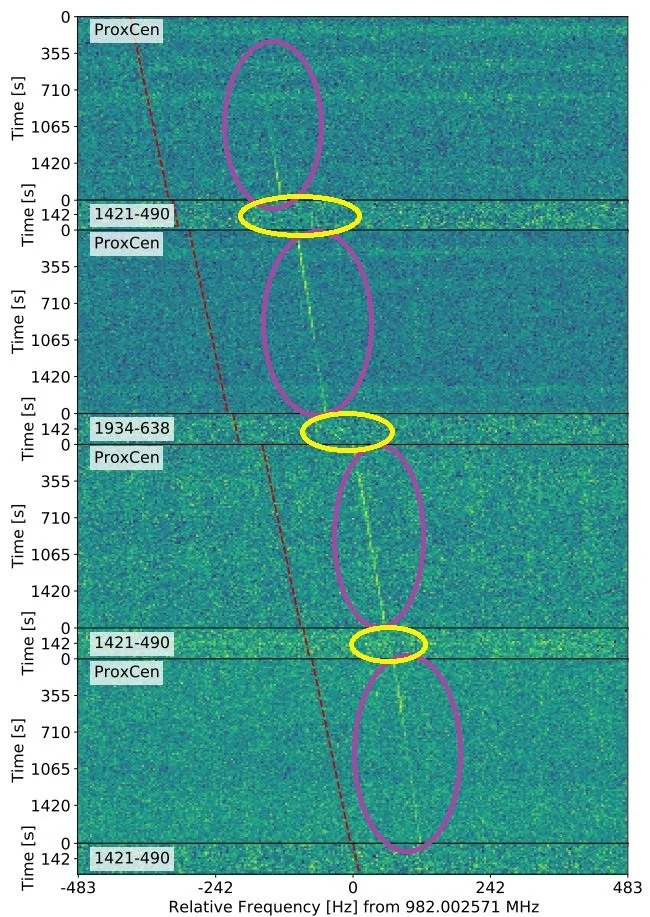
However, BLC1 is useful here because it shows that SETI is not simply a matter of finding something unusual. A signal has to survive repeated checks and comparisons before it can be considered evidence of technology beyond Earth. The search is therefore not only about how many signals a telescope can detect – it is also about how reliably researchers can separate a possible technosignature from the enormous amount of radio interference produced by technology on Earth.
The cosmic haystack
SETI researchers often describe the problem as ‘searching for a needle in a cosmic haystack’. The metaphor is useful, but the real problem is harder than finding a familiar object hidden in a large pile.
In an ordinary haystack, we know what the needle looks like. In SETI, we do not know which technological signature would be easiest to detect, whether it would be continuous or intermittent, whether it would be deliberately transmitted, or whether it would appear in radio, optical or another part of the spectrum. The ‘haystack’ therefore includes not only an enormous number of stars, but also distances, wavelengths, observing times, signal strengths and temporal behaviours.
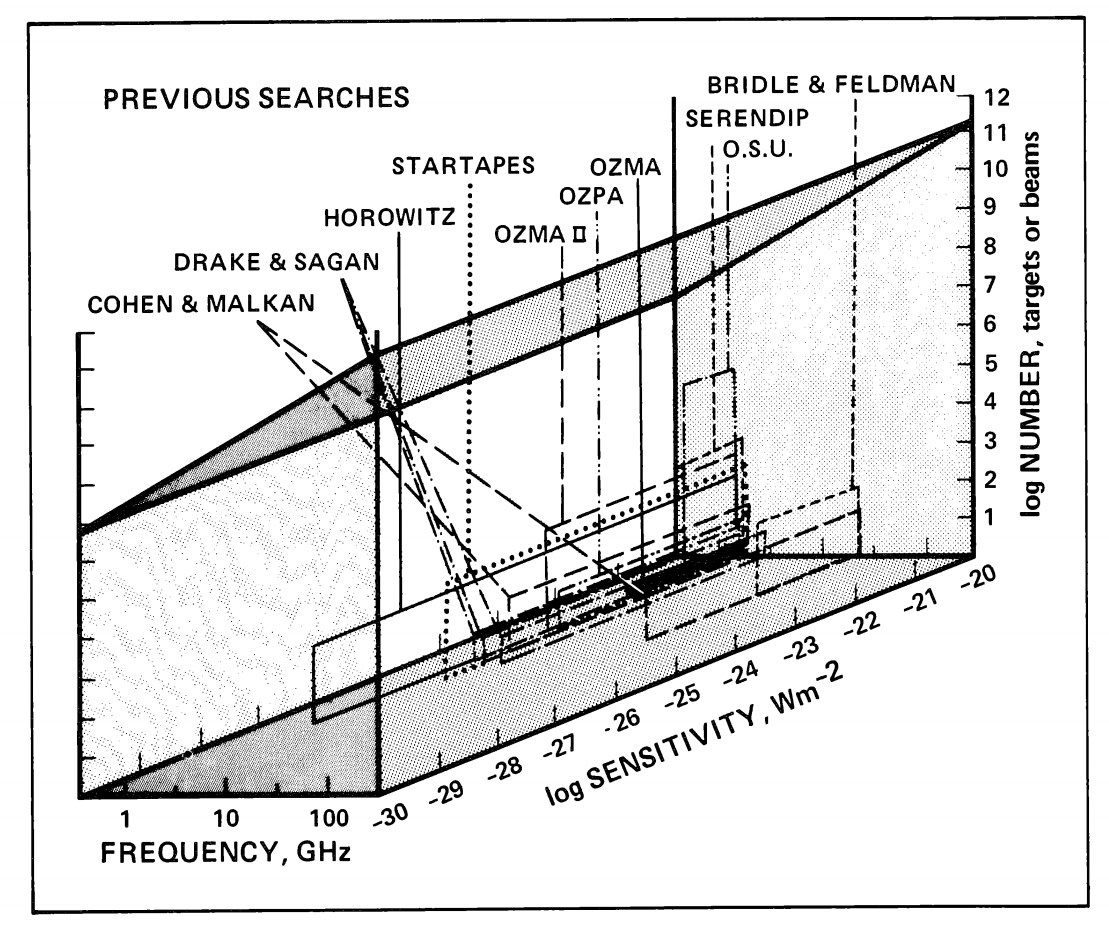
What is more, a search may cover one dimension very well and leave another almost untouched. Imagine observing ten thousand stars for several minutes each in a narrow frequency range. The target count sounds large, yet the same stars observed repeatedly across a much wider spectrum, with greater sensitivity and over many years, would represent a very different search. Counting stars alone does not tell us how much has been explored, neither does counting telescope hours.
How much have we actually searched?
Researchers Jason Wright, Shubham Kanodia and Emily Lubar tried to put a number on this problem in a 2018 study “How Much SETI Has Been Done? Finding Needles in the n-Dimensional Cosmic Haystack”. They built an eight-dimensional model of the radio SETI “cosmic haystack” and estimated how much of it had been covered by several major searches. [7]
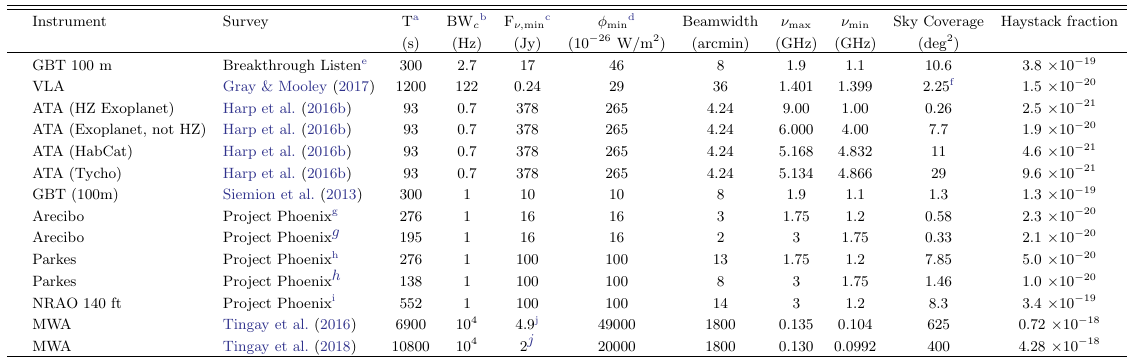
Their result was roughly 6 × 10⁻¹⁸ of the defined search space, or about 0.0000000000006%. This number needs an important qualification: it is not the percentage of the Universe, the Milky Way or all possible SETI searches that humanity has explored; it is a model-dependent estimate of a particular eight-dimensional radio search space. Change the assumptions about the dimensions or their boundaries, and the percentage changes too. It should therefore be treated as a way of showing the scale of the problem, not as a final “SETI completion score”. The comparison is striking nevertheless; decades of observations can sound like an enormous effort, while the corresponding fraction of a carefully defined search space can still be extremely small.
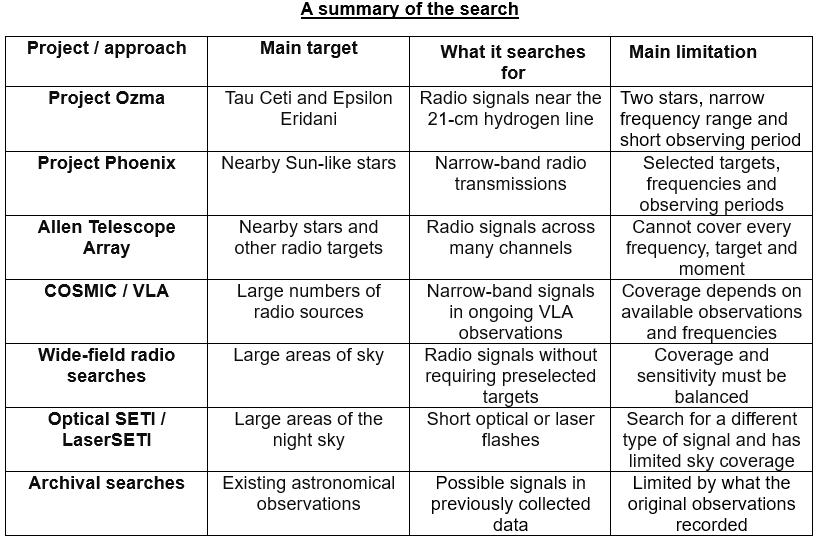
These projects show why there is no single number that tells us how much of SETI has been completed. A deep search of nearby stars, a wide-field radio survey and an optical search are not interchangeable; each examines a different part of the problem.
But humanity has been searching for decades; we have not searched most of what could be searched. That leaves the next question: if every survey examines only a defined piece of this enormous search space, what does it actually mean when that survey finds nothing?
References
[1] Cocconi, G., & Morrison, P. (1959). Searching for Interstellar Communications. Nature, 184, 844–846. https://doi.org/10.1038/184844a0
[2] SETI Institute. Project Ozma. https://www.seti.org/research/seti-101/project-ozma/
[3] SETI Institute. Project Phoenix. https://www.seti.org/research/seti-101/project-phoenix/
[4] SETI Institute. Allen Telescope Array. https://www.seti.org/projects/ata/
[5] SETI Institute. COSMIC. https://www.seti.org/projects/cosmic/
[6] Sheikh, S. Z. et al. (2021). A radio technosignature search towards Proxima Centauri resulting in a signal of interest. Nature Astronomy. https://doi.org/10.1038/s41550-021-01479-w
[7] Wright, J. T., Kanodia, S., & Lubar, E. G. (2018). How Much SETI Has Been Done? Finding Needles in the n-Dimensional Cosmic Haystack. arXiv:1809.07252. https://arxiv.org/abs/1809.07252