Posted by
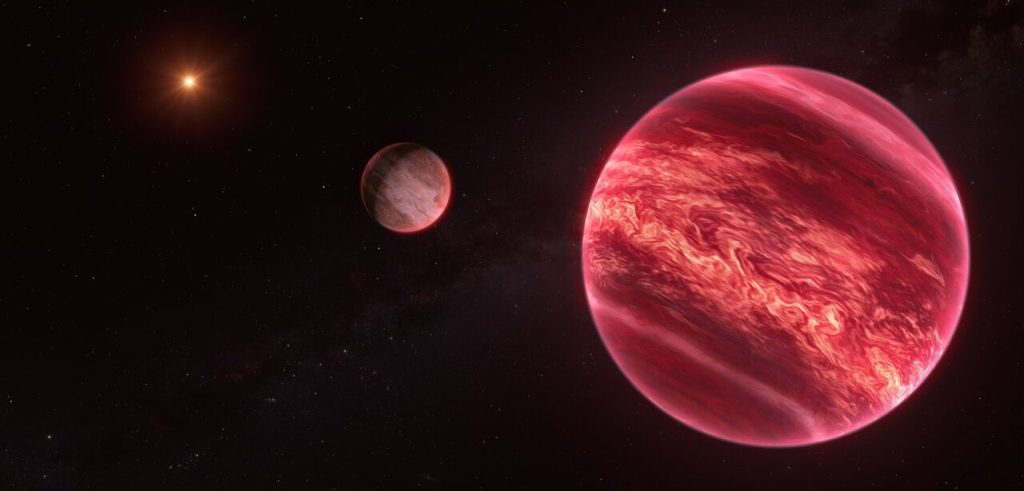
 The James Webb Space Telescope has revealed an unusual atmosphere surrounding GJ 504 b, the distant world nicknamed the “Pink Planet.” Located about 57 light-years from Earth, the object is one of the coldest planetary-mass companions ever directly imaged and has remained difficult to study since its discovery in 2013.
GJ 504 b orbits a Sun-like star and has an estimated mass around 25 times that of Jupiter. Its mass places it near the uncertain boundary between giant planets and brown dwarfs, so astronomers generally describe it as a planetary-mass companion rather than definitively classifying it as a planet. Its temperature is approximately 550°F, or 290°C, and researchers estimate its age at between 2.5 and 4 billion years.
Previous attempts to obtain a detailed spectrum from ground-based observatories were unsuccessful because the object is extremely faint. JWST, however, collected enough light in roughly two hours to reveal its atmospheric chemistry. Researchers identified water vapor, methane, carbon dioxide, ammonia and other molecules. The biggest surprise emerged when scientists attempted to reproduce the spectrum using atmospheric models. Models without clouds required unrealistic physical conditions. When several cloud types were tested, salt clouds produced the best match, suggesting they obscure deeper atmospheric layers and alter the spectrum observed by JWST. The result provides some of the first direct evidence for salt clouds in the atmosphere of such a cold object, confirming predictions made more than 15 years ago.
The observations also suggest GJ 504 b may contain unusually high concentrations of heavy elements. Beyond this individual world, the study demonstrates JWST’s ability to characterize extremely faint, cold companions and highlights the importance of including clouds when interpreting exoplanet spectra.
For more details, read the original paper.