Posted by
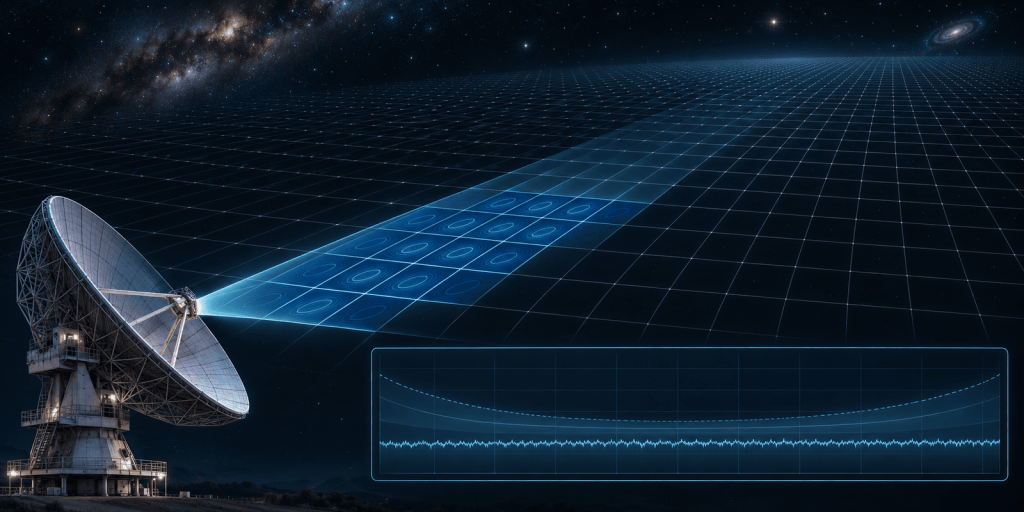
Astronomers have found a tentative excess of fast radio bursts (FRBs) in the directions of massive galaxy clusters, raising two intriguing possibilities: some bursts may originate inside cluster galaxies, or the clusters may be gravitationally magnifying FRBs from much farther away.
FRBs are millisecond-long flashes of radio emission that can travel across enormous cosmological distances. Their origins remain uncertain, although highly magnetized neutron stars known as magnetars are among the leading explanations. Other mechanisms, including compact-object mergers, may also contribute.
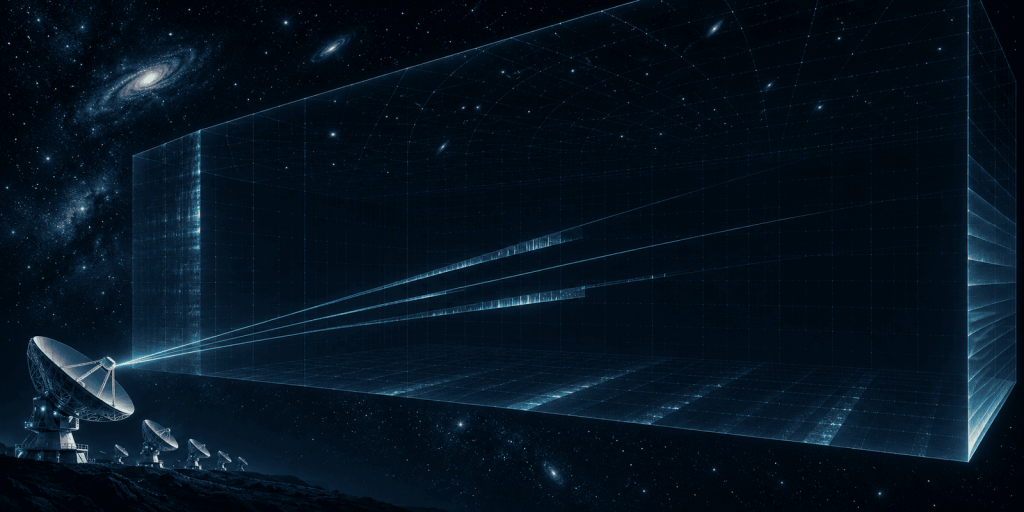
The new analysis used observations from the Canadian Hydrogen Intensity Mapping Experiment (CHIME), whose wide field of view has made it one of the most productive FRB detectors. Researchers focused on a subset of bursts with sufficiently precise positions to compare them with known galaxy clusters. They identified 26 FRBs that could be associated with clusters and found a modest excess compared with what would be expected from a random sky distribution. The statistical significance is around three sigma, meaning the result is suggestive but not yet strong enough to establish a physical connection.
The main difficulty is distance. An FRB appearing in the direction of a cluster might actually lie inside it, or it could be located far behind the cluster along the same line of sight. If the bursts originate within clusters, they could provide new information about FRB formation. Galaxy clusters contain hot gas that suppresses star formation, potentially reducing the number of young magnetars. An unexpected abundance of FRBs there could therefore point to additional progenitor channels.
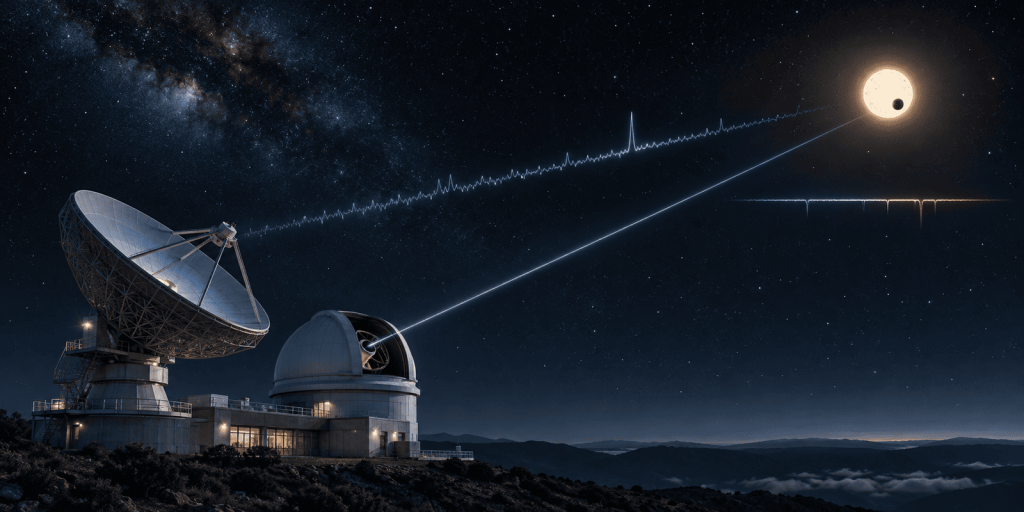
The alternative is gravitational lensing. Massive clusters can bend and amplify radio waves from distant objects, allowing otherwise faint FRBs to become detectable. One especially interesting candidate lies toward Abell 2218, a cluster already known for strong gravitational lensing.
For now, neither explanation is preferred. More detections and improved analysis will be needed to determine whether clusters are hosting unusual numbers of FRB sources, magnifying background bursts, or doing both. If the signal persists, FRBs could become useful not only for understanding compact objects, but also for probing the distribution of matter and gravity across the universe.
For more details, read the full article by SETI Institute.