Why Now May Be the Best Time to Search for Another Civilization?
The search for extraterrestrial intelligence has always been limited by two things: what our instruments could detect and how much data our computers could process. We could not observe the entire sky continuously and collect and analyse unlimited amounts of data; we had to choose which stars, frequencies and parts of the sky were worth observing. But it is changing now!
A new generation of instruments
Modern astronomical instruments are becoming more sensitive and capable of collecting much larger amounts of data. Facilities such as the VLA, FAST and MeerKAT allow researchers to observe weaker signals and work across wider ranges of frequencies.
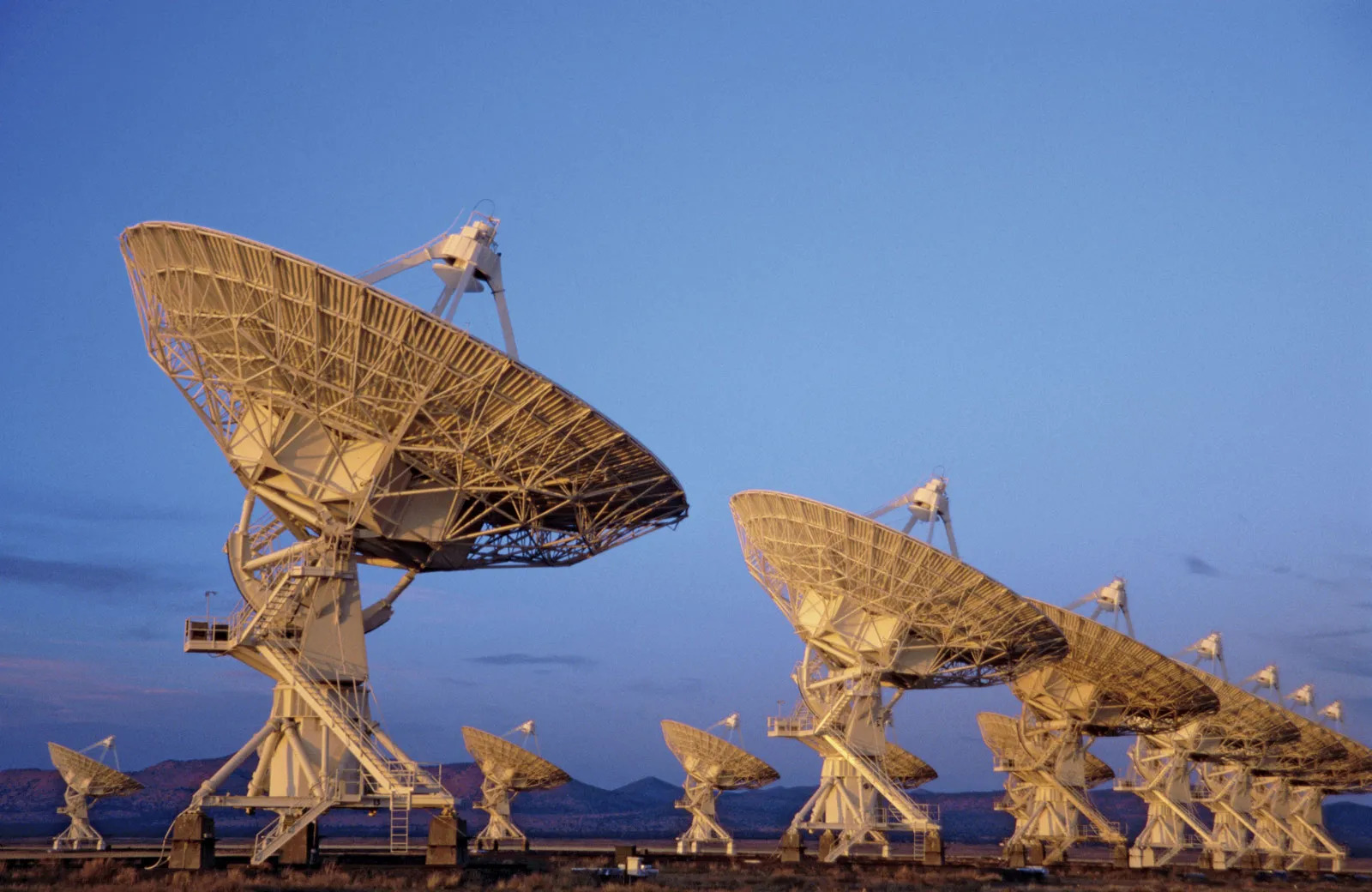
But the change is not only about sensitivity – modern instruments can produce enormous amounts of data during a single observation. This creates a new possibility: instead of waiting for a telescope to be used specifically for SETI, search systems can analyse observations that are already being collected for other scientific purposes.
This approach is known as ‘commensal observing’. The COSMIC system at the VLA is one example: it can process astronomical observations while simultaneously searching for possible technological signals [1]; this means that SETI can increasingly use existing astronomical observations without requiring every telescope to be dedicated exclusively to the search.
Powerful computers and AI
More sensitive instruments create more data, and more data require new ways of processing it. Modern computers can analyse enormous datasets much faster than previous generations of machines, artificial intelligence and machine learning can help identify unusual patterns, filter out interference and search through data in ways that would be impossible to perform manually.
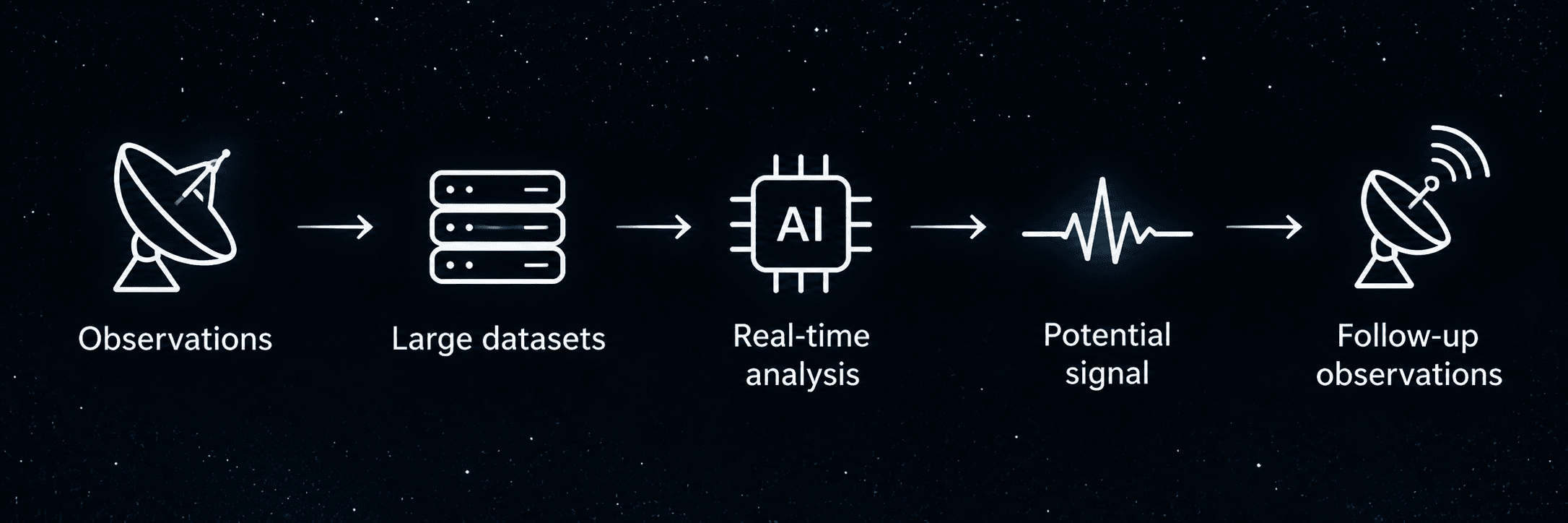
Another important development is real-time processing. Instead of recording observations and analysing them much later, modern systems can process data while the observation is still taking place; a potentially interesting signal can therefore be identified immediately and followed up with other instruments. This is especially important for signals that may be short-lived, intermittent or impossible to reproduce.
The combination of powerful computers and AI therefore changes not only how much data we can analyse, but also how quickly we can react to what we find. But better instruments and faster computers are not enough on their own..
Searching the entire sky
There is another fundamental problem: we do not know where or when a signal will appear. For decades, SETI has had to make choices about which stars to observe, which frequencies to monitor and when to conduct observations; this means that large parts of the sky can remain unobserved at any given moment. A truly comprehensive search would require something much more ambitious: monitoring the entire sky continuously, 24 hours a day, 7 days a week – something that has never been done for SETI at the required scale.
The idea changes the search itself – instead of asking which particular star we should observe, we can begin to ask how to build a system that does not have to choose; such a system would continuously collect data, process them in real time and identify unusual signals for further investigation.
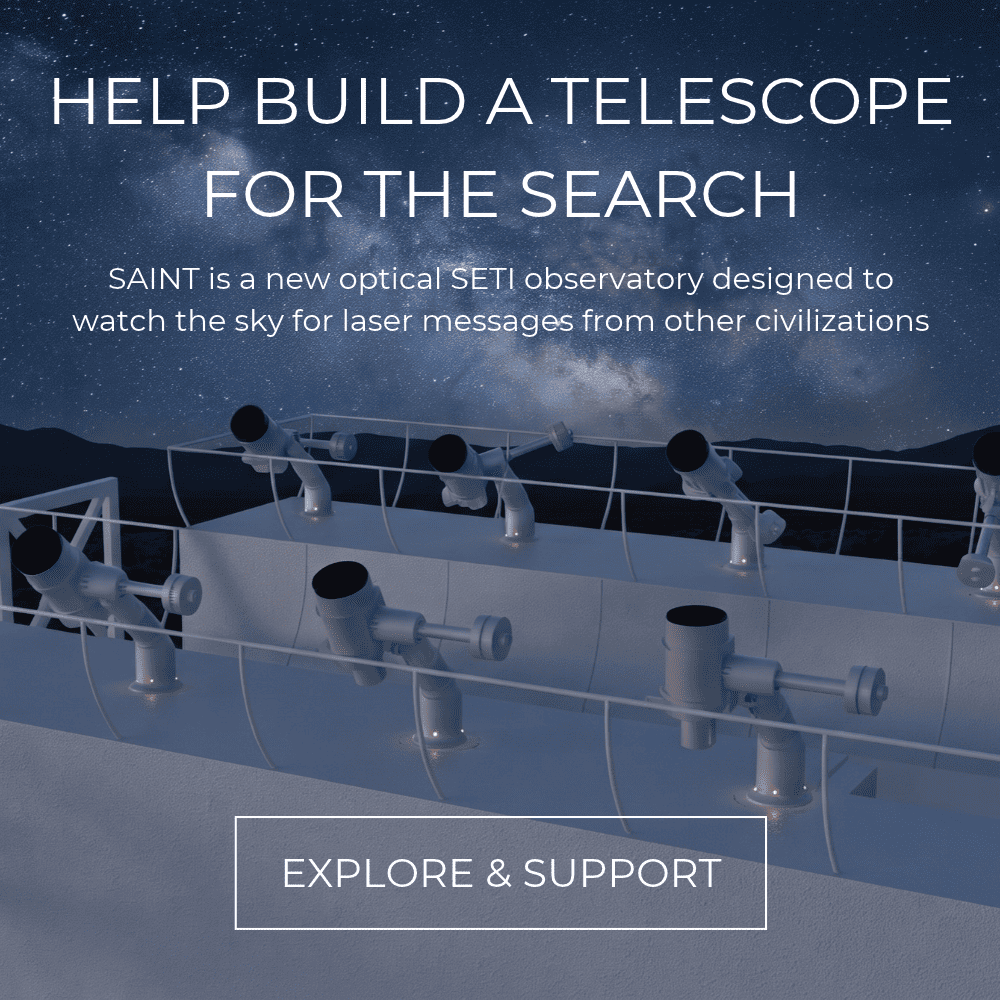
One example of this approach is SAINT (Small Aperture Imaging Network Telescope), a planned optical SETI observatory designed to monitor large areas of the sky continuously for short laser signals. Its concept combines wide-field monitoring with real-time processing and rapid follow-up: when a potential signal is detected, the system can quickly redirect its telescopes toward the source for a more detailed observation. A single SAINT observatory is designed to use 12 telescopes with a combined field of view of 468 square degrees, while a future network of observatories could provide continuous coverage of the entire sky.

A different scale of SETI
These three developments – more sensitive instruments, powerful real-time data processing and continuous all-sky monitoring – change the scale at which SETI can operate. With current technologies, we can build specialised instruments designed specifically for the search, capable of covering a much larger part of the space of possible signals. At the same time, we can use existing non-specialised astronomical instruments and analyse their observations in parallel, increasing the number of opportunities to detect something unusual. Neither approach guarantees a discovery, but together they can dramatically increase the number of possibilities that humanity is actually able to test.
For the first time, the question is not simply whether we can search for another civilization – the question is how far we are willing to take that search. To build and operate systems capable of doing this, we need resources – and, above all, a strong reason to invest them. So it is time to ask a different question: what is the reason we should do it? If we actually detect a signal from another civilization, what would it change? That is where the next question begins!
References
[1] SETI Institute. COSMIC: Commensal Open-Source Multimode Interferometer Cluster. COSMIC is a digital system installed at the Karl G. Jansky Very Large Array (VLA) that receives and processes a copy of the telescope’s data in real time while the VLA conducts its primary astronomical observations. The system is designed to search for technosignatures without interfering with the main observing programme. https://www.seti.org/projects/cosmic/